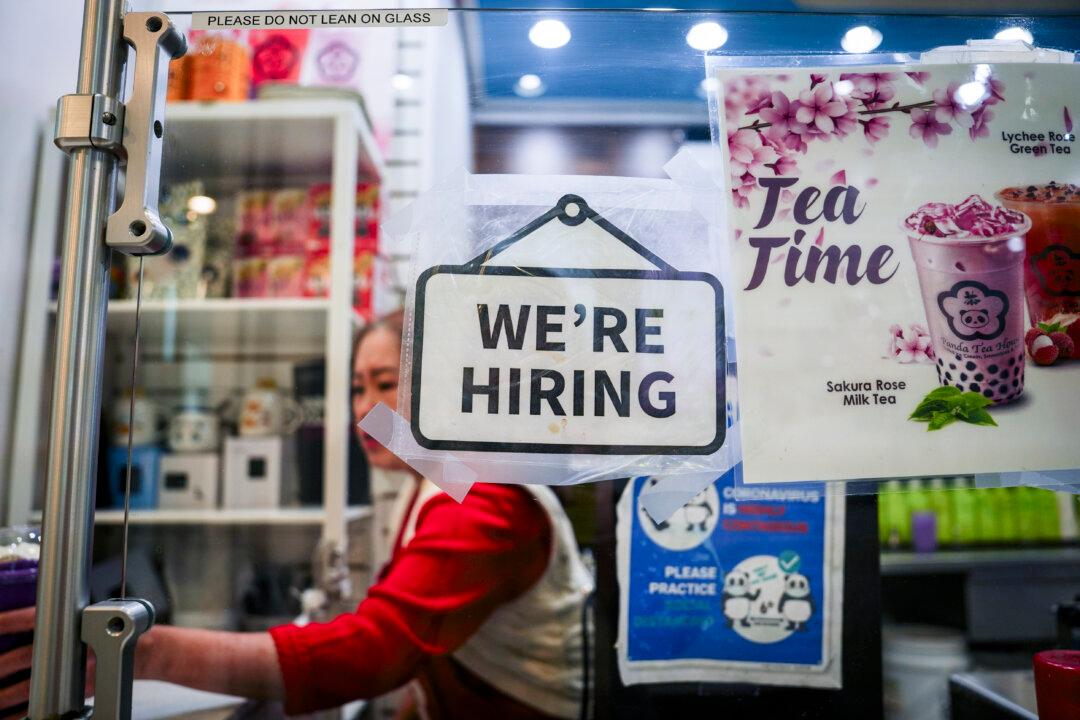
The number of individuals filing new applications for unemployment benefits ticked lower last week as businesses remain reluctant to lay off their workers.
For the week ending Aug. 9, initial jobless claims fell by 3,000 to 224,000 from a slightly upwardly revised 227,000 in the previous week.
Initial claims filed in a program for federal workers decreased by 71, to 637. Economic observers have been monitoring this portion of the Labor Department’s weekly report to determine whether actions by the Department of Government Efficiency are influencing federal payrolls.
The four-week average, which strips out week-to-week volatility, edged up to 221,750 from 221,000.
Continuing jobless claims—a measure of the number of unemployed individuals currently receiving jobless benefits—declined to a lower-than-expected 1.95 million from a downwardly adjusted 1.97 million.
This was the 12th consecutive week that continuing jobless claims remained above 1.9 million, the highest level in almost four years.
The consensus forecast indicated 1.96 million recurring claims.
In recent months, the U.S. labor market has been characterized by a twin landscape of tepid layoffs and slower hiring—a trend evident in various employment reports. This has been driven by companies’ attempts to navigate President Donald Trump’s trade agenda, which has resulted in uncertainty and mixed economic signals.
Fed’s Dual Mandate
A softer-than-expected reading and massive two-month revisions sparked confidence among investors that the Federal Reserve will lower interest rates at next month’s policy meeting.Expectations that the U.S. central bank will restart its easing cycle were also supported by decent July inflation data, according to Tom Essaye, president and cofounder of Sevens Report Research.
“Tuesday’s CPI report provided a mixed view on inflation thanks to a slightly hot ‘core’ reading, but the details of the report were favorable and CPI further reinforced the expectation for a September rate cut, which fueled the broad rally,” Essaye said in a note emailed to The Epoch Times.
The consumer price index (CPI) data, Essaye noted, do not “imply a sudden reversal is coming.”
However, the July producer price index (PPI)—a key indicator of pipeline inflation—may have poured cold water on expectations of a rate cut.
Gina Bolvin, president of Bolvin Wealth Management Group, said that although the PPI came in hot, “the bigger picture remains balanced.”
“The 0.9 [percent] jump in PPI reflects lingering cost pressures—some driven by tariffs—but core inflation trends remain contained,” Bolvin said in a note emailed to The Epoch Times.
“It’s a reminder that the path to lower rates may not be linear, but the broader disinflationary trend is still intact.”
Despite recent employment figures and inflation uncertainty, Atlanta Fed President Raphael Bostic said he believes the institution can wait before following through on monetary policy changes.
“Now I feel we have the luxury to do that today because the labor market has been pretty much at full employment,” Bostic said at an Aug. 13 event.
“Our maximum employment mandate is not at risk in the same way that the inflation mandate is.”
Outside the Hard Data
Recent indicators suggest growing optimism among employers and employees.“As the most extreme tariffs from Liberation Day have been walked back, workers are warily wondering if the worst of the storm has passed, though confidence remains extremely low by historical standards,” Daniel Zhao, chief economist at Glassdoor, said in the report, referring to the reciprocal tariffs that Trump unveiled on April 2.
“Optimism rose slightly in July with owners reporting more positive expectations on business conditions and expansion opportunities,” Bill Dunkelberg, the association’s chief economist, said in a statement.
The next six months should generate greater clarity for business owners, Dunkelberg said, particularly “as owners see the results of Congress making the 20 [percent] Small Business Deduction permanent and the final shape of trade policy.”
Labor quality was the top concern for small businesses again, he said.
The University of Michigan on Aug. 15 will release the first estimate for the August consumer sentiment index. The consensus projection points to a third consecutive monthly increase and further moderation in inflation expectations.