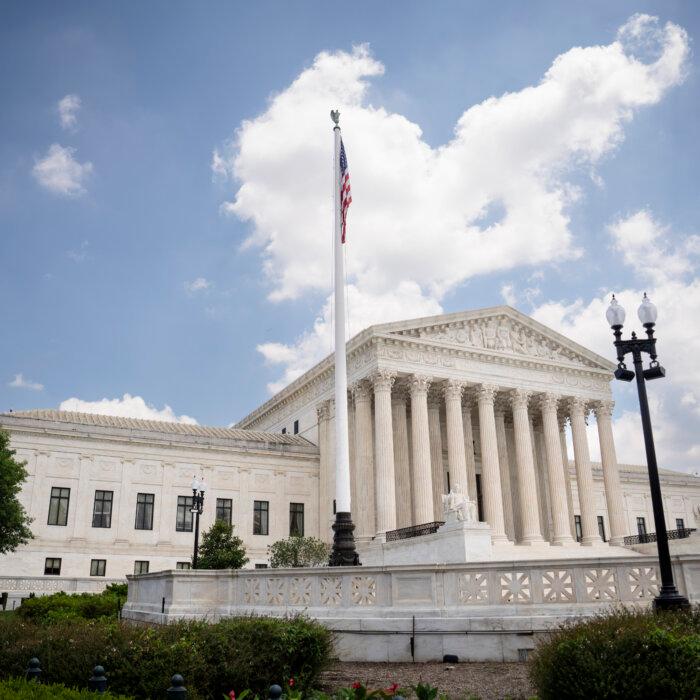
The U.S. Supreme Court on Tuesday agreed to take up a case on whether local and state governments can ban or restrict access to popular semi-automatic rifles such as the AR-15, sometimes called assault weapons, which have been enacted in states like Illinois, California, and New York.
In a brief order, the Supreme Court said it would take cases brought in Illinois and Connecticut that challenge the respective states’ bans on many types of semiautomatic rifles. One focuses on a statewide Connecticut law and the other on an ordinance that was issued in Cook County, Illinois.
At issue are whether AR-15-style and other, similar semiautomatic rifles are included under the Constitution’s Second Amendment’s protections. Those who backed such laws banning the rifles say they’re a preferred weapon used by mass shooters and have argued they are similar to military-style rifles, although many modern military rifles feature full automatic firing.
The justices took up two appeals after lower courts upheld the bans in Cook County and Connecticut. The lower courts rejected arguments that the measures violate the Second Amendment right to keep and bear arms.
Challengers to the restrictions on semiautomatic rifles have stated that Supreme Court precedents concerning the Second Amendment protect these firearms, which they described as being in common use.
Cook County in Illinois first enacted the ban on the weapons in a 1993 ordinance. The current law bans many semiautomatic rifles, including the AR-15 and versions of the AK-47.

Cook County, which includes the city of Chicago, said it has long been known that the rifles are the preferred tool for mass shooters. The weapons are “the weapon of choice for criminals and terrorists set on quickly massacring innocents,” county lawyers have said, citing several criminal cases including the attempted assassination of Donald Trump during a presidential campaign rally in 2024 in Pennsylvania in which a shooter, Thomas Crooks, had an AR-15-style rifle.
But challengers of the laws, the Firearms Policy Coalition and Second Amendment Foundation gun rights groups, argued that the rifles, including the AR-15, are “perfectly ordinary and common firearms.”
“These firearms are not distinct from other rifles in their design or their function. Indeed, the very term ‘assault weapon’ is a political slogan masquerading as a meaningful designation, designed to exploit ‘the public’s confusion over fully automatic machine guns versus semi-automatic’ firearms,” added the petition, which included two private citizens.
Last year, the Supreme Court said it would not hear cases involving a similar ban on the rifles in Maryland as well as a Rhode Island ban on magazines that hold 11 or more rounds, sometimes referred to as high-capacity or large-capacity magazines.
Similar laws are in place in about a dozen states, covering major cities like New York, Los Angeles, and Washington, D.C. Congress allowed a national assault weapons ban to expire in 2004, but Democrats have supported renewing it in response to a series of mass shootings, and states have continued to pass their own laws.
In recent years, the Supreme Court has issued multiple rulings that have been hailed as wins for pro-gun rights groups, including the landmark 2022 case New York State Rifle & Pistol Association v. Bruen, which established a legal standard requiring modern gun laws to fall within the historical tradition of firearms regulation in the United States.
During the term that ended on Tuesday, the court limited the government’s capacity to prosecute people for possessing guns if they use marijuana, and it also struck down a Hawaii law that restricted carrying firearms on private property in the state.
The justices will hear arguments in the AR-15 case during its next term, which is due to start this October and will last until either June or July 2027. The Supreme Court released its final list of decisions for the 2025–2026 term on Tuesday.
The court separately on Tuesday rejected a series of appeals challenging federal and state bans on handgun purchases by individuals ages 18 to 20.
Reuters contributed to this report.