NASA has been tasked with adding nuclear power to its future lunar base by Transportation Secretary Sean Duffy.
“We’re able to build a base,” Duffy, NASA’s acting administrator, told members of the press on Aug. 5. “But this is critically important. There’s a certain part of the moon that everyone knows is the best. We have ice there. We have sunlight there. We want to get there first and claim that for America. And to do this is, this part of the fission technology is critically important to sustain life, because solar won’t do it.”
In a letter sent to NASA leadership on July 31, Duffy said the agency has until the end of 2030 to have that power source ready to go to the moon.
Nuclear power has been used on Earth for nearly 80 years, converting the heat given off by the splitting of uranium atoms into electricity. That action of splitting the atoms is called fission.
Nuclear elements have already powered several previous spacecraft, including the Voyager 1 and 2 probes and the Mars Perseverance Rover. But those spacecraft have been powered by essentially batteries sustained by the natural decay of a form of plutonium. This will be the first time that a full-fledged fission reactor will be utilized in space.
Why Is Nuclear Power Necessary on the Moon?
Solar power is perhaps the most accessible power source connected with space travel. A massive array of solar panels plays a significant role in shaping the International Space Station.
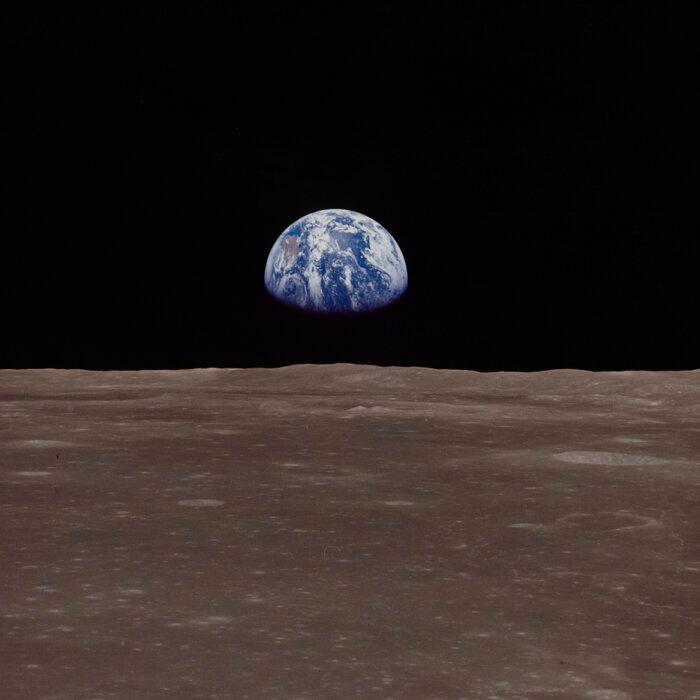
But solar panels need sunlight, and on the lunar surface, a moon base would go roughly two weeks without seeing the sun because of the lunar night. That is two weeks without the ability to replenish batteries.
Nuclear power, on the other hand, does not need sunlight to operate and is a very possible reality.
Duffy also pointed out in his letter that NASA acknowledged its “shortfalls” in its ability for systems to survive and operate through that lunar night, as well as the ability to provide a high-power energy source for the moon and Mars.
But there is also a matter of security.
Rick Fisher, a senior fellow at the International Assessment and Strategy Center who has written extensively about the U.S. race to the moon with China, told The Epoch Times that using nuclear power to keep the lights on at night is necessary to continuously justify U.S. lunar claims against its communist adversary.
Duffy also appeared to hold that perspective.
“Since March 2024, China and Russia have announced on at least three occasions a joint effort to place a reactor on the Moon by the mid-2030s,” Duffy said in a letter to NASA leadership.
What Could Nuclear Power on the Moon Look Like?
Duffy explained to NASA leadership that the nuclear power would be a fission reactor that needed to generate 100 kilowatts of power and weigh less than 15 tons in order to be carried to the moon by the rockets expected to be available by 2030, such as SpaceX’s Starship.The most common image of nuclear reactors is perhaps expansive facilities with wide towering smokestacks. But Fisher explained that micro-nuclear reactor technology has been advancing rapidly, with early estimates suggesting that the moon base’s power source could weigh not more than 1 to 2 tons.
However, Duffy made it clear that the space agency will utilize its commercial partners to develop the actual reactor.
NASA’s funded Space Act Authority, which is being utilized to establish commercial space stations in low Earth orbit, was ordered to grant “maximum flexibility to industry” for efficiently designing and developing the program’s flight systems.
“A fission reactor on the Moon is a must for human exploration to progress,” the company stated. “The Moon is dark and cold 14 days of the month and solar power is not enough to develop a sustainable Moon base. Space fission surface power is safe and we’re continuing to invest to make this a reality.”
It shows more than one compact power unit positioned across the lunar surface, seemingly separated from any living quarters.
Fisher, also a contributor to The Epoch Times, separately told the publication that one of the safety requirements of this technology would have to be the ability to separate itself from the crew areas if necessary.
The Epoch Times reached out to Lockheed Martin for more information regarding its concept and did not receive a response by publication time.
Duffy ordered NASA to put out a request for proposals to private industry by September, essentially sparking a competition for the opportunity to build the reactor and to select no more than two companies within the following six months.
The acting NASA administrator pointed out in his July 31 letter that this project would leverage the “innovation in commercial microreactor technologies specifically referenced in the White House’s 23 May 2025 Executive Order 14299 ‘Deploying Advanced Nuclear Reactor Technologies for National Security.’”
What About Helium-3?
Another point of discussion regarding the moon and nuclear power, according to Fisher, is an element called Helium-3 (He3). Embedded in the lunar soil by the sun’s constant radiation, He3 is considered by many to be the ideal fuel source for nuclear fusion power, which is the process of merging two atoms together rather than splitting them.The goal has been to harvest the He3 from the lunar soil and send it back to Earth to be used in fusion reactors there, while the lunar-based reactor would be powered by nuclear fission.
Many worry that the Chinese regime could win this race to harness nuclear fusion, as well as the one to establish a permanent presence on the lunar surface.