This copy is for your personal, non-commercial use only. Distribution and use of this material are governed by our Subscriber Agreement and by copyright law. For non-personal use or to order multiple copies, please contact The Epoch Times Reprints.
A leader of the Barrio 18 gang stands handcuffed facing a wall after his arrest in San Salvador, El Salvador, on July 28, 2015. Salvador Melendez/AP Photo
The U.S. State Department has designated the Barrio 18 street gang as a foreign terrorist organization, expanding Washington’s campaign against transnational gangs and cartels.
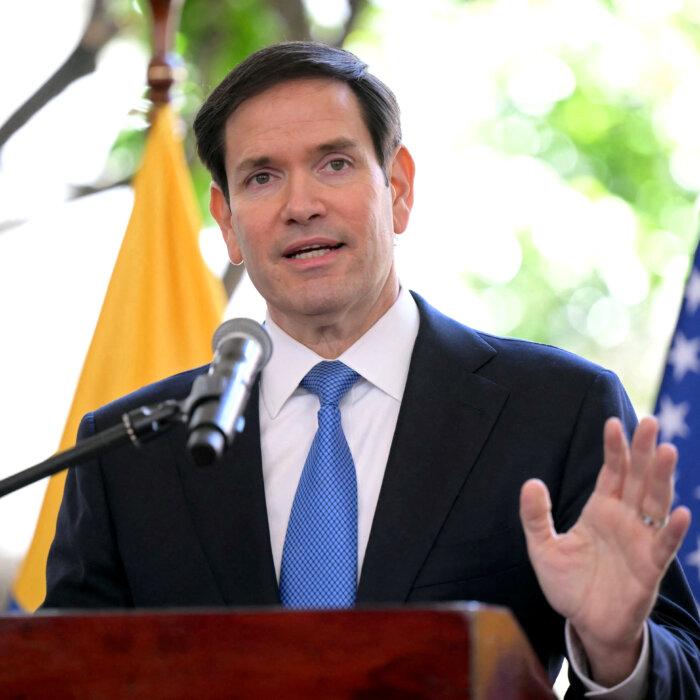
“Today, the Department of State is designating Barrio 18 as a Foreign Terrorist Organization (FTO) and Specially Designated Global Terrorist (SDGT),” Secretary of State Marco Rubio said in a Sept. 23 statement.
Rubio called Barrio 18 “one of the largest gangs in our hemisphere,” saying it has carried out attacks against security forces, officials, and civilians in El Salvador, Guatemala, and Honduras. He pledged to cut off the group’s funding streams, calling the move part of the Trump administration’s “unwavering commitment to dismantling cartels and gangs and ensuring the safety of the American people.”
Designation of Barrio 18 as a foreign terrorist organization has several implications. It makes it a federal crime to provide material support to the gang, freezes any assets it may hold under U.S. jurisdiction, and bars its members from entering the United States, giving law enforcement broader tools to prosecute and disrupt its activities.
Barrio 18 has been active in Los Angeles since at least the 1960s, according to a Justice Department-funded study. Unlike many rivals, it recruited across nationalities, fueling rapid growth. Its relationship with Mara Salvatrucha, or MS-13, turned violent in the late 1980s. The feud spread across Central America after mass deportations from the United States and remains a defining feature of both gangs.
“Hatred of the Barrio 18 is the glue that holds the MS-13 together,” researchers wrote in a study, describing the rivalry as central to the gang’s identity.
The two gangs have long battled for territory in Central America. In January, MS-13 gunmen stormed the funeral of a Barrio 18 member in Guatemala, killing at least seven people and wounding 13. Both groups extort civilians, transport workers, and shopkeepers, often killing those who refuse to pay.
MS-13 was formed in Los Angeles in the 1980s by Salvadoran immigrants fleeing civil war. It has since spread across Central America, helping make the region one of the most violent in the world. President Donald Trump has repeatedly called the gang “evil” and vowed its destruction. In 2020, the Justice Department announced terrorism charges against MS-13 leaders for the first time.
On his first day back in office, Trump signed an executive order creating a process for designating international cartels as terrorist organizations. The order said such groups “have engaged in a campaign of violence and terror throughout the Western Hemisphere,” destabilizing key U.S. partners and flooding American communities with deadly drugs.
Following Trump’s order, the State Department in February designated several groups as terrorist organizations under that process, including Tren de Aragua, MS-13, the Sinaloa and Jalisco New Generation cartels, Cártel del Noreste, La Nueva Familia Michoacana, Cártel del Golfo, and Cárteles Unidos.
In July, the U.S. Treasury Department added Venezuela’s Cartel de los Soles to its terrorism list, accusing the country’s President Nicolás Maduro and senior officials of leading the group and aiding cartels that threaten U.S. security.
Tom Ozimek is a senior reporter for The Epoch Times. He has a broad background in journalism, deposit insurance, marketing and communications, and adult education.