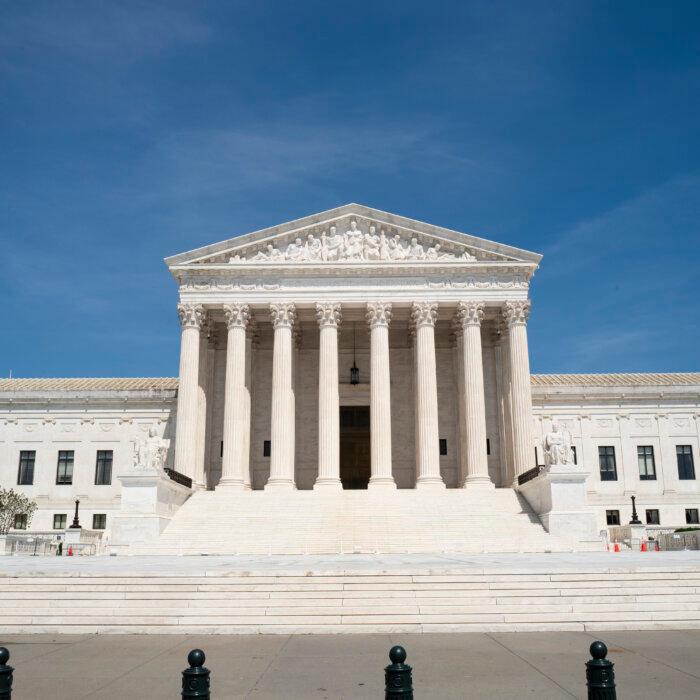
President Donald Trump again asked the U.S. Supreme Court on Aug. 12 to lift a lower court ruling that blocks key parts of his executive order restricting voting by mail ahead of the November midterm elections that will determine control of Congress.
Specifically, the federal government is asking the Supreme Court to stay a new order—the second in recent weeks from a federal judge in Boston—that prevents implementation of the president’s election integrity policies.
The order requires federal agencies to develop state-by-state lists of verified U.S. citizens of voting age. It directs the U.S. Postal Service (USPS) to begin the process of creating new government regulations about how mail-in and absentee ballots are handled, publish the proposed regulations to allow for public comment, and eventually publish the final, binding regulations.
The order forbids the postal service from sending mail ballots to anyone not on the verified citizen lists. It also requires the USPS to impose new envelope design and barcode standards for election mail.
That ruling applies only to the jurisdictions that sued, which include California, Massachusetts, Maryland, Arizona, Maine, New Mexico, among others.
Section 2 is an attempt “to intimidate local election officials to use the necessarily incomplete … lists as a resource, lest they face criminal prosecution,” Talwani said.
The judge said Section 3 could not stand because “no law enacted by Congress delegates authority to control mail-in voting to USPS.” The postal service does not have statutory authority to finalize “any binding regulations on mail-in voting.”
The ruling dealt a blow to Trump’s election-integrity efforts ahead of the November midterm elections as Republicans try to hold on to slim majorities in both chambers of Congress.
The nationwide preliminary injunction blocks the postal service from implementing Section 3 of the executive order. Unlike her June 25 ruling, the new order prevents the USPS from carrying out the provisions of the section with respect to upcoming federal elections throughout the entire United States.
Throughout multiple lawsuits pending in district courts, appeals courts, and the Supreme Court, the government “has declined to defend the constitutionality” of the executive order’s directives, Talwani said.
However, the court “finds it prudent to review the [executive order] now, where less than 90 days pend before the midterms and the millions of citizens who rely on mail voting require clarity as to how or whether they will vote in November.”
Talwani said protecting the right to vote was more important than allowing the executive branch “to unconstitutionally insert itself into the domain of election regulation.”
Executive order 14399 “is presently causing confusion and threatening both increasing chaos and an erosion of trust in our democracy,” and with fewer than 90 days remaining before the Nov. 3 midterm elections, an injunction was needed to prevent the federal government “from changing election rules on the eve of the election.”
If the justices fail to act, “the district court’s erroneous orders will effectively run out the clock on the government’s ability to implement Section 3 of the Executive Order for the federal elections in November, thereby causing irreparable harm to the federal government, the public, and election integrity.”
Talwani’s order was procedurally premature, Sauer said.
“Courts cannot enjoin implementation of an Executive Order that merely instructs agencies to pursue a proposed policy in a manner that is consistent with law, while leaving open material issues for them to resolve, unless and until those agencies actually take concrete actions that injure the plaintiffs.”
In other words, based on the Trump administration’s argument, because no final regulation yet exists, the opposing side cannot have experienced an injury that gives it standing to sue.
It is unclear when the Supreme Court will issue a ruling in Trump v. State of California.