President Donald Trump said on Oct. 15 that he plans to attend next month’s Supreme Court oral arguments about his reciprocal tariffs, most of which have been struck down by the lower courts.
Sitting presidents don’t normally attend Supreme Court arguments, but Trump said he will be in the audience for the argument of “one of the most important cases ever brought.”
Trump has said that the levies are reciprocal tariffs imposed on imports from other countries to match the tariffs and other trade barriers they impose on the United States’ exports.
The president has made tariffs the centerpiece of his foreign policy in his second administration, saying they may be used to encourage manufacturing to return to the United States. He has also said that tariffs may help correct what he considers to be unfair trade practices engaged in by countries that export goods to the United States, and curb the flow of dangerous products such as fentanyl into the country.
Although the lower courts found that Trump lacks authority under the federal International Emergency Economic Powers Act to impose the country-specific tariffs he unveiled months ago, enforcement of their rulings was put on hold, and the tariffs remain in effect for the time being.
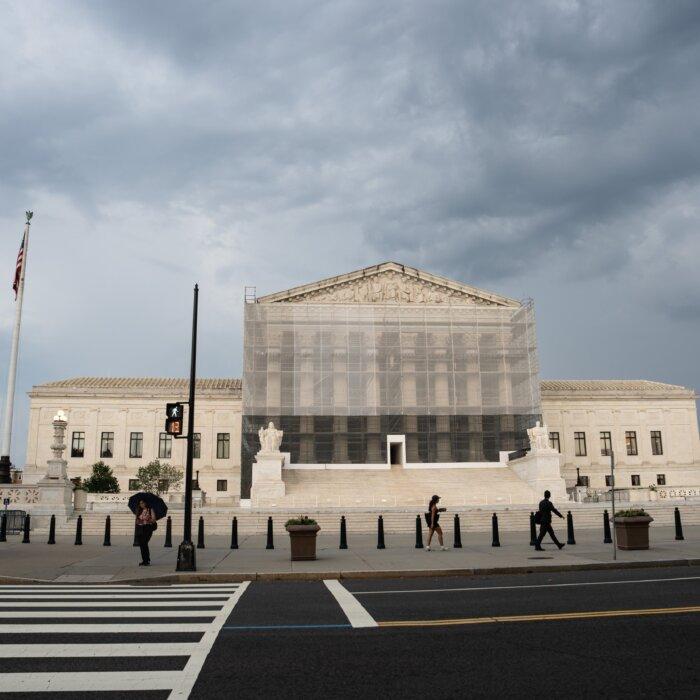
“We have a big case coming up in the Supreme Court, and I will tell you that’s one of the most important cases in the history of our country, because if we don’t win that case, we will be a weakened, troubled, financial mess for many, many years to come,” Trump told reporters in the Oval Office of the White House.
If the tariffs are struck down, “it’ll be a disaster for America,” he said.
“That’s why I think I’m going to go to the Supreme Court to watch it. I’ve not done that, and I had some pretty big cases. This is … one of the most important cases ever brought, because we will be defenseless against the world.”
The district court held that the tariffs were unlawful and that the International Emergency Economic Powers Act that Trump cited in issuing the tariffs does not allow the president “to unilaterally impose, revoke, pause, reinstate, and adjust tariffs to reorder the global economy.” The tariffs present “an existential threat” to the company’s business, the court also determined.
The U.S. Court of International Trade previously held that the president improperly used his emergency powers to enact the tariffs.
The Federal Circuit Court majority similarly found that the president went beyond his authority when he invoked the International Emergency Economic Powers Act.
“The statute bestows significant authority on the President to undertake a number of actions in response to a declared national emergency, but none of these actions explicitly include the power to impose tariffs, duties, or the like, or the power to tax,” the circuit court said.
The court also stated that it seems “unlikely that Congress intended, in enacting [the International Emergency Economic Powers Act], to depart from its past practice and grant the President unlimited authority to impose tariffs.”