Artificial intelligence (AI) data center developers are taking advantage of Trump administration inducements to go “behind-the-meter” and build their own power plants or co-locate adjacent to existing commercial electricity generators to cut transmission costs, short-circuit lengthy permitting requirements, and get projects online faster.
During an Oct. 21 Rose Garden Luncheon with Senate Republicans at the White House, President Donald Trump praised “first-mover” developers for advancing self-powered projects that will be key to the nation’s drive to maintain cutting-edge supremacy in artificial intelligence, quantum computing, and fission-fusion energy commercialization.
“We have an old grid. It’s a tired grid. It doesn’t have the juice that you need to fire-up these plants,” Trump said, noting that China “is building, right now, 52 power stations” and expanding its grid faster than the United States.
“These plants will need more than double the energy we have right now for the whole country,” Trump said. “That’s how big it is. And we can’t do that.”
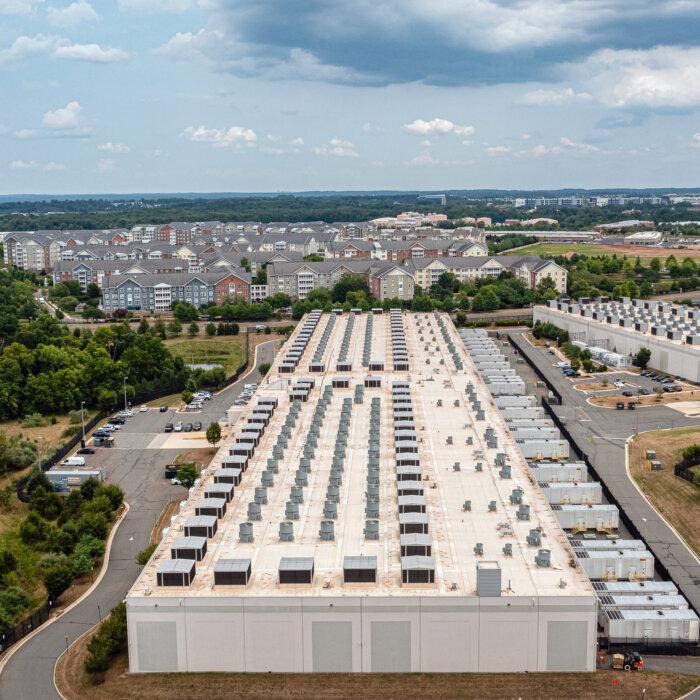
The president explained, “There’s no way we can do that” under standard electric grid expansion regulations, which can often take years to garner local, state, and federal approvals.
“But I did something better,” he said, “letting everybody build their own power plant, so they'll become like an electric utility in addition to AI.”
Since returning to office in January, the president has promoted the “co-location” of new energy sources and data centers to accelerate the build-out of AI infrastructure with initiatives that fast-track permits, reduce regulatory hurdles, and quickly make federal land available for these projects.
Getting Around Gridlock
Several data center developers have unveiled self-powered projects within the past few months, with others planning to do so in the coming years.Amazon, Google, and Microsoft are also heavily investing in Small Modular Reactors (SMRs) that use nuclear fission for AI data centers. The first commercial SMRs, which can be mass-produced, are on the cusp of being deployed.
Among the most ambitious of these projects is the planned 12 SMR Cascade Advanced Energy Facility near Richland, Washington, to be built by Energy Northwest and Amazon.
So while the decentralized, complex U.S. grid—managed by 3,000 electric utilities, regional transmission operators, and local and state governments—may not be able to pace the Chinese Communist Party’s centralized, subsidized expansion of China’s grid, American corporations and entrepreneurs are proving they can.
Definitions vary on what qualifies as a “data center,” and some estimate there are more than 6,000 in the United States and thousands more than 379 in China, but the trend is clear. The private sector is answering the president’s call to advance AI, quantum computing, and cryptocurrencies and spur technological breakthroughs in energy development.
“We’re dominating China right now in AI,” Trump said. “We have to get them fast, and we’re getting them fast, so we’re leading China in the AI race by a lot.”