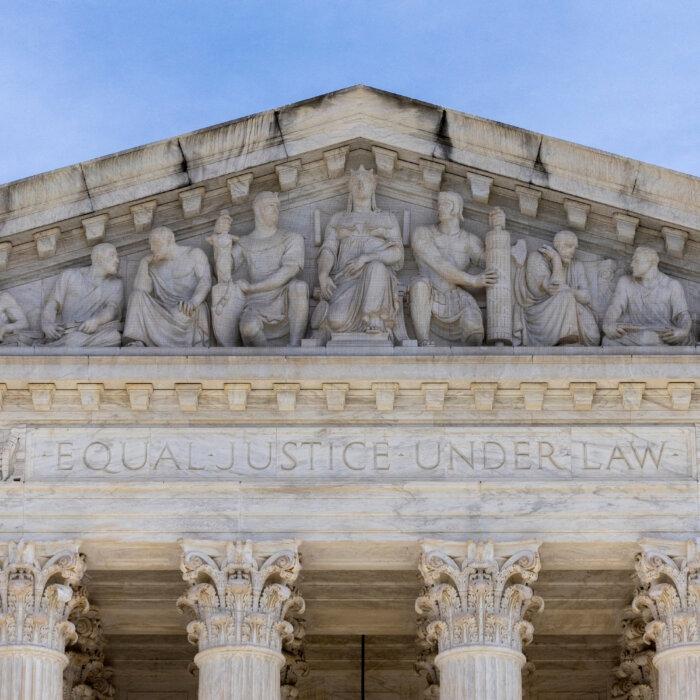
U.S. Treasury Secretary Scott Bessent said on Nov. 3 that he plans to attend this week’s Supreme Court oral arguments about President Donald Trump’s reciprocal tariffs.
The levies being challenged are reciprocal tariffs imposed on imports from other countries to match the tariffs and other trade barriers that they already impose on U.S. exports.
“This is a matter of national security,” the secretary said.
Trump told reporters he didn’t “want to call a lot of attention” to himself.
“It’s not about me, it’s about our country,” the president said.
Although sitting presidents don’t normally attend Supreme Court arguments, Trump had said on Oct. 15 that he would be in the audience for the argument of “one of the most important cases ever brought.”
If the tariffs are struck down, “it’ll be a disaster for America,” he said at the time.
Bessent told Watters that the United States has had “big trade deficits” for years, and “we were at the tipping point.”
“Fortunately, President Trump came in. He put on the tariffs. He is rebalancing global trade in favor of the U.S., and he has prevented an economic crisis.”
“I am there to emphasize that this is an economic emergency. National security is economic security; economic security is national security. As a treasury secretary of the United States, I’m in charge of maintaining both.”
“It will be, in my opinion, one of the most important and consequential Decisions ever made by the United States Supreme Court,” he wrote.
“If we win, we will be the Richest, Most Secure Country anywhere in the world, BY FAR. If we lose, our Country could be reduced to almost Third World status—Pray to God that that doesn’t happen!”
The president has made tariffs the centerpiece of his foreign policy in his second administration, saying they may be used to encourage manufacturing to return to the United States. He has also said that the tariffs may help correct what he considers unfair trade practices by countries that export goods to the United States, as well as to curb the illegal flow of fentanyl into the country.
Although lower courts found that Trump lacks authority under the federal International Emergency Economic Powers Act to impose the country-specific tariffs that he unveiled earlier this year, enforcement of their rulings was put on hold, and the tariffs remain in effect for the time being.
That court held that the International Emergency Economic Powers Act that Trump cited in issuing the tariffs does not allow the president “to unilaterally impose, revoke, pause, reinstate, and adjust tariffs to reorder the global economy.” The tariffs present “an existential threat” to the company’s business, the court also determined.
The U.S. Court of International Trade previously held that the president improperly used his emergency powers to enact the tariffs. The Federal Circuit Court majority similarly found that the president went beyond his authority when he invoked the International Emergency Economic Powers Act.