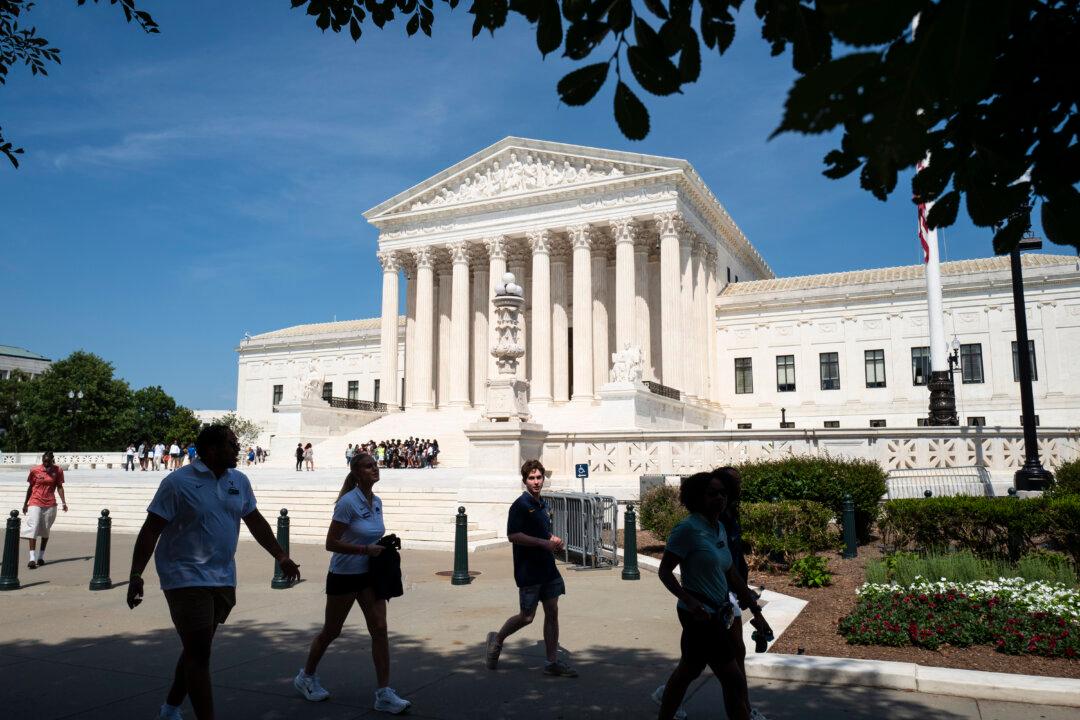
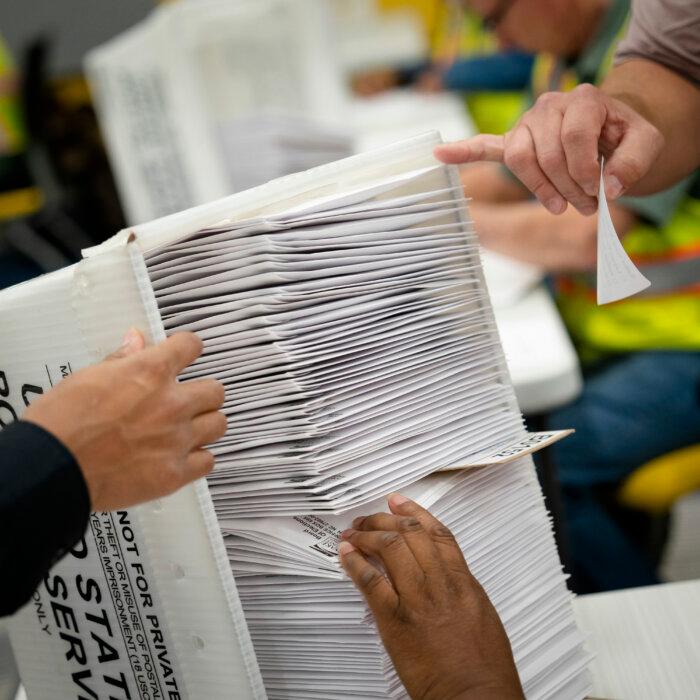
The Supreme Court voted 5–4 on June 29 to uphold a Mississippi law that allows the state to count mail-in ballots received after Election Day in federal elections.
Mississippi law allows the counting of mail-in ballots received within a five-day grace period after Election Day. The statute was enacted in July 2020 during the COVID-19 pandemic to provide flexibility to voters.
Federal law sets the Tuesday after the first Monday in November in certain years as Election Day for federal offices. A presidential election takes place every four years; a congressional election occurs every two years.
The federal Election Day law focuses on when ballots must be cast, not when they must be received by election officials for counting.
Roughly 30 states accept mailed ballots received after Election Day if they are postmarked on or before Election Day, according to a National Conference of State Legislatures report cited by the Supreme Court.
President Donald Trump took to social media to criticize the new ruling, calling it a “tremendous loss ... concerning Voter’s Rights” that allows votes to be counted “LONG AFTER an Election is over.”

Trump wrote on Truth Social that the ruling shows that “it is more important than ever to pass THE SAVE AMERICA ACT,” which is currently stalled in the U.S. Senate. That legislation would require all voters to present photo ID and proof of U.S. citizenship, and it would ban mail-in ballots except in cases of illness, disability, military deployment, or travel, he said.
Justice Amy Coney Barrett wrote the majority opinion in the case known as Watson v. Republican National Committee. Joining the majority opinion were Chief Justice John Roberts and Justices Sonia Sotomayor, Elena Kagan, and Ketanji Brown Jackson.
In October 2024, the U.S. Court of Appeals for the Fifth Circuit held in the case that even though states have primary responsibility for regulating federal elections within their borders, Congress is also allowed to “make or alter such regulations.”
The circuit court held that the federal Election Day law preempts Mississippi law, preventing the state from accepting late ballots.
Mississippi argued that striking down its law would cause upheaval in states that allow ballots received after Election Day to be counted.
The Republican National Committee, the state’s Republican Party, and the state’s Libertarian Party sued over the state law.
Trump issued an executive order a year ago to end the counting of ballots received after Election Day.
A federal court in Washington blocked part of the order in January.
In her opinion, Barrett wrote that three federal laws determine the day on which representatives, senators, and the president are elected, while a Mississippi law allows absentee ballots to be counted provided they are postmarked by Election Day but received no more than five days after.
“We must decide whether the federal election-day statutes preempt Mississippi’s law,” she said. “They do not.”
Barrett said the case is not about the Constitution or the scope of Congress’s authority to regulate federal elections.
“The sole question before us is whether counting ballots postmarked by election day, but received up to five days later, violates the federal election-day statutes,” she said.
Mississippi’s law is not preempted by federal Election Day statutes because they regulate only the timing of the election itself, not the separate administrative step of when ballots must be received by officials, Barrett said.
“The defining element of an ‘election’—the term used in all three federal statutes—has always been the electorate’s choice of candidate. ... The electorate’s choice is made when voting is complete, not when ballots are received,” she wrote.
Barrett also said a federal law, the Uniformed and Overseas Citizens Absentee Voting Act, confirms that states set receipt rules.
That statute “requires States to permit absent military and overseas voters to cast absentee ballots in federal elections,” and it creates a federal absentee voting system “as a backup.”
“In detailing this system, [the statute] repeatedly presupposes that ballot receipt is a matter of state law,” Barrett said.
The Supreme Court reversed the Fifth Circuit and sent the case back to that court for further proceedings consistent with the court’s opinion.
Justices Samuel Alito, Clarence Thomas, Neil Gorsuch, and Brett Kavanaugh dissented from the June 29 ruling.
In his dissenting opinion, Alito said the new decision is “based on a flawed understanding of the election-day statutes.”
“The majority’s rule apparently rests on the notion that a voter has made a ‘final selection of an officeholder’ once the voter tenders a ballot to the party who will deliver it,” yet the U.S. Postal Service permits customers to recall mail that is already in mid-transit, and plenty of private parcel services do the same, he said.
“Given that fact, is a voter’s ‘selection’ truly ‘final’ when he or she puts a ballot in the mailbox?”
Alito said that the majority leaves this question and the question whether state law should forbid voters from using recall services unanswered, and it opens a “Pandora’s box” for state legislatures “trying to understand what the election-day statutes allow.”
He said the ruling “leaves open opportunities for voter fraud,” which could further undermine Americans’ faith in the integrity of elections.
Alito noted that various reports have highlighted that mail-in ballots increase the potential for fraud. He cited a 2005 report by the Commission on Federal Election Reform that found that absentee voting was “the largest source of potential voter fraud” in American elections.
Voting by mail makes it harder for officials to verify the identity of the person asking for and filling out a ballot, it exposes voters to manipulation, and it makes the chain of ballot custody “more vulnerable.”
“Today’s decision compounds these vulnerabilities,” Alito said.
Several state attorneys general from Democrat-led states hailed the majority opinion.
New Jersey Attorney General Jennifer Davenport said the decision upheld states’ long-standing authority to count mail-in ballots that are cast by Election Day.
“Mail-in voting is a legal, reliable, and secure way to vote, and today’s decision reinforces that voters in New Jersey should feel confident voting by mail in this November’s midterm elections,” she wrote in a post on X.
Judicial Watch President Tom Fitton was critical of the new ruling, which he said “further eviscerates the very notion of Election Day and threatens to make a mess of [the nation’s] already stressed federal elections.” The group represented the Mississippi Libertarian Party in the case.
“The decision is contrary to the plain words of federal law establishing Election Day, invites significant voter fraud, and will undermine voter confidence in elections that could now regularly take months to resolve,” Fitton told The Epoch Times.