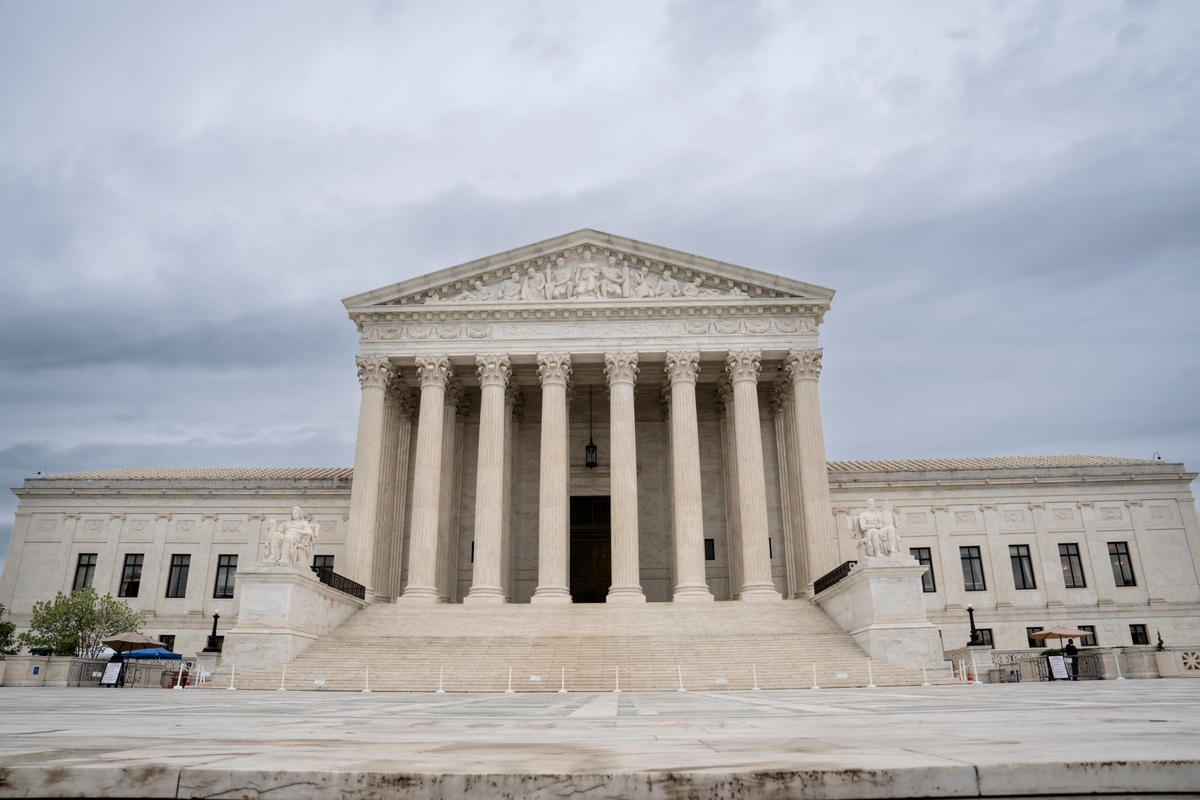

The Supreme Court agreed on June 22 to hear the appeal of an inmate who wants to sue prison officials for allegedly violating his constitutional rights by rendering inadequate medical care.
The new ruling took the form of an unsigned order in Nielsen v. Watanabe. No justices dissented. The court did not explain its decision.
Prisoner Kekai Watanabe says he suffered injuries in a gang riot in 2021 at the Federal Detention Center in Honolulu, Hawaii. He sought treatment from Francis Nielsen, a staff nurse, but alleges that Nielsen was intentionally indifferent to his medical needs by refusing his request to be sent to a hospital and giving him only over-the-counter medication. Later, he was diagnosed with a fractured tailbone and bone chips in nearby tissue.
Watanabe filed a Bivens action, based on Bivens v. Six Unknown Federal Narcotics Agents (1971). In that seminal ruling, the Supreme Court held that individuals may sue government officials for violations of their constitutional rights.
In Carlson v. Green (1980), the high court extended Bivens to an Eighth Amendment claim of deliberate indifference to medical needs where prison officials failed to deal with an inmate’s acute asthma attack and exacerbated it, leading to his death on-site within hours. The Eighth Amendment bans cruel and unusual punishment.
Since the 1980 ruling, the court has said it is up to Congress, not the courts, to create damages remedies.
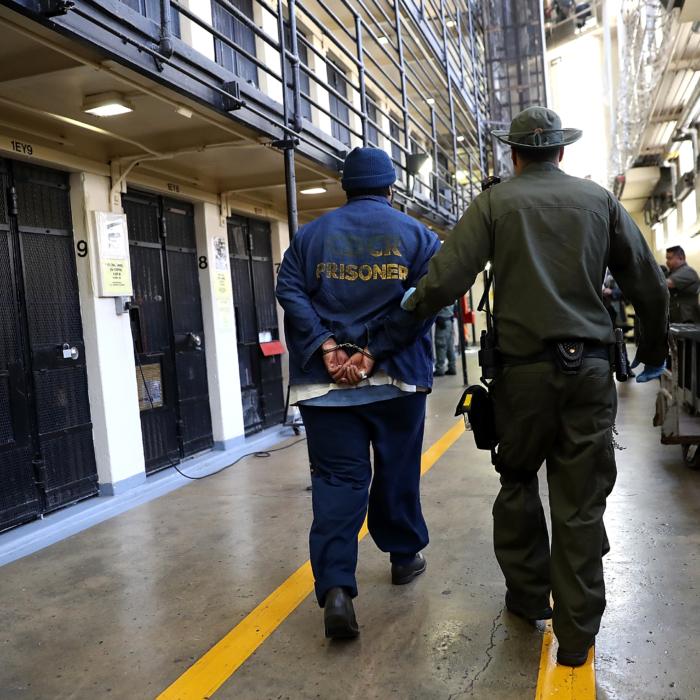
Watanabe alleged Nielsen and others violated his Eighth Amendment rights by calling him a “crybaby,” denying him “actual treatment,” and not letting him go to a hospital. He asked for $3 million in damages and injunctive relief.
The federal district court dismissed Watanabe’s lawsuit, finding the lawsuit presented a “new context” that was different from Carlson, according to Nielsen’s petition.
The court found that Watanabe had access to the Federal Bureau of Prisons’ Administrative Remedy Program (ARP), a formal internal grievance process that permits federal inmates to file complaints regarding medical care, confinement conditions, or other issues. Such complaints are resolved administratively rather than through lawsuits.
Because the existence of the ARP was not dealt with in Carlson, the court held it was “another reason that Watanabe’s claim arises in a new context.”
The court also determined that his injury was “not akin to” the fatal “medical emergency faced by the inmate in Carlson,” and that allowing Watanabe to proceed with a Bivens claim could burden district courts by transforming them into “medical review boards” monitoring prison injuries, the petition said.
A divided panel of the U.S. Court of Appeals for the Ninth Circuit reversed the district court, ruling the lawsuit could move forward.
The panel found that Watanabe’s access to “alternative remedial structures does not render this case a new context,” although the availability of such structures as the ARP can be a “special factor” to be considered in the Bivens analysis.
“Carlson dealt with the exact same issue” as this case, which is “deliberate indifference to an inmate’s serious medical needs.” A plaintiff does not have to suffer “death or a life-threatening injury for his claim to be sufficiently analogous to Carlson,” the panel found.
Nielsen urged the Supreme Court to take up the case.
The court has limited Bivens to “three circumstances in which the Court previously recognized Bivens actions.” Watanabe’s case does not come within any of those three circumstances, the petition said.
Federal courts of appeals are split on the role of alternative remedies, and the Supreme Court should accept the case to resolve the split, the petition said.
Watanabe filed a brief urging the Supreme Court to deny the petition and leave the Ninth Circuit’s ruling intact.
Echoing the language of the circuit court, the brief said the Supreme Court has “never suggested that an inmate must die (or suffer a life-threatening injury) in order to pursue a Carlson claim.”
The Supreme Court’s cases “limiting Carlson have involved efforts to dramatically extend Carlson, such as to private employees in private prisons (rather than federal officers in federal prisons),” the brief said.
“Watanabe alleges a violation of the same constitutional right (the Eighth Amendment) for the same kind of conduct (deliberate indifference to a serious medical need) injuring the same kind of plaintiff (a federal prisoner) under the same circumstances (failure to provide adequate treatment) against the same class of officers (medical staff at a federal prison) as in Carlson,” it said.
“Along every dimension, Watanabe’s claim lines up with Carlson. There is no ‘new context’ here.”
The Supreme Court is expected to hold oral argument in the case during its new term, which begins in October. A decision is likely to follow by June 2027.