The Supreme Court on March 16 agreed to fast-track the Trump administration’s request to end temporary protected status (TPS) for Haitians after an appeals court blocked the move.
TPS is a designation that allows individuals from countries affected by armed conflict, natural disasters, or other extraordinary events to remain in the United States. Under President Donald Trump, the Department of Homeland Security (DHS) has taken steps to end TPS for about a dozen countries, saying it was always intended to be temporary.
The court said it will hear oral argument in the cases, which will be heard together, in the second week of April.
The Obama administration first gave the TPS designation to Haiti in 2010 after that country was hit by a devastating earthquake. That country-specific designation was extended in subsequent years.
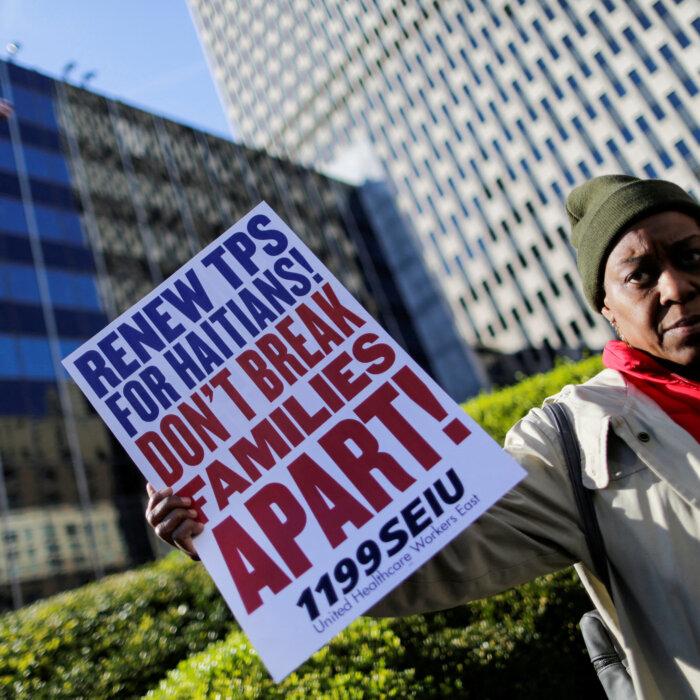

Under Trump, DHS found in November 2025 that there were “no extraordinary and temporary conditions” in Haiti that would prevent Haitians from returning to the Caribbean country. Meanwhile, the State Department advises Americans against traveling to Haiti “due to kidnapping, crime, terrorist activity, civil unrest, and limited healthcare.”
U.S. District Judge Ana Reyes ruled on Feb. 2 that the DHS decision to terminate TPS for Haitians was likely motivated, in part, by “racial animus” and issued an order preventing the government from ending the Haiti designation.
In its order, the appeals court denied the government’s request to suspend Reyes’s order. The decision left in place protections for about 330,000 Haitian nationals as the underlying legal challenge plays out.
That court found that DHS failed to show that it would experience irreparable harm if the lower court’s order were allowed to stand. The plaintiffs, who are Haitian TPS recipients, would face “substantial and well documented harms,” the majority wrote.
Judge Justin Walker of the D.C. Circuit wrote in a dissenting opinion that TPS was never intended to be permanent and that the government should not be prevented from revoking them after 16 years.
“The Government is irreparably harmed by ‘an improper intrusion by a federal court into the workings of a coordinate branch of the Government,’” Walker wrote.
The Supreme Court, according to Sauer, should temporarily allow the revocation of the Haiti designation and schedule oral arguments in the case because the lower courts are divided on the legal issues involved, which has led to a situation in which “stop-and-start litigation over TPS terminations has become endemic.”
Sauer said that the district court, in this case, and other courts around the country have endorsed “a far-fetched and far-reaching equal-protection claim” based on officials’ purported racial animus, and this legal theory now “threatens to invalidate virtually every immigration policy of the current administration.”
The lead respondent in one of the two cases, Haitian TPS holder Fritz Emmanuel Lesly Miot, urged the Supreme Court to leave the D.C. Circuit’s ruling in place.
The brief stated that terrorist and gang violence has nearly paralyzed Haiti, which also suffers from “famine-like conditions.” It states that reports indicate the threat of violence has shut down essential services, including roadways and hospitals, and that “the humanitarian situation in Haiti is considered among the most dire in the world.”
Haitian TPS holders have resided in the United States for almost two decades “without problem,” and “there is no sudden emergency requiring their immediate expulsion,” the brief stated.
The D.C. Circuit’s March 6 order blocking revocation of TPS status for Haiti remains in effect for the time being.