The U.S. Supreme Court on Oct. 15 seemed likely to limit the use of race-based districting during an oral argument concerning Louisiana’s congressional map.
At the same time, some justices on the nation’s highest court pushed back against the idea that discarding the use of race in drawing electoral districts was necessary or constitutional.
The outcome of the high-profile racial gerrymandering case—known as Louisiana v. Callais—could have an impact on the balance of power in the federal legislative branch. Gerrymandering is the manipulation of electoral district boundaries to favor a particular party or constituency.
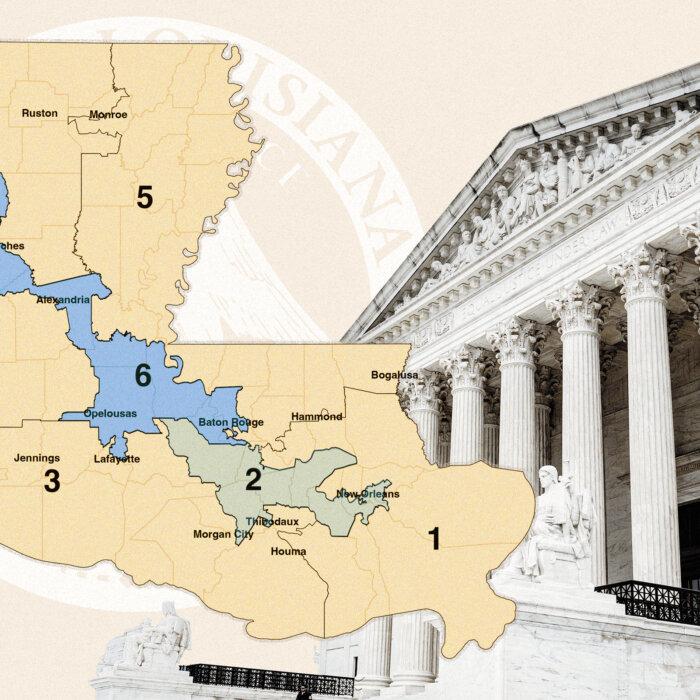
Currently, Republicans maintain a razor-thin majority over Democrats in the U.S. House of Representatives. The congressional seat at the heart of the litigation is currently held by Rep. Cleo Fields (D-La.).
The legal issue is whether the creation of a second black-majority congressional district in the Pelican State violates the 14th or 15th Amendments. The 14th Amendment guarantees equal protection under the law. The 15th Amendment forbids the federal government and the states from interfering with voting rights based on a citizen’s race.
A federal district judge ruled that an earlier version of the state’s electoral map, which included only one black-majority congressional district, discriminated against black voters, who constitute almost one-third of the state’s population. The judge ordered the state to create a second black-majority district after finding that its failure to do so likely violated Section 2 of the federal Voting Rights Act of 1965.
Section 2 prohibits voting practices or procedures that discriminate based on race, color, or membership in a large language-minority group such as American Indian, Asian American, Alaskan Native, or American Hispanic.
Courts have held that the Voting Rights Act, in certain circumstances, allows states to take race into account when drawing electoral boundaries, but electoral maps drawn explicitly based on race are unconstitutional. The statute has been interpreted by the courts to forbid racial gerrymandering when it dilutes minority voting power.
A group of non-black voters filed suit, arguing that the map with two black-majority districts discriminated against non-minorities by engaging “in explicit, racial segregation of voters.”
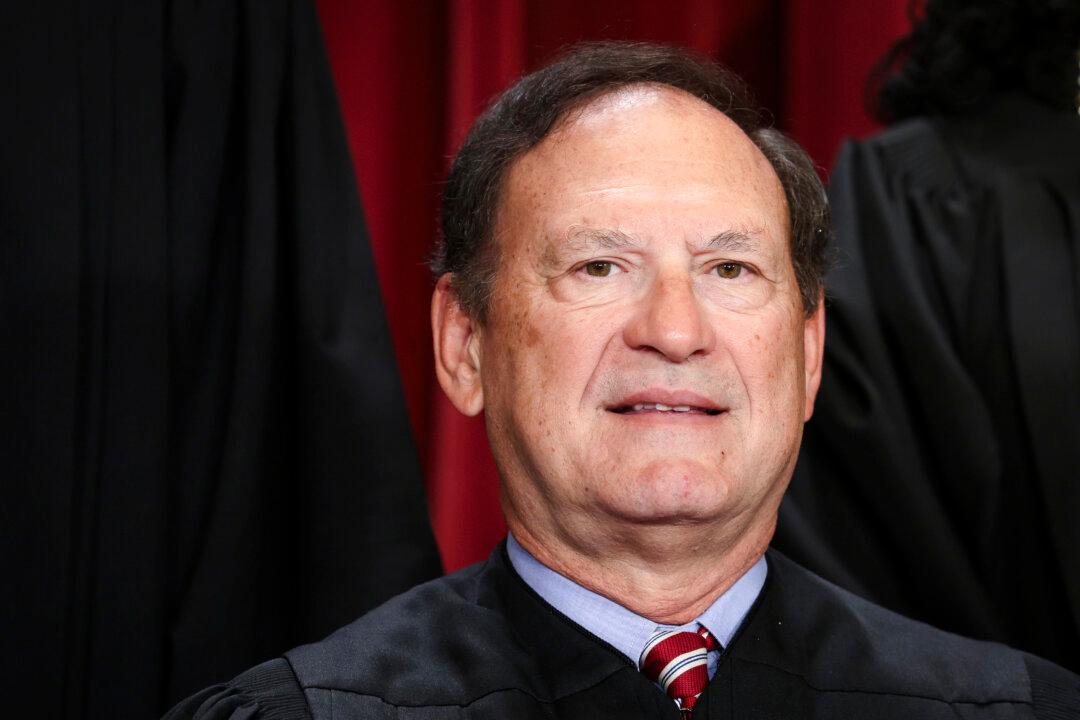
Justice Samuel Alito said it is unconstitutional for race to be used as a “proxy for partisan affiliation.”
Louisiana Solicitor General Benjamin Aguiñaga said the current system involves “racial stereotyping” and “has no logical endpoint.”
Forty years after the Supreme Court’s decision in Thornburg v. Gingles, which laid down rules for the use of race in redistricting, the other side in this case claims that “nothing has changed in the voting and housing patterns in Louisiana.”
“If anything is clear in this court’s dedication to eliminating all racial discrimination, it is that the Constitution does not tolerate this system of government-mandated racial balancing,” Aguiñaga said.
Justice Sonia Sotomayor said: “Race is a part of redistricting always.
“My colleagues are trying to tease it out in this intellectual way that doesn’t deal with the fact that race is used to help people.”
Legislators might use a race-based approach to try to keep an ethnic community intact in one district or to decide which district an incumbent should be placed in, according to Sotomayor.
“They might review it to predict what kind of issues a district voter might be particularly interested in. They might use it to inform partisan goals. We permit all of that,” she said.
Aguiñaga replied, “The government has no business telling citizens in which districts they may live.”
Sotomayor asked Justice Department attorney Hashim Mooppan if the Trump administration’s “bottom line is just [to] get rid of Section 2.”
Mooppan replied, “Yes.”
In that case, the state of Alabama presented “several arguments that we specifically rejected, and in the answers that you just gave to me, it seems to me that you repeated each and every one of those arguments that we rejected,” Kagan said.
Chief Justice John Roberts seemed concerned about overruling Milligan so soon after the court decided it.
“That case, of course, took the existing precedent as a given,” he said.
Attorney Janai Nelson, who represents black voters, told the court that it should preserve what she called “opportunity districts,” which have been drawn on racial grounds under the auspices of Section 2 of the Voting Rights Act.
“Every justice in Louisiana has been elected through a [Voting Rights Act] opportunity district, and nearly all legislative representatives have been elected in those same districts. So Louisiana alone is an example of how important it is to have Section 2 continue to be enforced to create these opportunities,” Nelson said.
The Supreme Court is expected to rule on the case by the end of June 2026.