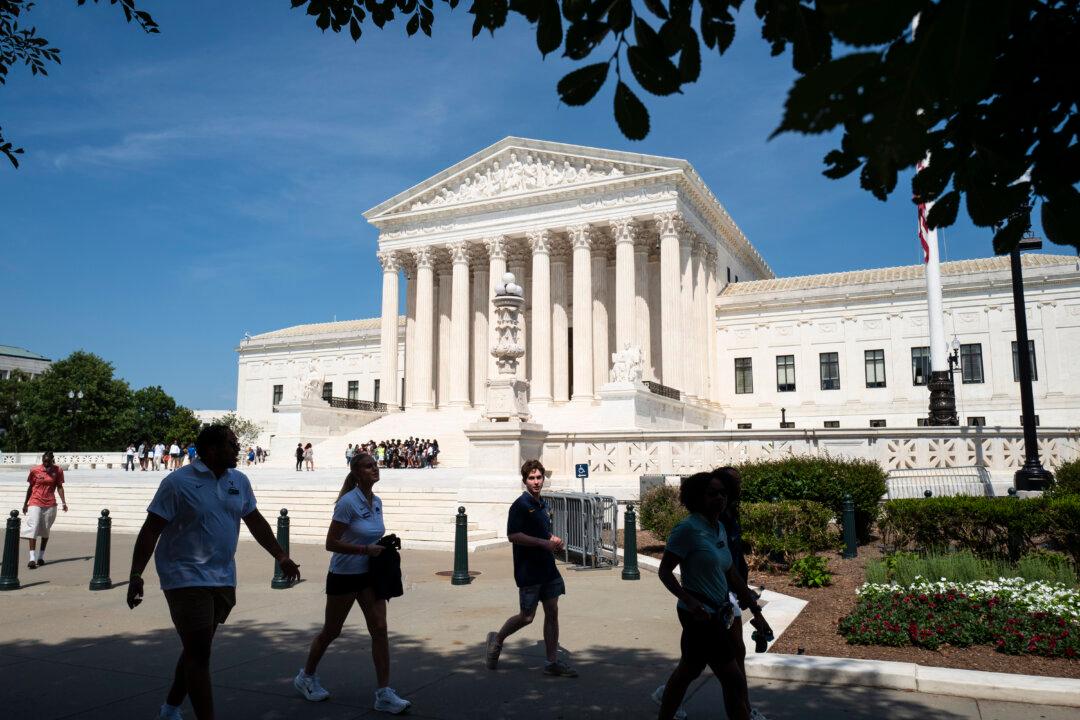
The U.S. Supreme Court on June 15 declined to take up the case of a 98-year-old federal judge’s challenge to her ongoing suspension from an appeals court in the nation’s capital.
The U.S. Court of Appeals for the Federal Circuit, not to be mistaken for the U.S. Court of Appeals for the District of Columbia Circuit, is a specialized court that has exclusive authority to hear cases involving patents, trademarks, international trade, government contracts, and federal personnel and employment issues.
Newman, who was appointed in 1984 by President Ronald Reagan, is an authority on patent law and a high-profile author of dissenting court opinions.
The lead respondent in the case is Chief Federal Circuit Judge Kimberly Moore.


Newman failed to undergo medical testing after an expert recommended it, the order said. Newman also declined to accept service of orders, saying she “was not interested in receiving any documents regarding this matter,” and directed the mailroom at her residence not to accept the orders.
Later the same year, a council of judges barred Newman from hearing new cases for one year or until she underwent court-ordered medical examinations.
“We are acutely aware that this is not a fitting capstone to Judge Newman’s exemplary and storied career,” the council said at the time.
It stated that it had no choice because she was “no longer capable of performing the duties of her judicial office.”
In the petition, Newman’s attorneys said the judge remains intellectually and physically robust.
They cite Dr. Aaron G. Filler of the Institute for Nerve Medicine in San Diego, who produced a report in 2024 saying that the then-97-year-old Newman “appears generally healthy and active as if 20 or more years younger than her stated age.”
“[Newman] engages normally and fluidly in interaction and conversation without any apparent diminishment that might be associated with age in the 10th decade as to other individuals,” Filler said.
The physician said Newman was a “super-ager,” which means she “does not demonstrate effects of age on cognition or demeanor comparable to many others at this age.”
“Based on my experience as an attorney and my expertise as a physician, the content of her speech is entirely appropriate for a serving Court of Appeals Judge,” Filler said.
Newman sued the council in federal district court in Washington. That court dismissed the lawsuit in 2024, finding that the courts have “consistently affirmed the judiciary’s authority to police itself.”
The U.S. Court of Appeals for the District of Columbia Circuit affirmed the ruling in 2025.
Newman’s attorneys said in the petition that Moore has “improperly” used the federal Judicial Councils Reform and Judicial Conduct and Disability Act of 1980 “to perpetually sideline Judge Newman until she gives in to the bullying and retires or takes senior status.”
Senior status is a form of semi-retirement for judges aged 65 or older who have served a minimum number of years of judicial service. Such judges work reduced caseloads but retain their full salary. Taking senior status creates a vacancy on a court, which the sitting president may then fill.
Sauer said the lower courts correctly ruled that the law bars most district court reviews of judicial council decisions in misconduct or disability cases.
Andrew Morris, a lawyer at the New Civil Liberties Alliance, which represents Newman, said he was disappointed that the justices “did not take this opportunity to protect judicial independence.”
“We will continue to pursue available avenues to vindicate Judge Newman against her stealth impeachment,” he said.
A spokesperson for the Federal Circuit declined to comment.