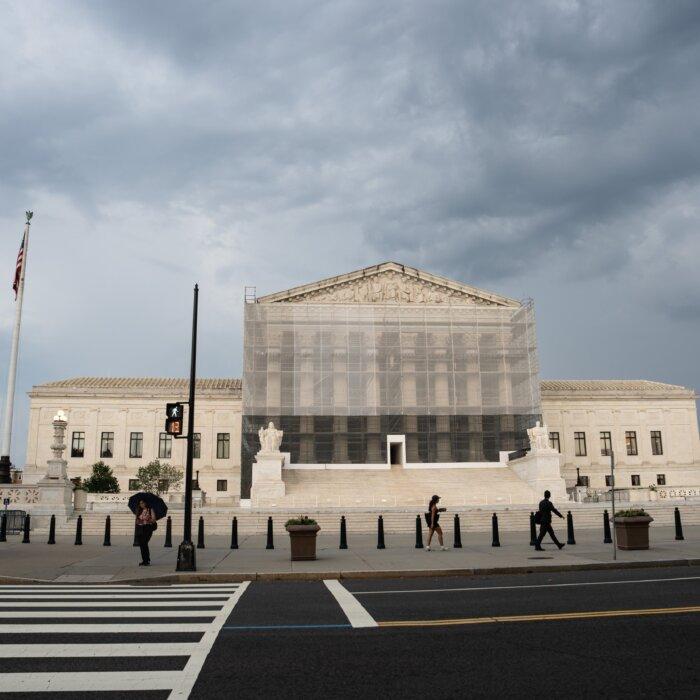
The Supreme Court on Sept. 9 granted a Trump administration request to temporarily withhold approximately $4 billion in foreign aid funding previously authorized by Congress.
The court issued an administrative stay, which puts a lower court order requiring the release of the funding on hold to give the justices more time to fully consider the matter. The court did not provide reasons for its decision.
The money is earmarked for foreign aid and United Nations peacekeeping projects.
The Supreme Court’s new order states that Ali’s orders of Sept. 3 in the two cases are “hereby partially stayed for funds that are subject to the President’s August 28, 2025 [rescission] proposal currently pending before Congress pending further order of the undersigned or of the Court.”
In February, Ali gave the federal government 36 hours to pay roughly $2 billion in invoices for past foreign-aid work, which Sauer called “an impossible task,” and one that the judge lacked authority to order. The Supreme Court ended the dispute by granting an administrative stay.
After the deadline was lifted, the government paid “virtually all of the contested amounts,” Sauer said.
Next, Ali issued a “novel injunction requiring the government to obligate tens of billions of dollars” in foreign-aid appropriations, based on the theory that withholding the funds violated the Constitution and the Impoundment Control Act, Sauer said.
The U.S. Court of Appeals for the District of Columbia Circuit lifted that injunction, and that court allowed its ruling to come into effect on Aug. 28, Sauer said.
Now that its original theory has been “decisively rejected,” the district court precipitated a new emergency “by issuing a version of the same injunction near midnight on September 3,” Sauer stated.
The district court is again forcing the government to obligate about $10.5 billion in foreign-aid funding that was due to expire on Sept. 30, according to Sauer. But now the government has been left “with even less time for further review or compliance, with even more deficient legal theories,” Sauer said.
Sauer said the government had already planned to obligate $6.5 billion of that funding by Sept. 30, but Ali’s order regarding the remaining $4 billion “raises a grave and urgent threat to the separation of powers,” a constitutional doctrine that divides the government into three branches to prevent any single branch from accumulating too much power.
“The government’s theory that the agencies need not comply with enacted legislation mandating that they spend funds, because the President has unilaterally proposed legislation to rescind those statutory mandates, would fundamentally upend our constitutional structure,” the brief reads.
The Supreme Court directed the associations and grant recipients who want the funding released to file a reply with the court by 4 p.m. on Sept. 12.