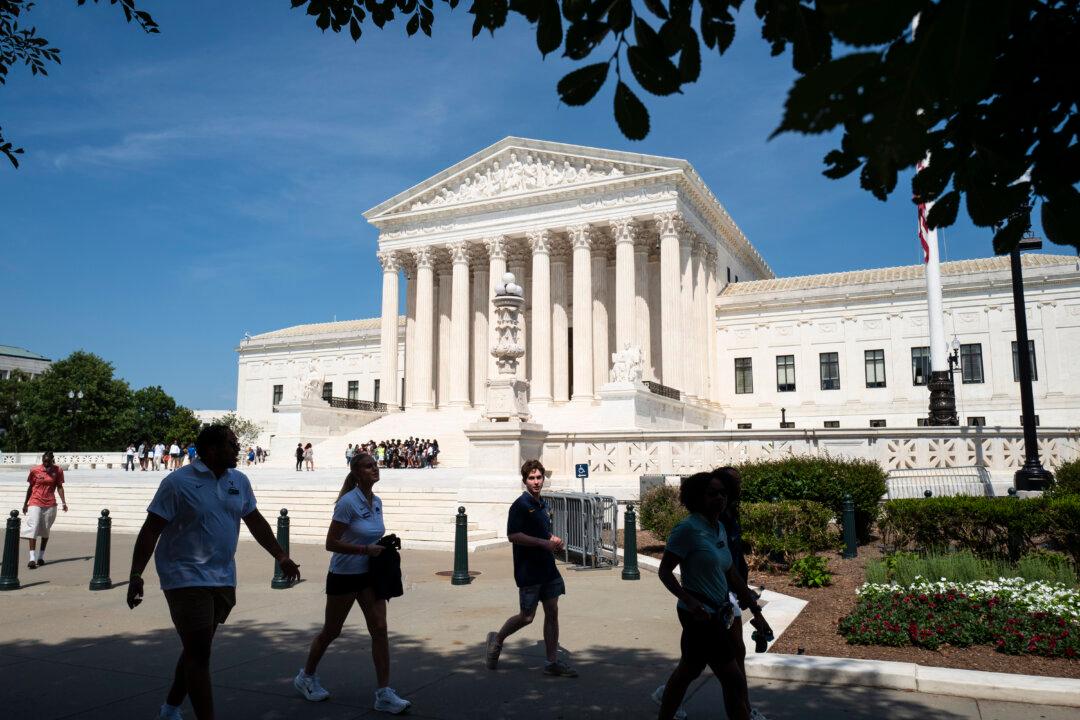
The U.S. Supreme Court ruled on June 23 that Exxon Mobil may sue state-owned companies in Cuba over its energy-related assets that were seized in 1960.
The ruling is not on the merits of Exxon’s case, but allows the company to move forward with its lawsuit.
Justices Elena Kagan, Sonia Sotomayor, and Ketanji Brown Jackson dissented.
The case focuses on the 1996 Cuban Liberty and Democratic Solidarity Act, created to pressure Cuba by penalizing companies “trafficking” in property Cuba seized from U.S. interests. Also known as the Helms-Burton Act, the law allows U.S. citizens and companies to sue any person who traffics in, uses, or profits from the confiscated property.
Cuba’s late dictator Fidel Castro overthrew the former government in 1959 and turned Cuba into a one-party state in which socialist policies were implemented, including nationalization of assets of foreign businesses.
Parties had been unable to sue Cuban government-owned enterprises under the act because U.S. President Bill Clinton suspended Title III, the part of the law allowing compensation lawsuits to be filed. President Donald Trump revoked the suspension on May 2, 2019, and Exxon Mobil sued the same day.
Exxon Mobil, which was previously known as Standard Oil Co., seeks compensation from three Cuban government-owned companies for energy assets seized in 1960.
In 2024, a divided U.S. Court of Appeals for the District of Columbia Circuit ruled that the Foreign Sovereign Immunities Act (FSIA) presents an additional hurdle for lawsuits against Cuban entities. That court held that Title III claims may proceed against Cuban entities only if the lawsuit falls under an exception in the FSIA. That act generally forbids lawsuits against foreign governments, but allows suits involving commercial activities or property seized in violation of international law.
The appeals court ruled that when the district court considered the case, it failed to properly analyze whether the commercial activities exception applied and sent the case back to that court for further consideration.
In the Supreme Court’s majority opinion, Kavanaugh said, “Foreign sovereigns, including their agencies and instrumentalities, are presumptively immune from suit in U.S. courts.
“The question here is whether the Helms-Burton Act abrogates the foreign sovereign immunity of Cuban agencies and instrumentalities—or whether plaintiffs such as Exxon suing under the Act must also satisfy one of the exceptions to immunity in the generally applicable Foreign Sovereign Immunities Act of 1976, or FSIA.”
Foreign sovereign immunity is a legal doctrine that prevents governments from being sued in the courts of another nation, with certain exceptions, unless they agree to be sued. Abrogation is the act of formally annulling a law or legal provision.
“We conclude that the Helms-Burton Act itself abrogates the sovereign immunity of Cuban agencies and instrumentalities. Therefore, plaintiffs who sue Cuban agencies or instrumentalities under the Act are not required to also satisfy an FSIA exception,” Kavanaugh said.
He said the cause of action, or right to sue for a specific wrong, applies against Cuban agencies and instrumentalities, specifically creating a private right to sue for any U.S. national whose property was seized by the government of Cuba. The right runs against “any person that ... traffics in” that property.
The court’s sovereign immunity precedents hold that when Congress creates a cause of action and specifically applies it against government agencies or instrumentalities, Congress has abrogated that immunity, the justice said.
“Congress does not ordinarily enact self-defeating statutes ... [or] ‘authorize a suit against a sovereign with one hand, only to bar it with the other,’” he said. The interpretation of the Helms-Burton Act argued by the Cuban government defendants “would do just that and largely negate the Act’s cause of action.”
Congress does not need to employ “‘magic words’ to abrogate sovereign immunity,” but simply has to make a waiver “‘clearly discernable’ from the ‘sum total’ of its work ... [which] the Helms-Burton Act did.”
“Stacking an FSIA requirement on top of the Helms-Burton Act would thwart Congress’s design and directly contravene the President’s foreign policy judgments,” Kavanaugh said.
The Supreme Court reversed the judgment of the D.C. Circuit and returned the case to that court “for further proceedings consistent with this opinion.”
The lower court is expected to examine the potential liability of Corporacion Cimex and the other Cuban companies sued by Exxon.
Kagan wrote a dissenting opinion that was joined by Sotomayor and Jackson.
The Foreign Sovereign Immunities Act spells out that foreign states and instrumentalities “‘shall be immune from the jurisdiction’ of the federal courts unless an FSIA exception is met,” she said.
The issue here is whether the defendants, which are Cuban-owned companies, are immune from the jurisdiction of the federal courts. “The answer should be just what the FSIA says: It depends on whether an FSIA exception is met.”
But the majority concluded that a different statute, the Helms-Burton Act, cancels out the immunity that the Foreign Sovereign Immunities Act may otherwise provide, she said.
“The problem for the majority is that the bar for finding congressional abrogation is high, and the Helms-Burton Act falls short,” Kagan said.
“Because there is no abrogation in that Act—even in hiding, as the majority finds—I respectfully dissent.”