The Supreme Court on April 27 agreed to consider whether the Department of Labor’s in-house administrative tribunals, which can levy large fines on employers for violating agricultural visa rules, are constitutional.
The department is trying to overturn a ruling by the U.S. Court of Appeals for the Third Circuit that found Sun Valley Orchards of New Jersey, a fruit and vegetable farm, was entitled to be heard in federal court before being fined hundreds of thousands of dollars for allegedly violating H-2A visa program rules.
The dispute is the latest legal case to test whether the in-house enforcement system used by a federal agency violates the Seventh Amendment right to a jury trial in federal civil cases.
The case comes after the Supreme Court limited the Securities and Exchange Commission’s use of in-house administrative tribunals in SEC v. Jarkesy, finding in 2024 that defendants facing civil penalties are constitutionally entitled to a jury trial.

In the cases of FCC v. AT&T and Verizon Communications v. FCC, the court is expected to issue a ruling by the end of June.
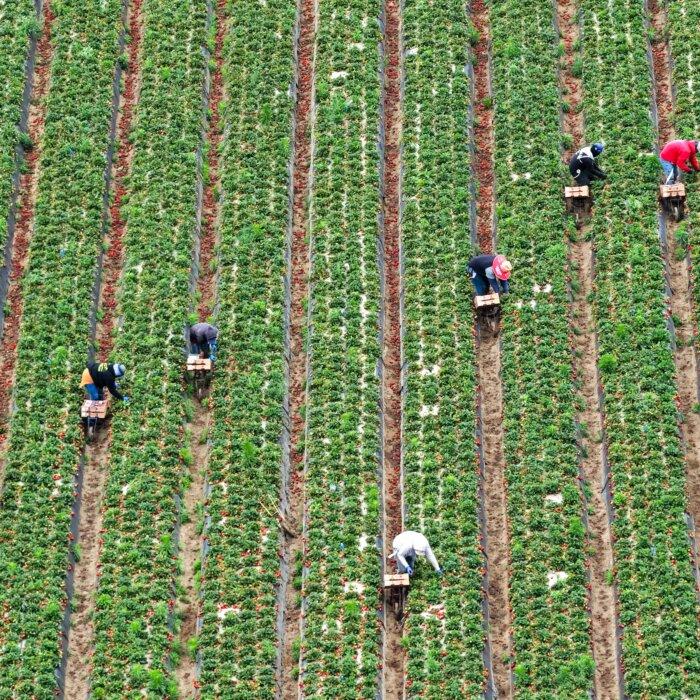
In the case at hand, the Department of Labor targeted Sun Valley Orchards of New Jersey, a fruit and vegetable farm, for penalties in 2015.
The company hired 96 foreign workers to work alongside 51 U.S. workers to pick peppers and asparagus from April 2015 to October 2015 in 12-hour shifts that allowed a single, one-hour break. The department alleged, among other things, that the company violated the rules by not providing consistent access to drinking water and sanitary bathrooms while working and that workers were transported to the fields in unsafe vehicles by unlicensed drivers, the petition states.
The department investigated and issued a notice finding that the company violated the H-2A program’s rules and owed back wages and civil penalties. An administrative law judge sided with the department in part and assessed $211,800 in civil penalties and $344,945.80 in back wages to be paid by the company. The Administrative Review Board affirmed, the petition states.
The petition states that the company filed suit in federal district court, challenging the in-house adjudication system. The court sided with the department, finding that Congress has “significant latitude to assign adjudication of public rights to entities other than Article III courts.” Article III courts are duly constituted federal courts whose judges are nominated by the president and confirmed by the U.S. Senate. The court held that the case involves public rights because it deals with immigration.
The Third Circuit reversed, siding with the company.
The appeals court held that the case involves private rights, likening the legal process to an action “for breach of contract, which would have traditionally been heard in common law courts.” The court rejected the department’s argument that the lawsuit touched upon public rights because it concerns immigration. Although history permits “non-Article III adjudication for certain matters,” it found that this case was about rules regarding housing and working hours that have more to do with employment law than immigration, the petition states.
“By any metric, barring the Department from relying on in-house adjudication of civil penalties to enforce the terms and conditions of the H-2A program—and requiring the Department to jettison its decades-old procedures for resolving such cases— inflicts upheaval in a national program,” he said.
“To implement Article III’s guarantee of an independent judicial forum, this Court has said that cases involving ‘private’ rights must be adjudicated in the Article III courts,” the brief reads.
The Institute for Justice, a public interest law firm that represents Sun Valley Orchards, reacted to the Supreme Court’s decision to accept the case.
“Small businesses targeted for fines have the right to defend themselves in a real court, with a real judge and jury, rather than an agency court where the only judge is an agency bureaucrat,” Institute for Justice senior attorney Rob Johnson said in a statement.
“It’s fundamentally unfair to try a business in a court where everybody involved is employed by the same administrative agency.”
The Epoch Times reached out for comment to the Department of Justice, which represents federal agencies in court. No reply was received by publication time.
The Supreme Court is expected to schedule oral arguments in the case for the court’s new term that begins in October.