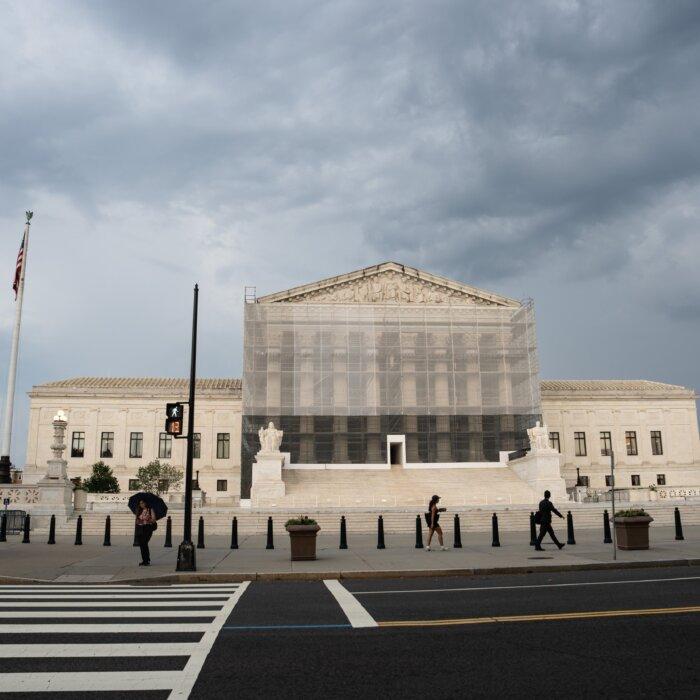
The Supreme Court decided on June 30 to review a $1 billion jury verdict that music labels won against an internet service provider over music piracy that the provider’s customers allegedly committed.
The Fourth Circuit’s decision installs “the most draconian secondary-liability regime in the country, one that departs from three other circuits, defies this Court’s precedents, and threatens mass disruption across the internet,” the petition said.
The first lawsuit against Cox was filed by music publisher BMG Rights Management in 2014. A federal district court found that Cox’s case-by-case approach to subscriber termination was “not standardized or aggressive enough to immunize Cox” under the federal Digital Millennium Copyright Act. A jury rejected BMG’s vicarious liability claims but ruled in favor of BMG on willful, contributory liability, according to the petition.

The Fourth Circuit reversed, saying the district court judge failed to tell the jury that contributory negligence requires that Cox had actual knowledge or was willfully blind to specific instances of infringement. However, the appeals court ruled that the district court was correct when it instructed the jury that “contributorily (or vicariously) infringing with knowledge that one’s subscribers are infringing is consistent with at least reckless disregard for the copyright holder’s rights.” The case was later settled out of court, the petition said.
The petition said that a month before the BMG case was settled in July 2018, a large group of record labels and publishers filed a “copycat” lawsuit against Cox, claiming that Cox was liable vicariously and contributorily for individual subscribers’ infringement over file-sharing networks from February 2013 to November 2014. A federal district court ruled against Cox, finding the company was liable because it received the infringement notices and failed to terminate subscribers’ access on the affected accounts. A jury held that Cox acted willfully and was responsible for both contributory and vicarious infringement on the accounts.
The finding of willfulness boosted the ceiling on damages available under the Act to $150,000 from $30,000 per work. Although Cox presented evidence showing the other side’s actual losses amounted to $692,000, the plaintiffs convinced the jury it should award $1 billion, representing $99,830 for each one of the 10,017 works that were allegedly infringed.
The Fourth Circuit ruled that Cox could not be held vicariously liable but could be held responsible for contributory liability because the company “materially contributed” to infringement on its networks by not cutting off individual infringers.
Cox is “off base” to say there is a three-way split among federal courts of appeal “over whether and under what circumstances an online service provider ‘materially contributes’ to copyright infringement.’
“There is no split. This Court should deny the petition,” the brief said.
The Supreme Court is expected to hear the case in its new term that begins in October.