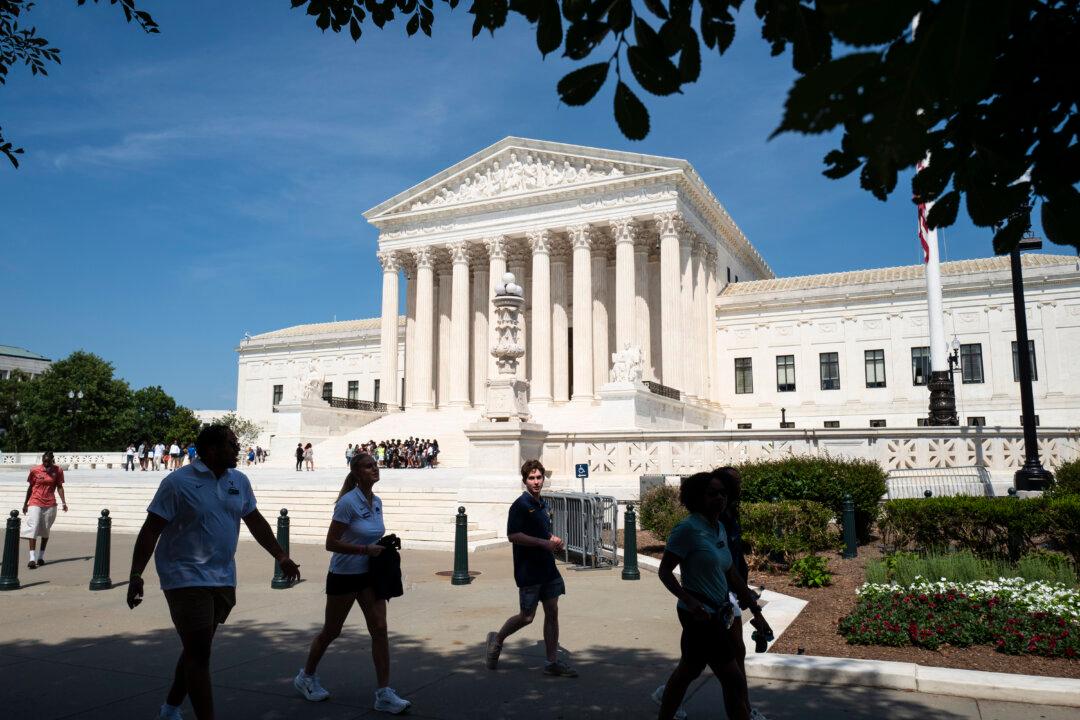
The U.S. Supreme Court on Oct. 20 declined a male college student’s request to withdraw his challenge to Idaho’s ban on male athletes competing on school sports teams intended for females.
Respondent Lindsay Hecox had sued Idaho, alleging that Idaho’s Fairness in Women’s Sports Act violates the U.S. Constitution’s equal protection clause and Title IX, a federal civil rights law that forbids sex-based discrimination at any school that receives federal funding.
Hecox, a biological male who identifies with a female identity, wanted to compete as part of the Boise State University women’s teams for track and cross-country.
A federal district court previously issued a preliminary injunction blocking the state law so Hecox could try out for the teams. The court ruled that the statute discriminates against transgender-identifying athletes.
The U.S. Court of Appeals for the Ninth Circuit affirmed the injunction, holding that laws making sex-based distinctions in schools serve as “proxy discrimination” against transgender-identifying athletes.
“Ms. Hecox has also come under negative public scrutiny from certain quarters because of this litigation, and she believes that such continued—and likely intensified—attention in the coming school year will distract her from her schoolwork and prevent her from meeting her academic and personal goals.”
The document said that by filing a notice of voluntary dismissal at the district court level, Hecox terminated the case there, so there is no longer a live claim left to be decided by the courts. The Supreme Court should vacate the Ninth Circuit’s ruling and send the case back to that court with instructions to dismiss the appeal, the brief said.
Nye noted it was Hecox’s position that Idaho should be pleased he was attempting to dismiss the suit because doing so would allow the state law to remain in effect.
“But again, if Hecox dismisses this case and the Ninth Circuit’s decision is vacated, what is to prevent another individual from taking up Hecox’s mantel and bringing an identical suit. The parties (and the Court) would be back to square one.”
While it seems likely Hecox won’t “reengage in collegiate sports, she could still change her mind,” the judge said.
The court finds the argument that the case is moot “somewhat manipulative to avoid Supreme Court review and should not be endorsed,” Nye said, as he declined to dismiss the lawsuit.
Idaho Attorney General Raul Labrador was pleased with the new ruling.
“Idaho looks forward to presenting our case before the nation’s highest court to defend the right of women to compete safely and fairly in sports,” Labrador told The Epoch Times.
The Epoch Times reached out for comment to Hecox’s attorney, Kathleen Hartnett of Cooley in San Francisco. No reply was received by publication time.