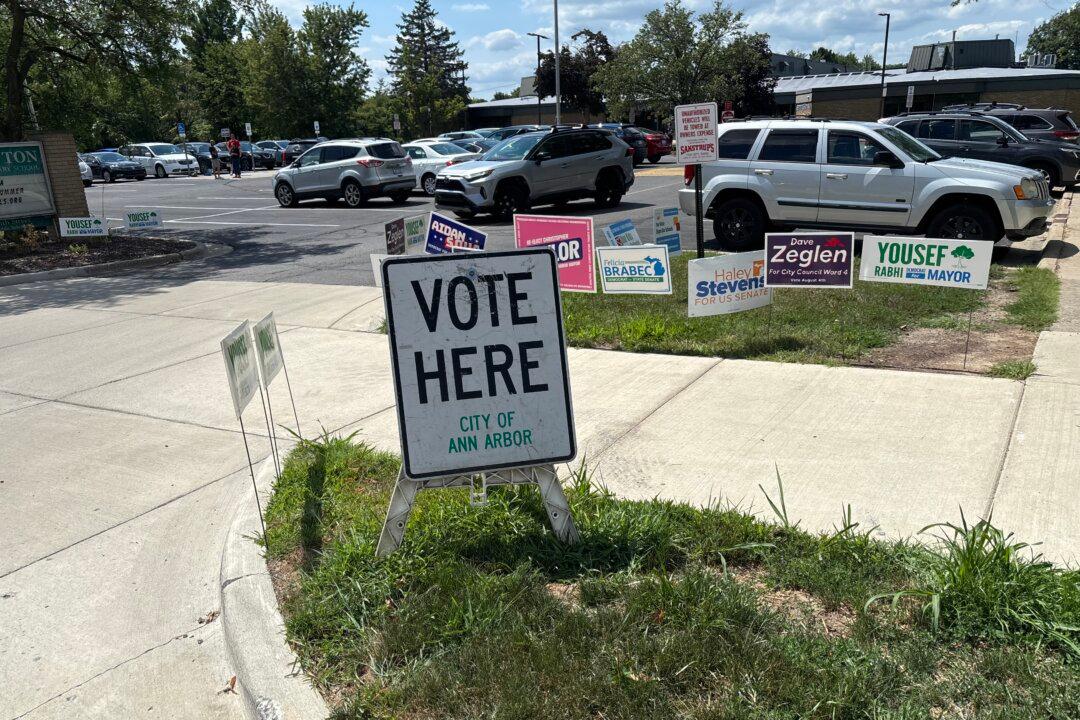
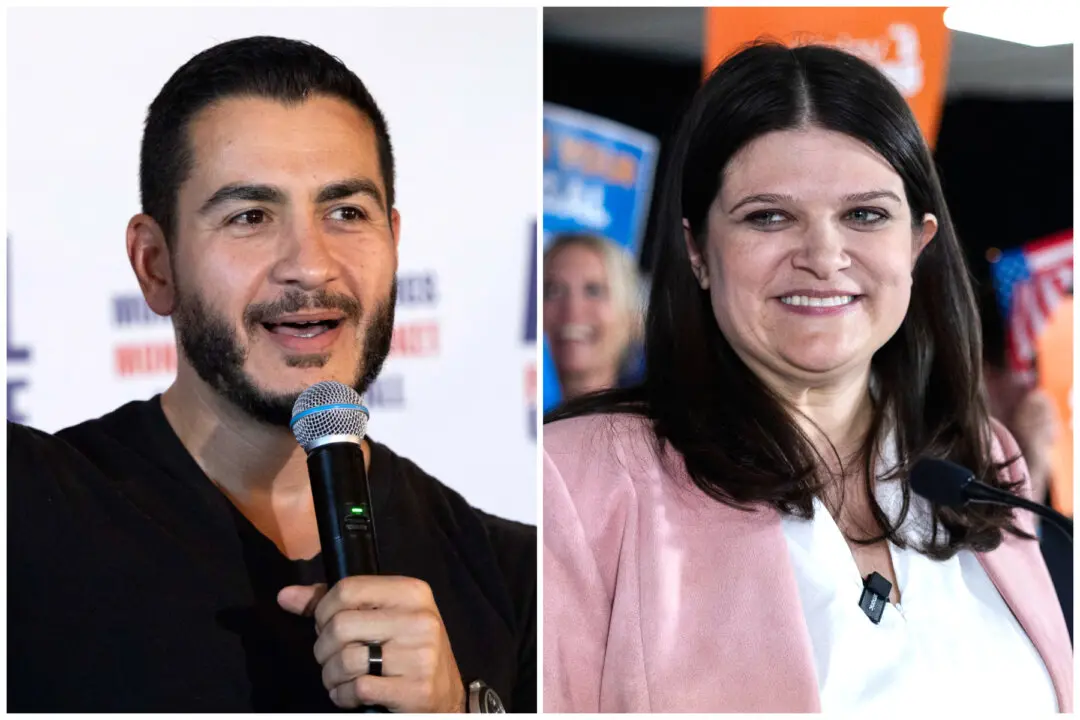
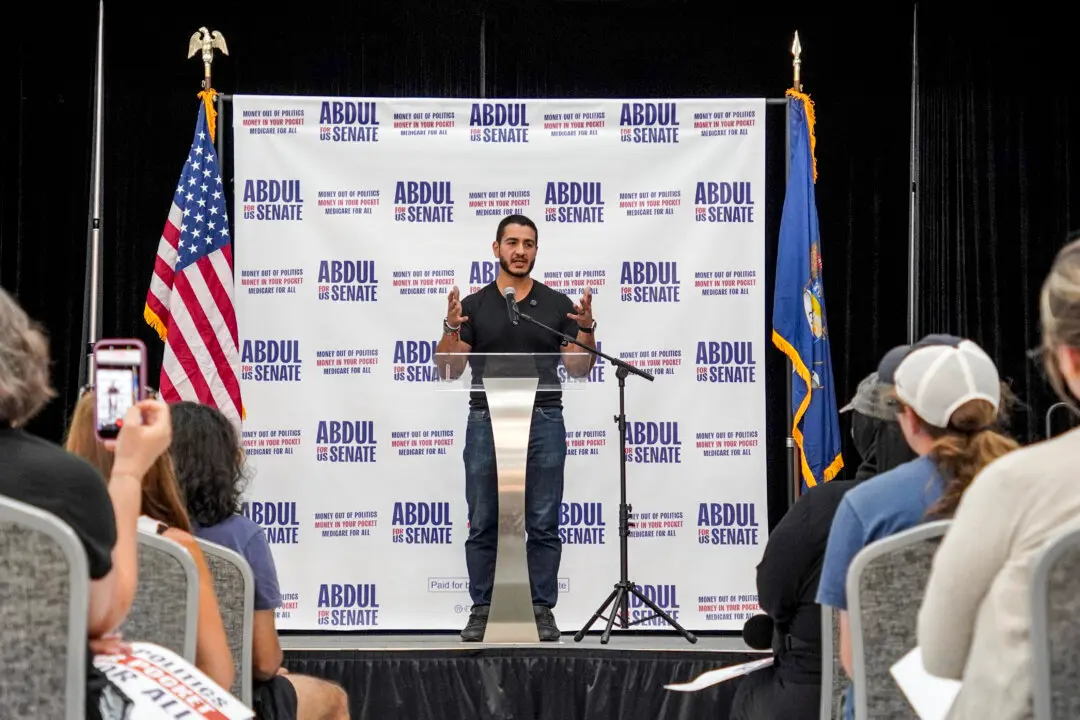
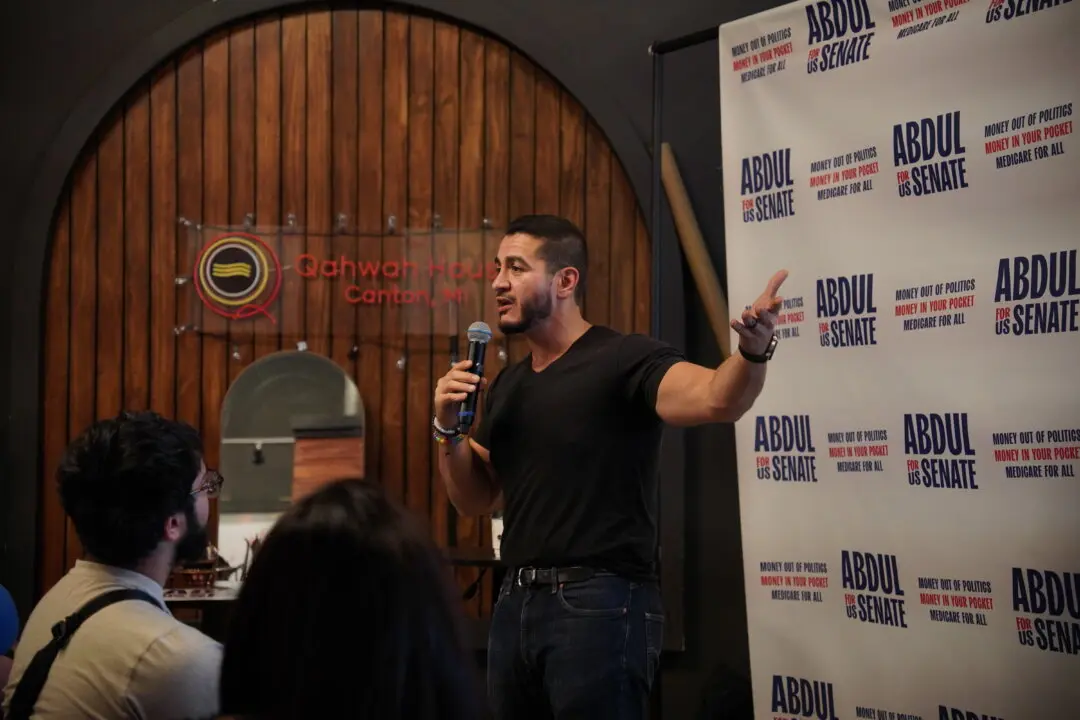
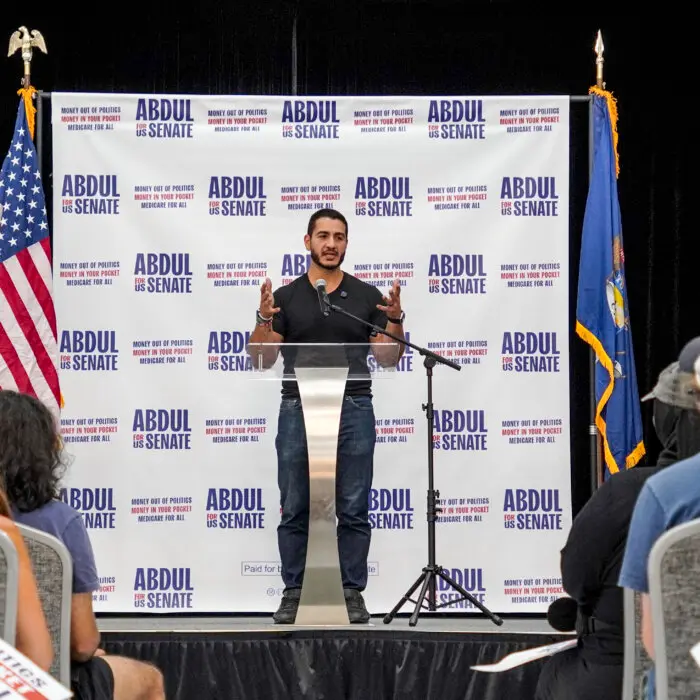
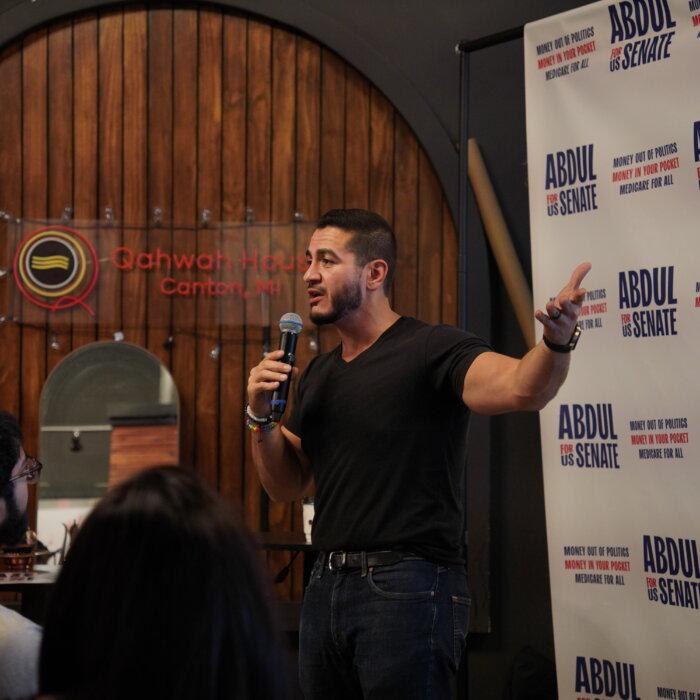
ANN ARBOR, Mich.—Progressive Abdul El-Sayed narrowly defeated establishment candidate Rep. Haley Stevens (D-Mich.) to win the Michigan Democratic Senate primary in a contentious race that became a proxy fight for the broader battle within the party over its direction.
El-Sayed beat Stevens 48.5 percent to 47.5 percent, with 99 percent of the votes tabulated. The Associated Press called the race at 9:54 a.m. ET on Aug. 5.
The progressive will take on Republican Mike Rogers in November in the race for Michigan’s battleground Senate seat.
El-Sayed faced more than $60 million in outside spending in support of Stevens, compared to around $4.6 million spent to support his campaign.
A number of progressive leaders, including Sens. Bernie Sanders (I-Vt.) and Elizabeth Warren (D-Mass.), and Reps. Alexandria Ocasio-Cortez (D-N.Y.), Rashida Tlaib (D-Mich.), and Ro Khanna (D-Calif.) endorsed El-Sayed ahead of the Aug. 4 primary.
Stevens received support from outgoing Sen. Gary Peters (D-Mich.), as well as Gov. Gretchen Whitmer (D), Senate Minority Leader Chuck Schumer (D-N.Y.), and Sens. Jeanne Shaheen (D-N.H.), Catherine Cortez Masto (D-Nev.), and Ruben Gallego (D-Ariz.).
A Rhodes Scholar and epidemiologist, El-Sayed was the director of the Wayne County Health Department from 2023 to 2025. He ran on a platform supporting Medicare for All, abolishing Immigration and Customs Enforcement (ICE) in favor of bringing back the Immigration and Naturalization Service (INS), passing a moratorium on U.S. data centers, and ending U.S. military support for Israel.
Stevens began her political career working on the 2008 Hillary Clinton presidential campaign, before pivoting to President Barack Obama’s campaign after he clinched the nomination that year. She then served as chief of staff for Obama’s auto rescue program—experience she championed throughout her campaign for Senate.
Running on a broadly liberal platform of lowering costs, rebuilding the auto industry, and bringing back manufacturing to Michigan, Stevens faced criticism from progressives like El-Sayed for defending continued U.S. military support of Israel and for accepting record financial support from the American Israel Public Affairs Committee (AIPAC) this year.
AIPAC and its associated groups—which supported Stevens’ successful primary battle against then-Rep. Andy Levin (D-Mich.) in 2022—had spent $30.6 million on the race by July 30, its largest election expenditure in history.
El-Sayed highlighted the record expenditures on the campaign trail over the past month, telling rallygoers that AIPAC was trying to “buy” the race away from Michiganders.
Asked about AIPAC’s ongoing financial support for her during a July 27 debate, Stevens said her support for Israel was more nuanced but didn’t address the record spending.
“I believe in a two-state solution. [El-Sayed] has attacked me for supporting that people in Palestine and Israel deserve to live side by side peacefully. And [Benjamin Netanyahu] has attacked me by name, and they both represent the extremes,” Stevens said.
“We pay more for all we have to buy. We pay less for the work we do. [We] watch as our tax dollars get misappropriated to drop bombs and buy tanks for foreign countries instead of building schools and healthcare for our own,” El-Sayed said.
Electability Argument
The closing argument of Stevens’ campaign was that she is more electable in a November matchup against Rogers, who lost to Sen. Elissa Slotkin (D-Mich.) by less than 20,000 votes in 2024, when President Donald Trump won Michigan.
In a flurry of text messages sent out in the twilight hours of the primary race, Stevens claimed she was the only Democrat who could defeat a Republican in purple Michigan.
The congresswoman seized on a July 28 Glengariff Group poll that measured hypothetical matchups of Stevens vs. Rogers and El-Sayed vs. Rogers.
That poll gave Stevens a 0.8-point advantage over Rogers, while by contrast, the Republican led El-Sayed by more than 10 percentage points.
“Poll after poll shows I’m the strongest Democrat to beat Mike Rogers. But MAGA Republicans and their billionaire donors are trying to boost my opponent to shut down our momentum,” Stevens wrote in a campaign text sent on Aug. 2.
However, a Mitchell Research poll released on July 31 found Rogers and El-Sayed tied in a hypothetical matchup, whereas Stevens trailed the Republican by 4 percentage points.
“Highly electable candidates don’t usually need $60 million to come in to help them get elected. That is a historical amount of money,” El-Sayed told The Epoch Times after his rally in Ypsilanti, Michigan, on July 30.
“If you can’t get elected without $60 million, you’re not electable,” he added.
Speaking to The Epoch Times from Ann Arbor’s Gallup Park one day before the race, multiple voters said they were backing El-Sayed.
“I think what I appreciate the most is like setting someone who is an epidemiologist into the U.S. Senate on behalf of Michigan because health care is probably the highest topic that we should be worried about,” Kristen Kolka, who lives in Scio Township and works in education, told The Epoch Times.
Retired National Guardsman Paul Tramp, who lives in Ypsilanti and works for Ford, also cast his ballot for El-Sayed.
However, Tramp, who said many in his circle found Stevens too tied into the political “mainstream,” said he thinks El-Sayed may struggle to appeal to a larger demographic in Michigan due to assumptions people may make about his name.
Speaking in Dearborn last Friday, El-Sayed said he felt for years that he was unelectable because of his name. But seeing President Donald Trump’s rise in American politics changed his mind.
“I said, ‘You know what? If that man can get elected, what the hell does electability really mean?’” El-Sayed told a crowd of hundreds at the Yemeni American Cultural Center.