Faith Fiorello dreaded the thought of classrooms during summer recess, but her interest in dollars and cents and a heavier piggy bank quickly took over.
The 11-year-old came home each day and bombarded her mother, Kimberly Fiorello, with questions: Did you know the money you deposited doesn’t stay at the neighborhood bank? Did you know it’s used to build local businesses nearby and improve our community? Do you know why certain products cost so much? I know how to negotiate now, but do you?
Faith, of course, was quick to provide detailed explanations on every topic, sharing what she learned during a two-week Middle School MBA program at her school in Chattanooga, Tennessee, and entering the sixth grade this month with visions of someday owning a business.
“I see money differently now,” Faith told The Epoch Times. “You don’t want to just spend it. You want to think about it. You have it for an amount of time. You learn how to value it more.”
John Rock Foster, who developed the Middle School MBA program, said his curriculum will be piloted at schools in the Oklahoma City area in the coming academic year, benefitting 400 students in sixth, seventh, and eighth grade.
If all goes well, he hopes to expand it and a similar program for high school students across the nation at the rate of 20,000 students annually.
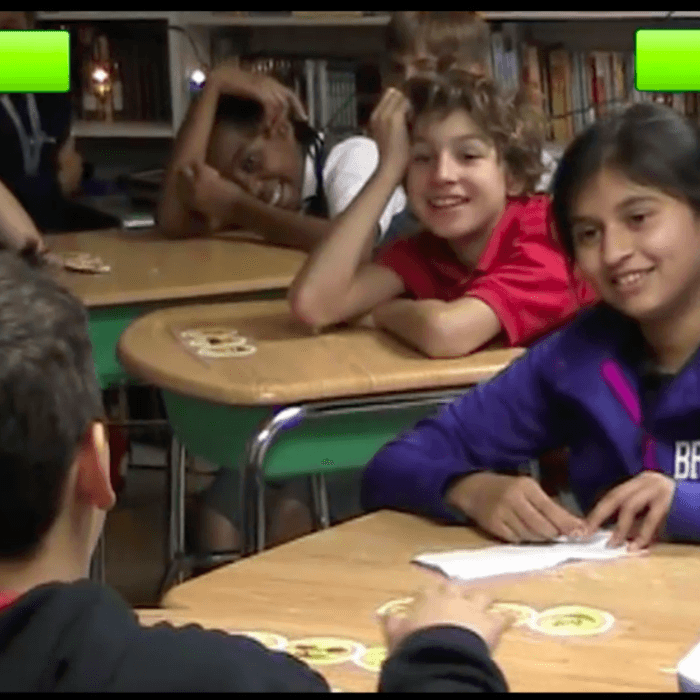
“We bring reality into the classroom,” Foster told The Epoch Times. “Basically, we show them how the world works.”
“Immediately, they become more serious about their schoolwork, and they behave like an adult,” he said.
The curriculum, focused on business economics, is modeled after graduate school degree programs but scaled down to the appropriate age group and packed into modules totaling 30 classroom hours, Foster said.
The website says, “From the classroom to the boardroom.”
The uniqueness and notoriety of this program, Foster added, are reflected in how readily it appears in ChatGPT queries.
Programs such as this, in combination with high school financial literacy instruction, which is mandated in some states, are necessary at a time when young people are more disconnected from basic economics, Foster said. A generation that always makes purchases with plastic or smartphones should be taught how to grasp concepts like cash flow, capital, and liquidity.
“When you teach kids how to read, you want them to be fluent, not just literate. It’s the same idea with this,” he said. “And it’s nonpartisan, as if we are teaching physics.”
Kimberly Fiorello is among them. She recalled a unit on managing household expenses during middle school home economics class and a few lessons about capitalism during social studies, but nothing like what her daughter experienced.
“They touch on so many different aspects in a storytelling way to explain economics,” she said. “You never know if one of them turns on a lightbulb, like when Faith was talking about how banks reinvest in their communities. It’s great that she was having this revelation.
“Teaching kids how value and wealth are created is important. Why not make kids realize that they play a role as a market participant?”