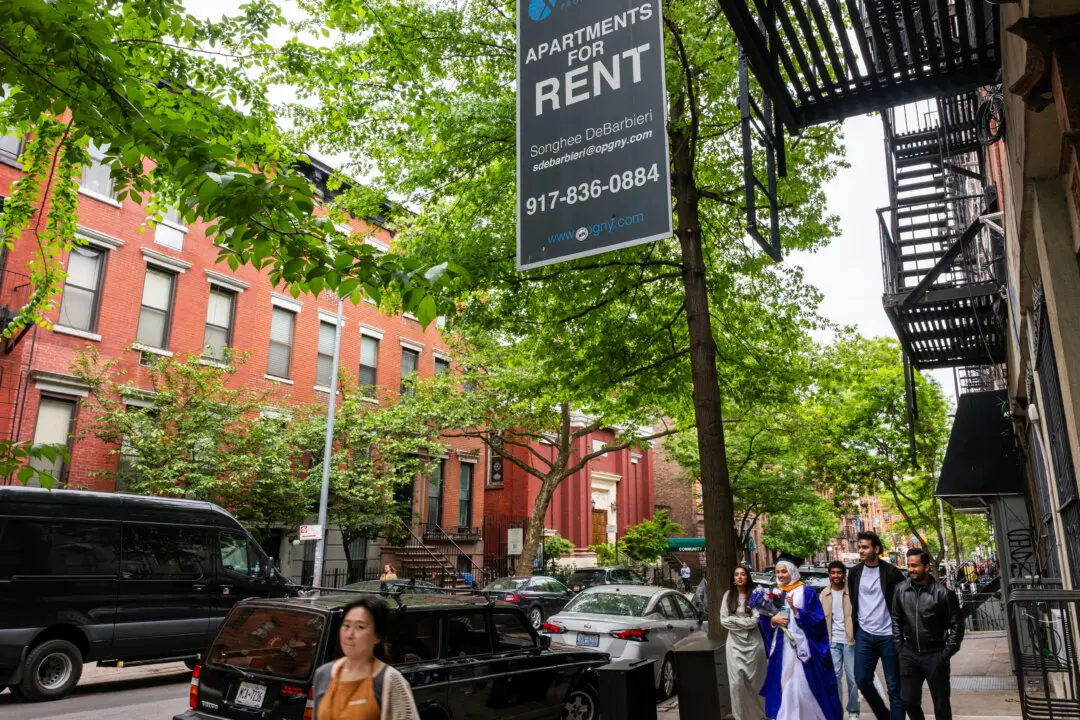
That translates to about one in nine people changing homes last year, down from one in three in the 1900s.
The report states that the homeownership rate was about 45 percent at the start of the twentieth century, compared with about 65 percent today.
The rising share of homeowners has had a profound effect on mobility rates, according to the report. Meanwhile, increasing home prices and a more volatile job market may also be keeping people in the same place.
“More people are reluctant to give up a home to try and find another one, especially if they secured lower mortgage rates during the pandemic,” the report states.
“With housing costs rising, economic uncertainty, more people working remotely, and many feeling settled where they are, fewer Americans are packing up and starting fresh somewhere new.”
Across the nation, New York and New Jersey had the lowest mobility rates, with fewer than 9 percent of residents changing addresses in 2024. Illinois, Connecticut, and Pennsylvania followed at about 9.5 percent.
“Either residents of New York and New Jersey are satisfied with their homes and communities and aren’t looking for a change, or they feel stuck and don’t really see other options out there, be it on a different street or in a different state,” the report says.
Alaska led the country with the highest mobility rate of 14 percent, followed by Colorado, Idaho and, North Dakota, all at more than 13 percent.
Among those who chose to move, one in five crossed state lines, and more than 71 percent relocated to a different city.
Wyoming and New Hampshire had the highest shares of newcomers from out of state, with more than 35 percent of movers settling there.
Housing affordability, milder climates, and job growth were cited as the top reasons people are flocking to those regions, according to the report.
The study also indicates that 61 percent of all movers nationwide are renters, with California and Texas claiming the top spots. More than 67 percent of those moving into these states were renting.
Among metropolitan areas, San Jose, California, ranked first for attracting out-of-state renters, at 90.8 percent, followed by Austin, Texas (88.9 percent), and Boston, Massachusetts (87.2 percent).
Other cities, such as Las Vegas, Nevada, and Mesa, Arizona, also drew large shares of out-of-state movers, with about 30 percent relocating there.
Renters typically have higher mobility than homeowners, due to lifestyle preferences, financial flexibility, and external housing factors. In addition, the report notes that renting usually offers more freedom to relocate at the end of a lease.
However, in Fort Worth, Texas, homeowners accounted for 53.3 percent of all incoming movers.
In its review of intrastate moves, the report notes that homeowners in New Hampshire, West Virginia, and Maine tended to move almost as often as renters, with both groups changing homes at least once in the past year.
The study suggests that the sluggish mobility rates could have an adverse effect on the economy by limiting labor market flexibility, slowing wage growth, and potentially reducing innovation as people are less likely to move for better job opportunities.