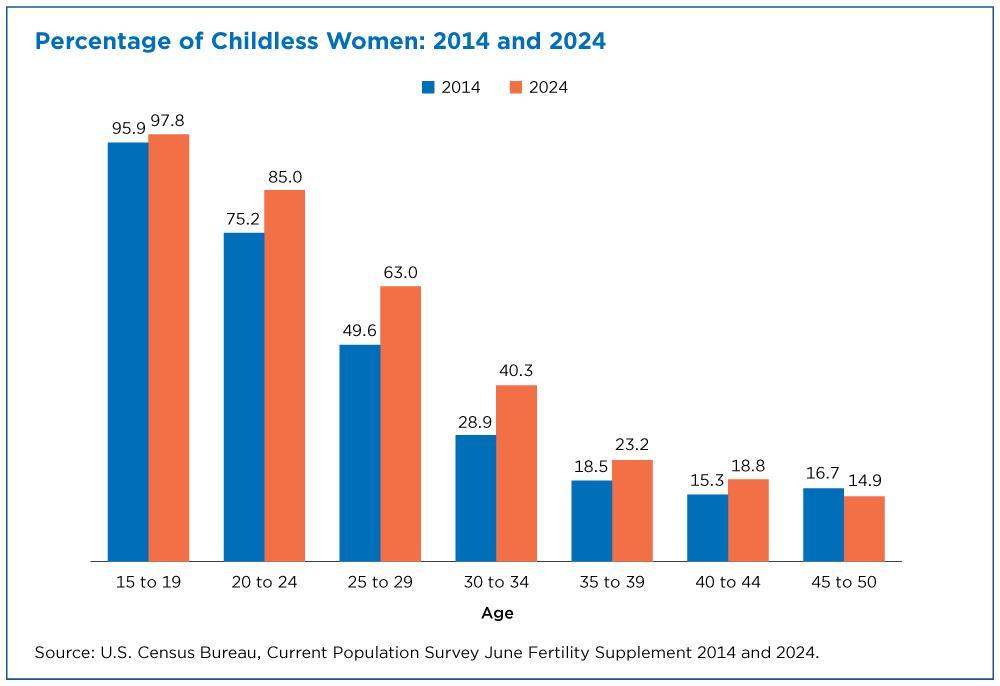
The report shows the share of childless women increased in almost every age group, with a dramatic rise among women in their twenties and early thirties.
In 2024, the percentage of childless women aged 20–24 jumped to 85 percent, up from 75 percent in 2014. Those aged 25–29 increased to 63 percent from 50 percent a decade ago.
Even women in their thirties and early forties chose to delay having children, as the census data show 40 percent of women from 30–34 were childless last year—a significant rise from 29 percent in 2014.
There were also fewer teen pregnancies in 2024, as 97.8 percent of females aged 15–19 remained childless, up from 95.9 percent in 2014.
The only group in which childlessness declined—indicating an increase in births—was women aged 45–50. In 2014, 16.7 percent of women in this age group were childless, compared with 14.9 percent last year.

According to the Census Bureau, this unexpected rise in births among women over 40 suggests that many may be waiting until they achieve their intended social and economic milestones before starting a family.
“Findings suggest that young adults today prioritize economic security over starting a family, reflecting the rising burden of housing, food, gas, and other costs,” the report states.
Samantha Trajkovski, a professor of economics at Saint Michael’s College in Vermont, told The Epoch Times that the drop in birth rates will eventually take its toll on the economy.
“This will have a big impact on Social Security in the next 20 to 30 years if we don’t find a solution,” she said. “It could mean cutting benefits to Social Security payments or raising taxes to cover the loss.”
She also noted that the birth rate has been falling for several years—not only in the United States but also worldwide.
Reasons for Delaying Birth
One of the main reasons she believes people are putting off starting families is the rising expense of housing, insurance, food, clothing, medicine, and childcare.“Affordable quality childcare is hard to find,” Trajkovski said. “In some cases, parents can pay upwards of $100 a day. That’s $500 a week, $2,000 a month, and a total of $24,000 a year.”
“Some people living in rural areas often find themselves on waiting lists for up to three years, due to the lack of available childcare,” Trajkovski said.
“Then women often have to decide whether it makes financial sense to go back to work.”
In addition, she said, the younger generations are now choosing to be more financially stable before settling down.
“If they enter the job market at 22 instead of 18, it’s going to take them longer to establish their careers and climb that ladder,” Trajkovski said.
“As a result, they’re now spending much more time to save for a home and children.”
Those who are waiting until 40 or later to have children may typically have only one child.
Economic Implications
As for a lower birth rate’s impact on America’s future workforce, Trajkovski believes that the labor market is very adaptive and will change to accommodate this.“For the past 20–30 years, we’ve been seeing a trend toward automation, and especially now with the introduction of AI technology, that trend will continue,” she noted.
“I think we’re going to see a shift in the types of jobs people are doing because technology can do things that we previously employed people to do.”
Wafa Hakim Orman, labor economist and associate dean at the University of Alabama Huntsville School of Business, agrees.
“It’s actually a double-edged sword,” she told The Epoch Times. “As AI continues to enter the workforce, fewer people in the future will mean fewer mass job losses,” she said.
“However, the downside is that creativity and innovation in the workplace often come from younger generations, and too few younger people could mean less creativity and slower economic growth.”
Orman believes that the U.S. workforce needs a combination of older, more experienced employees who can offer wisdom, plus innovative thinking from the younger sect.
“A lack of balance could create issues in the long run,” she said.
Relying more on AI also does not address shortages in fields where humans cannot be replaced, such as medical personnel, plumbers, electricians, builders, and service personnel like police and fire fighters, she said.
Concerning Social Security, Orman also agrees that benefits could be cut or that people will need to continue working well into their senior years.
“Because the current system is set up as ‘pay as you go,’ it will not be sustainable,” she said.
“The current Social Security system made sense in the 1930s, when life expectancy was much shorter and people had larger families to help with expenses.”
If there are no significant changes to the system, Orman noted, Social Security payments could run out.
According to Orman, the falling birth rate is not exclusive to the United States.
Changing Attitudes Toward Motherhood
“It may not be just about the cost of living, though. People in their 20s and 30s want to spend time exploring, traveling, and enjoying their lives, so they are delaying marriage and starting families,” Orman said.Expectations also have changed, she noted, as years ago people often thought of children as another pair of hands to help with work.
“But now, people want to invest in their children, giving them the best possible education and those costs have also accelerated,” Orman said.
“I think the answer to this issue can be found by looking at it from a broader prospective since its now a global phenomenon,” she said.
Even in Africa, where fertility rates were historically the highest, the birth rate has dropped from 6.5 to 4.0 between 1950 and 2025. Europe and North America currently have the world’s lowest fertility rates at 1.4 and 1.6 births per woman.
“By 2100, women under 25 will bear a much smaller share of births than women ages 25–34 in each region,” the report states. “And in every region except Africa, they will also account for a smaller share of births than women older than 34.”
The Pew Research Center found that some countries, including the United States, have been discussing incentives for couples to have children, including tax breaks, expanded parental leave, and more access to childcare.
In 2021, several European nations spent more than 3 percent of their gross domestic product (GDP) on family benefits, with Poland spending 3.6 percent and Iceland spending 3.8 percent of their respective GDPs.
The United States spent only about 1 percent of its GDP on these types of benefits in 2021, with most of that going toward services and tax breaks.