When the phone call came on June 30 notifying him that President Donald Trump had just signed a presidential permit authorizing his “little LLC from Texas” to build a cross-border pipeline in Montana to import Canadian oil, it was no surprise to Mike Dubuisson and his partners at Junction Pipeline Co.
“We weren’t surprised—we were shocked,” he told The Epoch Times, recalling the early morning call from Marcus Lee, policy adviser at the State Department’s Bureau of Energy Resources.
“When you get that kind of personal phone call, you get that kind of news, it brings a lot of history to the fore all at once.”
Murphy Oil built its Milk River pipeline, and, since 1970, it has been pushing crude south to refineries in Montana. That pipeline crosses the border under another permit with different easements than Johnson’s 1966 order.
Plains All American Pipeline purchased Murphy Oil’s “midstream assets” in 2001, which included the Milk River pipeline network and the latent 1966 presidential permit for a cross-border pipeline and roughly 30 miles of easements to Cut Bank, Montana.

In 2007, Junction Pipeline, based in Boerne (pronounced “Burney”), Texas, purchased the permit and easements from Plains All American as part of a deal that “included a basket of assets in multiple states,” according to Junction Executive Officer Brent Taber.
The easements and permit “provided for the import of oil across the border,” he told The Epoch Times. “And that was kind of our path to this.”
That path would be tangled in litigation, mercurial markets, and even more mercurial politics on both sides of the border.
“I’ll make this short to fast forward to where we are today,” Taber said, explaining rather than arguing with deep-pocket corporations in lawsuits about who owns what along downstream easements.
Junction Pipeline—“a private company of never more than seven or eight individuals”—took a different tack.
“We decided we will just apply for a new presidential permit because we were not high on the idea of litigating to affirm our rights,” he said.
“We started this thing in Trump’s first term, and by the time the State Department bureaucracy developed a protocol, it was three months before the election.”
Dubuisson, Junction’s vice president and manager, said the company was “told by a political operative after the election in 2020 that we could forget about the permit.”
“We just left it there,” he said.
And so it sat. When Trump was elected to a second term and returned to the White House in January, the State Department reached out to Junction to remind the company that it had a permit in limbo.
“I almost think it was found in a drawer or something,” Dubuisson said. “The way it was described was, ‘Someone in the White House noticed this permit.’”
Pipe Dreams
Junction’s presidential permit was one of three pipeline-related executive actions signed by Trump on June 30, but it was the only one authorizing a permittee to “construct” a new pipeline at “the international boundary between the United States and Canada.”The revised permits repeal the “harmful and shortsighted policies of the previous administration” and state that the two Canadian companies can operate under relaxed oversight authorized with executive actions, agency rule-making, and anticipated congressional legislation.
Most oil pipelines carry crude south, while most natural gas pipelines push natural gas north.
Cross-border pipelines have been authorized by presidential permits since the 1960s, when Johnson cited such international exchanges as an “inherent foreign affairs power” of the executive under Article 2 of the U.S. Constitution.
While a presidential permit is required for any cross-border pipeline, oil pipelines are regulated separately by a different federal agency than natural gas pipelines.
The State Department’s Bureau of Energy Resources permits crude oil border crossings, while the Federal Energy Regulatory Commission permits cross-border natural gas pipelines.
It’s uncertain if the revised cross-border presidential permits for South Bow and Steel Reef are the first in a slate of similar executive actions and if idling presidential permits issued years, even decades ago, will be dusted off and renewed.
Dubuisson said there are at least three other latent presidential permits for cross-border pipelines.
Taber said the permits address only the immediate border crossing area.
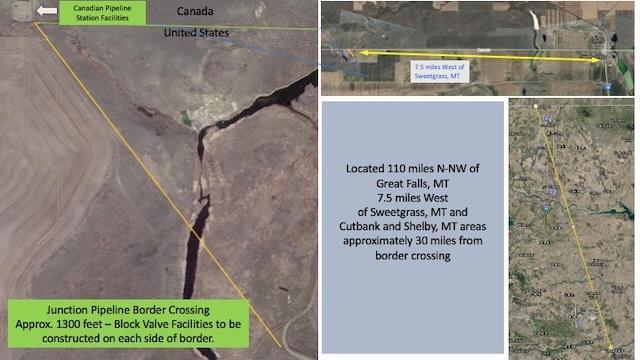
“There’s a very short piece of pipe attendant to our permit application that will be constructed, a 30-inch pipe,” he said.
“It goes from the Canadian side approximately about a quarter-mile onto the U.S. side [with] the infrastructure and associated facilities. That is the scope of that presidential permit.”
But Junction has plans, and easements, to go “30 plus-or-minus miles—all new line—from the border to Cut Bank, which has a major train station” and oil depot, according to Dubuisson.
Enduring Values
When Junction envisioned its downstream pipeline from the border crossing in 2007, “the West Coast was the ideal market,” Taber said.But that has changed with the completion of the significantly expanded Trans Mountain Pipeline network in Canada, linking Alberta’s sand oil fields to British Columbia ports on the Pacific coast. It became fully functional in May 2024.
Dubuisson said the “old easement” runs from the border near Shelby to Cut Bank, and from there, Junction can ship oil by rail to Great Falls, the closest refinery.
“These are things that can be done relatively quickly” and were a proposed “phase one,” he said.
From Great Falls, refined oil can be piped south via the 785-mile Express Pipeline that runs from Hardisty, Alberta, to Guernsey, Wyoming, near Casper.
That original phased plan drew interest from ExxonMobil and other oil companies, but Dubuisson said Junction is thinking bigger these days, perhaps “dropping [oil] in just one line” directly to refineries.
“This depends a little bit on our financial backing,” he said.
The “little LLC from Texas” has no capacity to build and operate a pipeline, just the presidential permit and easements to do so—a literal gold mine on plats and paper.
“We have no illusions that we are the company to actually build out a multibillion-dollar pipeline into the United States and south to serve all the markets that are available,” Taber said.
“We are in discussions with some major pipeline infrastructure companies on both sides of the border.
“We’re all just individuals from Texas,” he said, noting that many have “work relationships that go back decades.”
“We recognized the enduring value of these Plains’ assets, owning these perpetual easements, of having those land rights,” Taber said.
And the value of enduring relationships.
Taber and Dubuisson praised Lee, an energy policy adviser at the State Department since the Obama administration, and others who never lost track of their permit.
“Just for the record, our experience with the people in that [State Department] energy group has been very good over many years,” Dubuisson said.
“They stuck with us. They did their job; were always trying to get the job right. And it wasn’t a political thing. It was just, they’re professionals.”
That job became clearer when Trump ordered federal agencies to scour files and ferret through dusty corners of desk drawers to find idling energy projects and get them moving.
“Obviously, we’re very pleased with President Trump’s commitment to energy dominance, and his leadership is, no doubt, the defining factor in us receiving this permit,” Taber said.
“The critical catalytic event for our story is President Trump’s executive order on the permit.”
But it was Lee who reached out in February to ask if Junction was still interested in pursuing its presidential permit.
“We were floored when he told us they had the permit up there,” Dubuisson said. “We were triply floored when he told us the president had actually signed it.”