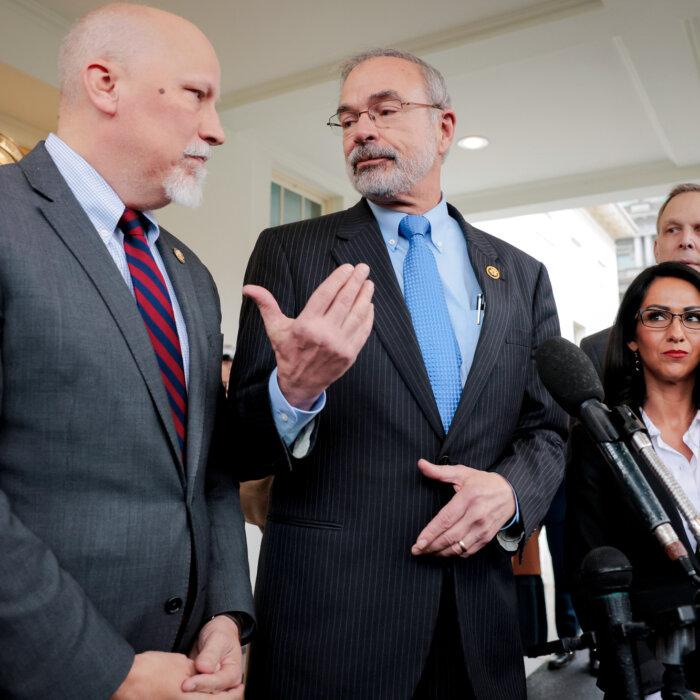
WASHINGTON—With the deadline to fund the government now less than a month away, members of the conservative House Freedom Caucus laid out their chief aims on spending following a policy summit.
The caucus chairman, Rep. Andy Harris (R-Md.), told The Epoch Times on Sept. 5 that their goal was to ensure that “we do not increase funding over fiscal year 2024 levels.”
“We could achieve huge 10-year savings just by level funding,” he added.
In March, Congress passed a continuing resolution to fund the government through September, the end of fiscal 2025.
On Sept. 3, Senate Minority Leader Chuck Schumer (D-N.Y.) warned that a government shutdown could be looming. He said Congressional Republicans have not been responsive to requests to cooperate with Democrats on spending.
“Time is short,” he said.
With Congress’s summer recess in the rearview mirror, Harris and other Freedom Caucus members gathered at D.C.’s Willard Hotel to mark the group’s 10 years of existence and discuss policy.
The summit was held by the Freedom Caucus Foundation, a nonprofit that is independent from caucus members.
House Speaker Mike Johnson (R-La.), who does not belong to the caucus, addressed the summit on Sept. 4.
So did Russ Vought, director of the White House’s Office of Management and Budget (OMB) and a key force behind executive-branch cuts often backed by fiscal hawks such as those in the caucus.
Vought’s deputy, former Rep. Dan Bishop (R-N.C.), also spoke. Bishop belonged to the caucus while in the legislative branch.
So far, the House has not made such sweeping cuts through appropriations.
For example, while the White House requested $45.1 billion for the Department of Energy, a $4.7 billion drop from the previous fiscal year, the bill that advanced through the House on Sept. 4 gives it $48.8 billion.
Harris noted Vought’s support for deeper spending reductions but said that such moves might run afoul of the Senate.
Unlike the One Big Beautiful Bill Act, which was passed in July through the reconciliation process, appropriations packages can be filibustered if they do not reach a 60-vote threshold in the Senate. Republicans control 53 seats in that chamber.
Rep. Andrew Clyde (R-Ga.), another caucus member, told The Epoch Times that the caucus would prefer to spend at Trump’s level but that “Republicans, unfortunately, are not going to all agree to that.”
He said his group “can’t be, ‘no, no, no, no, no,’ on everything.”
“If we don’t pass legislation, we won’t be able to govern,” Clyde said.
He said the Senate could prove an obstacle to any attempts to codify cuts identified by the Department of Government Efficiency, or DOGE.
Clyde sounded more optimistic about spending levels that could be achieved through a second reconciliation bill, a possibility Republican leadership has floated and that is now meeting growing skepticism.
Freedom Caucus in Flux
The caucus summit comes as multiple members make their way to the exits.“We do have to replace some heavy hitters,” Rep. Keith Self (R-Texas) told The Epoch Times on the sidelines.
He named Reps. Ralph Norman (R-S.C.), Chip Roy (R-Texas), and Andy Biggs (R-Ariz.).
All three announced they will not run for reelection in 2026 as they seek higher office. Norman is running for Senate in South Carolina, Roy is seeking the attorney general position in Texas, and Biggs is running for governor of Arizona.
Rep. Byron Donalds (R-Fla.) is also not seeking reelection as he vies to serve as the governor of Florida.
Johnson’s appearance at the event might suggest the caucus, once a marginal force in the House, has made a lasting peace with leadership.
Caucus members played a key role in the ouster of former House Speaker Kevin McCarthy.
Yet, Clyde did not rule out the possibility of a future effort to replace Johnson—at least at the beginning of the next Congress, when the House elects its new speaker.
“We’ll see how Mike Johnson does,” he said. “He’s definitely the most conservative speaker we’ve ever had, at least that I know of. I would prefer that we just back him up and keep him as conservative as possible.”