


The House of Representatives is set to consider a bill this week that would limit stock trading by members of Congress and their families.
It’s the latest of many such proposals, and it faces uncertain prospects in the Senate.
Introduced by Rep. Bryan Steil (R-Wis.), the Stop Insider Trading Act would not prohibit them or family members from selling existing stocks.
Here’s what to know about the bill and the debate surrounding it.
What the Bill Would Do
The Stop Insider Trading Act would prohibit members of Congress, their spouses, and their children from purchasing new individual, publicly traded stocks. It would not apply to stocks they currently hold.

A member would file a public notice of intent to sell with the clerk of the House of Representatives or the secretary of the Senate, depending on what chamber he or she serves in, between seven and 14 days before a member of Congress, their spouse, or dependent sells a covered investment.
The bill applies to investments such as a security issued by a publicly traded company. It would not include an interest in a widely held investment fund or certain investments held in a trust.
The clerk or secretary would be required to publish this notice online. The notice would be withdrawn if the individual decides he or she no longer wants to sell the covered investment.
Trading stocks would result in a fee and, in the event of a purchase, require the covered investment to be sold. The fee would be required to equal the greater of $2,000 or 10 percent of the transaction value, and any net gain realized from the transaction during a specified period.
The fees, which would be deposited in the general fund of the Treasury, could not be covered from a member’s representational allowance or the senator’s official personnel and office expense account. A representational allowance is a budget provided to House members to operate their offices and cover salaries and other expenses.
There are exceptions for spouses and dependents, such as making a stock trade on behalf of another individual.
Democratic Resistance
Democrats appear to be opposed to the Stop Insider Trading Act.
Rep. Joe Morelle (D-N.Y.) in January criticized the bill as insufficient with loopholes because it would allow lawmakers and others covered under the bill to keep stocks they already have and allow them to use dividends to purchase further shares and permit spouses or dependents to trade on their behalf.
Rep. Pramila Jayapal (D-Wash.) told The Epoch Times that the legislation was weak and wouldn’t actually stop trading.
“I think this is an attempt to say that they did something, but it allows members to continue to hold stocks,” she said. “It allows members to continue to sell stocks. It doesn’t prevent any of the conflicts of interest that we’ve seen, any of the insider trading that we’ve seen.”
In a joint statement on Jan. 12, Jayapal and Reps. Seth Magaziner (D-R.I.) and Alexandria Ocasio-Cortez (D-N.Y.) said: “While this bill prohibits members from buying new stocks, it does nothing to remove the conflict of interest that arises from owning or selling existing stocks.
“Members can still act on legislation, investigations, and briefings that directly influence the value of their stocks for personal benefit.”
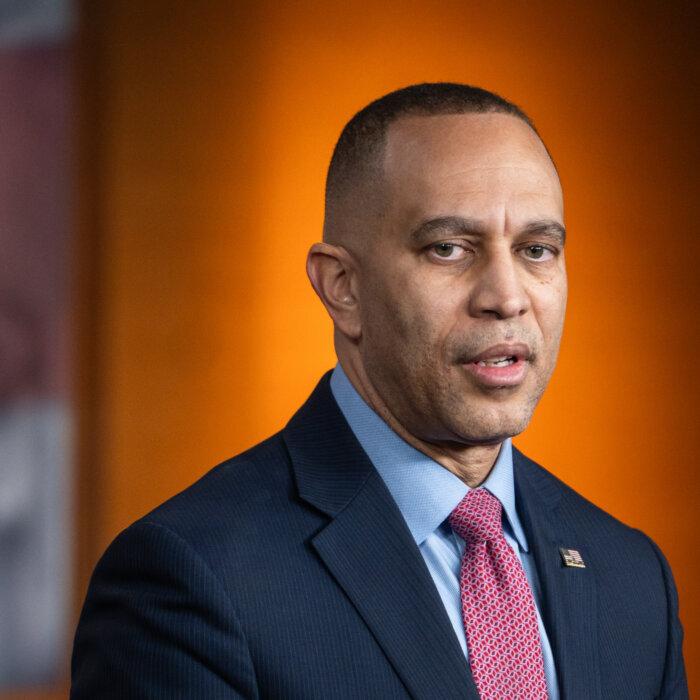
“If Republicans were serious about cleaning up corruption in this town, they would start at 1600 Pennsylvania Avenue,” Jeffries said at a press conference on July 16, when asked how Democrats would answer Republicans who could use the vote against them in the midterm elections.
The Epoch Times has reached out to the White House to ask if President Donald Trump would sign the Stop Insider Trading Act.
Uphill Battle
House Speaker Mike Johnson (R-La.) has given his stamp of approval to the legislation.
Even if the bill passes the House, it would have an uphill climb in the Senate, where 60 votes are needed to overcome a filibuster. Republicans currently have 53 Senate seats.
Rep. Chip Roy (R-Texas) told reporters that “this is a giant step forward.”
“I would rather it be a little bit stronger, but it’s a good bill, good step forward that I’m proud to support, and I'll vote for [it],” he said.
Rep. Anna Paulina Luna (R-Fla.) posted on X on Jan. 12: “This is a win, but it should be noted that this would not have happened if individual members, both Democrats and Republicans, had not stepped forward to call this out on both sides.”
Rep. Kevin Kiley (I-Calif.), who caucuses with Republicans, told The Epoch Times that the measure is “a good first step.”
“I think that the vast majority of Americans support stopping members of Congress from trading stocks,” he added.
Congress is also considering other proposals to limit stock trading, such as The Restore Trust in Congress Act, sponsored by Reps. Seth Magaziner (D-R.I.) and Roy.
It has not gotten momentum or the support of House GOP leadership. The act would prohibit owning and trading stocks by members of Congress, their spouses, and dependent children. It would require divestment within a certain amount of time after taking office.
Luna has put forth a discharge petition to get a vote on the End Congressional Stock Trading Act, sponsored by Rep. Tim Burchett (R-Tenn.). It would forbid stock trading and ownership by members of Congress and their spouses and dependent children.
However, it has the support of just 84 members—well behind the 218 signatures needed to force a House floor vote.
The Public Service Accountability Act, sponsored by Reps. Maggie Goodlander (D-N.H.) and Brian Fitzpatrick (R-Pa.), would apply not only to members of Congress and their spouses and dependent children, but also to the president, vice president, and Supreme Court justices.
It would prohibit them from trading individual stocks and engaging in prediction markets related to government and politics.