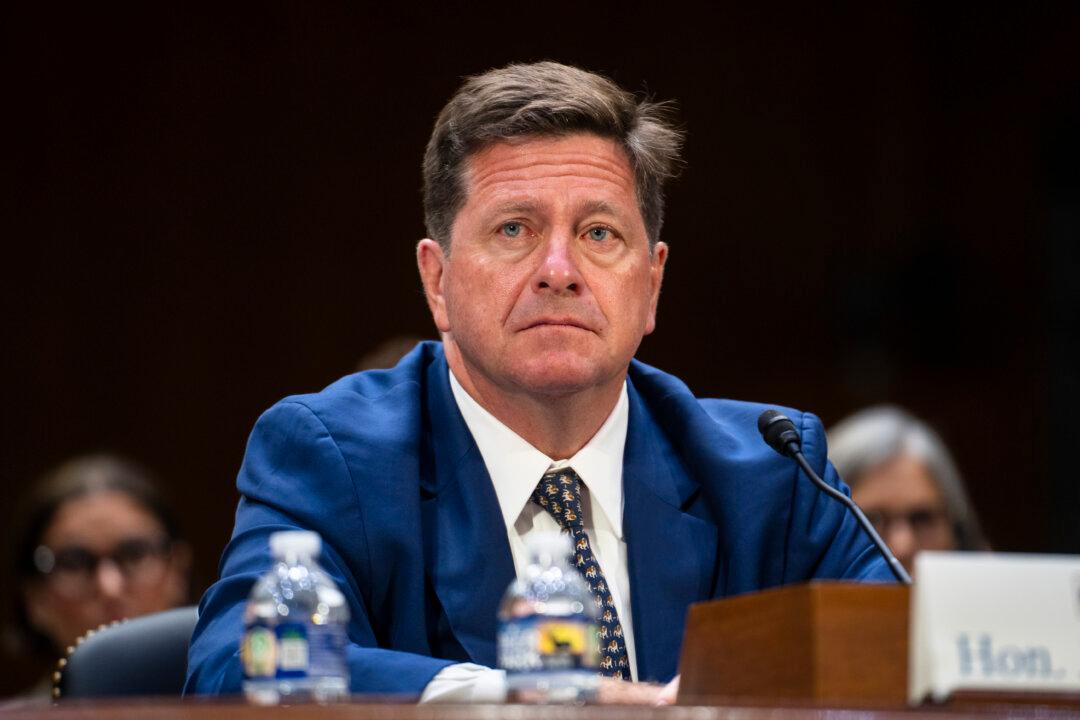
U.S. Attorney Jay Clayton shared his vision for the Intelligence Community during his confirmation hearing for the position of director of national intelligence (DNI) on July 15.
Clayton, who was nominated last month by President Donald Trump, faced questions from lawmakers regarding the independence of the DNI and key national security issues facing the United States.
Trump canceled the initial DNI confirmation hearing after accusing Democrats of breaking an agreement to remove acting DNI Bill Pulte, who was appointed last month, in return for the approval of a Foreign Intelligence Surveillance Act (FISA) extension.
Here are some key takeaways from the hearing.

Mission Objectives
As part of his testimony before the Senate Intelligence Committee, Clayton emphasized that he would work to increase the American public’s trust in the DNI office, the Intelligence Community, and the federal government.
He said the DNI office’s mission is to ensure that the president, Congress, policymakers, and military leaders are provided the “best possible intelligence in a timely, objective, and independent manner.”
“If confirmed, I will work to strengthen the coordination and communication between the Intelligence Community and the people we serve,” he said.
Clayton told the Senate Intelligence Committee that he would approach the role Trump nominated him for with a “mission-focused” and “team-oriented” perspective.
He said he would work with the committee members to develop the Intelligence Community’s commitment to its mission, strategic objectives that advance its mission, and metrics that help assess and improve its operations.
Journalists Subpoenaed
During the July 15 hearing, Sen. Ron Wyden (D-Ore.) questioned Clayton regarding the Southern District of New York’s recent decision to subpoena journalists at The New York Times.
The journalists were subpoenaed by the Southern District of New York, which he currently leads as U.S. attorney, after reporting on concerns regarding the safety of the president’s new Air Force One aircraft.
While Wyden suggested that the subpoenas represented a “flagrant attack on journalists,” Clayton testified that he is “absolutely committed to” and respects both the First Amendment and the role of the press.
He said he could not discuss the specifics of the investigation at the public hearing as it remains ongoing.
Sen. Kirsten Gillibrand (D-N.Y.) said the subpoenas appeared to have been issued in a “quite aggressive way” since they were issued to the journalists at their homes instead of their place of business.
Sen. Michael Bennet (D-Colo.) questioned how quickly the subpoenas were issued and whether Clayton or anyone from his office consulted with the White House or the Department of Justice beforehand.
Clayton repeatedly said the Southern District of New York’s office followed its protocols, which include consulting the Department of Justice, and said the time frames for issuing subpoenas depend on facts and circumstances.
“I’m confident that the procedures that we have in place to protect the First Amendment and protect the freedom of the press and not result in intimidation of journalists or the like were followed,” he said.
Election Integrity
Clayton was pressed multiple times by the committee’s Democratic senators throughout the hearing to give his views on the 2020 presidential election and the security of U.S. elections.
In response to Sen. Mark Warner (D-Va.), the top Democrat on the Senate Intelligence Committee, asking whether former President Joe Biden won the 2020 election, Clayton confirmed he was not an “election denier.”
“Joe Biden was certified as the president of the United States,” he said. “Let me just be clear. We have substantial work to do ... in improving our electoral processes.”
Clayton emphasized that one of the responsibilities of the DNI role was dealing with foreign interference in U.S. elections, something he said he was “gravely concerned about.”
Asked about his prior criticisms of U.S. election integrity, Clayton said the United States can take steps to improve ballot access while strengthening election integrity.
“I’m a big believer that we can have better access than we’ve ever had before and better integrity than we’ve ever had before,” he said.
Top Threats
After being questioned about the 2020 election, Sen. Mark Kelly (D-Ariz.) asked Clayton to share his view of the top threats currently facing the United States.
Clayton suggested that the top threats include terrorism, drug trafficking, cartels, and traditional U.S. adversaries.
Trump’s DNI nominee said the United States currently faces terrorism threats from many sources.
Clayton also warned that drug trafficking and fentanyl deaths presented an “incredible threat.”
However, he said the United States has “done a good job” of reducing the danger.
While Clayton did not list specific countries, he said the combination of cartels, militaries, and businesses in certain countries was very dangerous.
He also said Russia, China, and Iran remained threats to the United States.
Clayton said his experience as the head of the Securities and Exchange Commission would allow him to be “extremely helpful” in understanding and using economic strategies against traditional U.S. adversaries.
He told the committee that some of the “most formidable threat actors” are the countries that are the most well-funded.
Clayton suggested that U.S. adversaries not only look for “traditional ways” to harm Americans but also for economic ways to harm Americans.
He said the Intelligence Community should provide an understanding of the economic consequences of various actions.
Artificial Intelligence
Clayton said the expansion of artificial intelligence (AI) has led to an increased need for oversight and controls to protect the American public.
Sen. Mike Rounds (R-S.D.) described AI as a “game changer” and warned that Americans could view the technology as a threat, especially if the government used it to collect personal data.
He asked Clayton how the Intelligence Community would use AI to gather information while also protecting the privacy of U.S. citizens under his leadership.
If confirmed, Clayton said that the Intelligence Community would continue to collect necessary data to provide “a good intelligence product” while respecting Americans’ Fourth Amendment privacy rights.
“AI is going to greatly amplify that collection ability, which amplifies the need for oversight and controls to protect our citizens,” he said. “I think we should just recognize that that’s the case.”
Sen. Tom Cotton (R-Ark.), the committee’s chairman, told lawmakers he planned to hold a committee business meeting early next week to vote on Clayton’s nomination before sending it to the Senate floor for a final vote.