The firm claims that the interest rate-setting Federal Open Market Committee (FOMC) meetings, which are closed to the public, violate a 49-year-old federal transparency law.
The Government in Sunshine Act was established in 1976, following the Watergate scandal, to promote transparency in federal decision-making. While the law contains several exemptions, Azoria said the central bank’s “decades-long policy of blanket secrecy is unlawful.”
Fishback and his firm are concerned that the Powell-led central bank is keeping interest rates too high. He argues that this policy seeks “to undermine President Donald J Trump and his economic agenda, to the detriment of American citizens and to our economy.”
The lawsuit further argues that because the Fed is not facing public scrutiny, it is “deliberately undermining the public accountability envisioned by Congress.” In addition, it claims that if firms such as Azoria do not have real-time access to FOMC discussions, it “cannot fully consider and protect itself against Federal Reserve policy shifts that can create volatility.”
Should the July 29–July 30 closed-door meeting proceed as usual, “it will unlawfully deprive Azoria and the American public of timely access to deliberations that may reveal improper political motives behind the FOMC’s decisions,” the document states.
If the District of Columbia court rejects the emergency request, Fishback noted, an appeal would be submitted to the U.S. Court of Appeals for the D.C. Circuit, or if that fails, Azoria will seek intervention from the U.S. Supreme Court.
In addition to Powell, the other FOMC members listed in the court documents are Michael Barr, Michelle Bowman, Susan Collins, Lisa Cook, Austan Goolsbee, Philip Jefferson, Adriana Kugler, Alberto Musalem, Jeffrey Schmid, Christopher Waller, and John Williams.
White House, Federal Reserve Spat
The president and senior administration officials have ratcheted up their pressure campaign to encourage Powell and his colleagues to lower interest rates.The Fed has left the benchmark federal funds rate—a key interest rate that influences business, consumer, and government borrowing costs, and can impact Treasury yields—unchanged in a range of 4.25 percent to 4.5 percent since January.
Powell and his colleagues have been apprehensive about restarting the Fed’s easing cycle over concerns that the president’s changes to trade policy will reignite inflationary pressures.
“We do expect ... tariff inflation to show up more,” Powell told the House Financial Services Committee during June’s semi-annual monetary policy report.
“But I want to be honest—we really don’t know how much of that’s going to be passed through to the consumers. We just don’t know. And we won’t know until we see it. It could be lower than we expect; it could be higher. We have to wait and see, which is kind of what we’re doing.”
President Donald Trump and the White House have repeatedly stated that tariffs are not causing increases in consumer prices.
“Goods and imported goods prices started to diverge toward the end of 2023, and have continued since,” the report stated. “Importantly, there is no clear trend break so far this year. This analysis suggests that tariffs have not reduced the disinflationary impulse from imported goods as of May.”
In June, the consumer price index rose by 0.3 percent, the producer price index was unchanged at zero percent, and import prices ticked up 0.1 percent. The PCE price index, which will be released next week, is projected to have climbed by 0.3 percent.
Despite his ongoing criticisms of Powell, the president has reaffirmed that he will not fire the central bank chief. Powell’s term ends in May 2026.
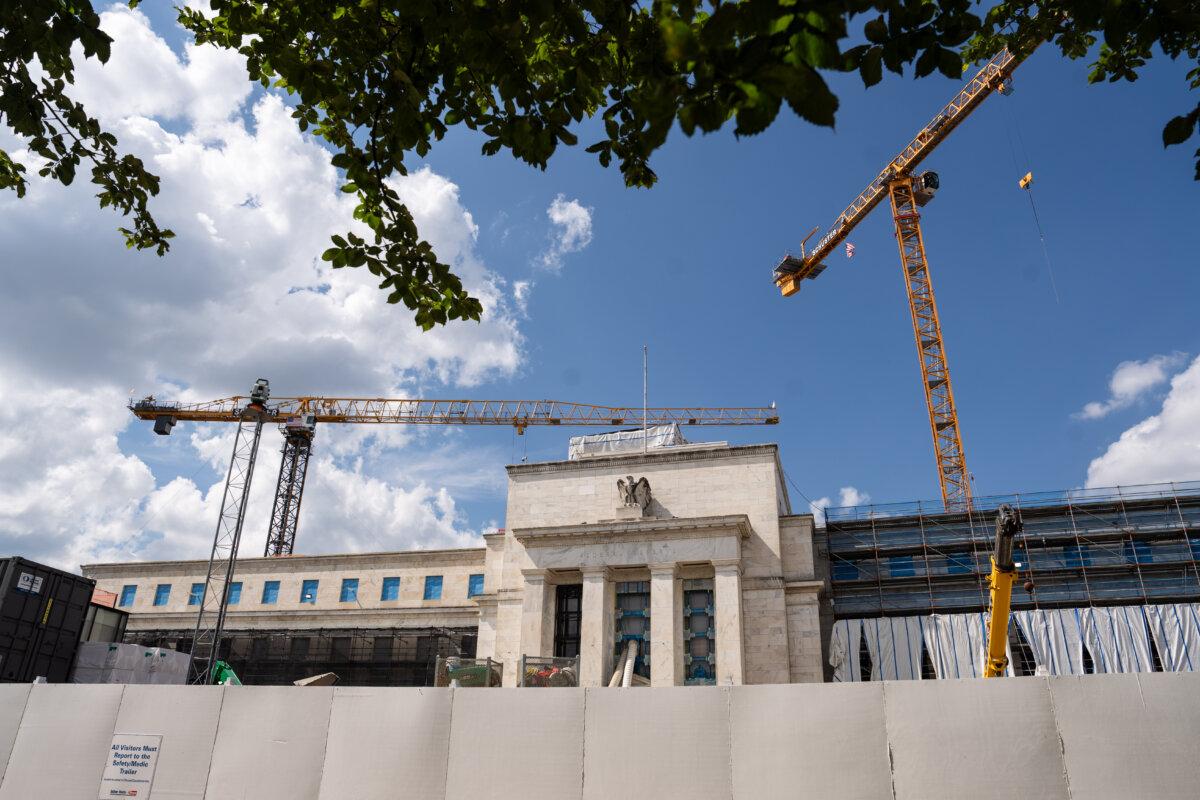
Trump visited the Federal Reserve’s construction site on July 24 and briefly met with Powell. The president estimated that the cost of renovations to the central bank’s headquarters is $3.1 billion, up from $2.5 billion.
Powell disagreed, telling Trump that the revised number includes the cost of a third building that was completed five years ago. “It’s not new,” the Fed chief said.
“So we’re going to take a look,” Trump responded. “We’re going to see what’s happening, and it’s got a long way [to go].”
Russ Vought, director of the Office of Management and Budget, said in a July 10 statement on X that the Fed head “has grossly mismanaged the Fed.”
“Instead of attempting to right the Fed’s fiscal ship, you have plowed ahead with an ostentatious overhaul of your Washington, D.C., headquarters,” Vought said.
Powell and other Fed officials defended the size and scope of the renovation and its costs, pointing to the fact that the headquarters was constructed in the 1930s.
The Federal Reserve declined to comment on the lawsuit.