U.S. Defense Secretary Pete Hegseth said on June 5 that he was confident NATO members would sign up to Washington’s demand to increase defense spending across the alliance to 5 percent of gross domestic product (GDP).
“To be an alliance, you’ve got to be more than flags. You’ve got to be formations. You’ve got to be more than conferences,” Hegseth said as he arrived at a meeting of NATO defense ministers in Brussels.
“We’re here to continue the work that President Trump started, which is a commitment to 5 percent defense spending across this alliance, which we think will happen. It has to happen by the summit at The Hague later this month.”
Defense ministers are gathering in the Belgian capital for talks, three weeks before NATO heads of state and government, including U.S. President Donald Trump, are set to meet in The Hague, Netherlands.
That will be the first meeting of alliance leaders since a changing of the guard in several key positions, with a new U.S. president, British prime minister, German chancellor, Canadian prime minister, and NATO secretary-general all in place since they last gathered in Vilnius, Lithuania, in 2023.
On June 4, NATO Secretary-General Mark Rutte said that the military alliance needs to go further and faster in its efforts to increase defense spending.
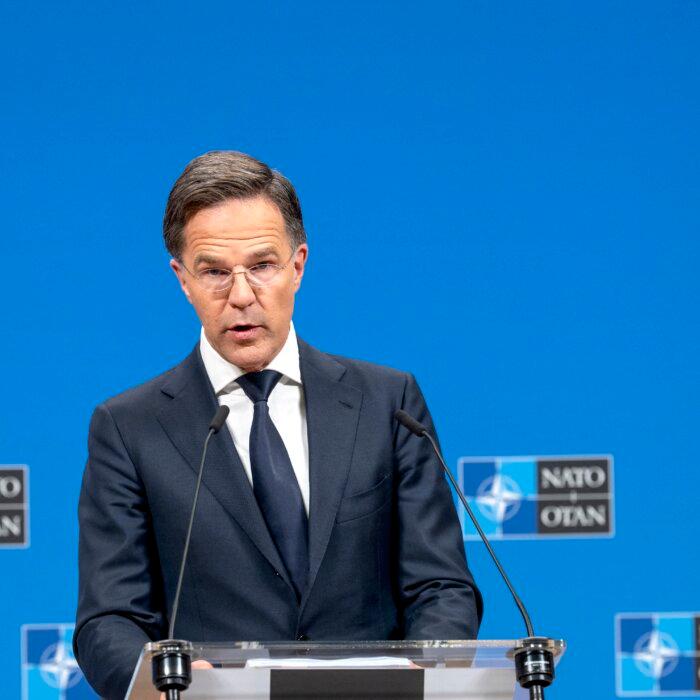
Rutte has proposed that members increase defense spending to 3.5 percent of GDP and commit a further 1.5 percent to broader security-related spending. He said he expects allies to agree on June 5 to what he called “historic” new capability targets.
The targets—which define how many troops and weapons and how much ammunition a country must provide to NATO—aim to better balance defense contributions among Europe, Canada, and the United States and “make NATO a stronger, fairer and a more lethal alliance,” he said during opening remarks at the meeting.
Hegseth’s absence from a meeting of the Ukraine Defense Contact Group on June 4—the first time since the conflict in Ukraine began that a U.S. defense secretary has missed the meeting—sparked questions from reporters.
Rutte attempted to allay concerns that this indicated a lack of interest in the conflict on Washington’s part, telling reporters on June 5 that he was not disappointed by Hegseth’s absence.
Member states remain divided over the timeline for reaching the proposed new spending target of 5 percent.
Rutte proposed reaching it by 2032, but some Eastern European nations consider that timeframe too long, while others located farther away from the Russian border regard it as too swift, given current spending, industrial production levels, and the state of their economies.
“Are we going to gather here again and say, ‘OK, we failed a bit,’ and then maybe we start learning Russian?” Lithuanian Defense Minister Dovile Sakaliene said.
Estonian Defence Minister Hanno Pevkur said: “We need to agree on the 5 percent in five years. We don’t have time for 10 years, we don’t have time even for seven years.”
Swedish Defense Minister Pal Jonson also warned that the situation could quickly change.
“We also know after an armistice or a peace agreement, of course, Russia is going to allocate more forces closer to our vicinity,“ Jonson said. ”Therefore, it’s extremely important that the alliance use these couple of years now when Russia is still limited by its force posture in and around Ukraine.”