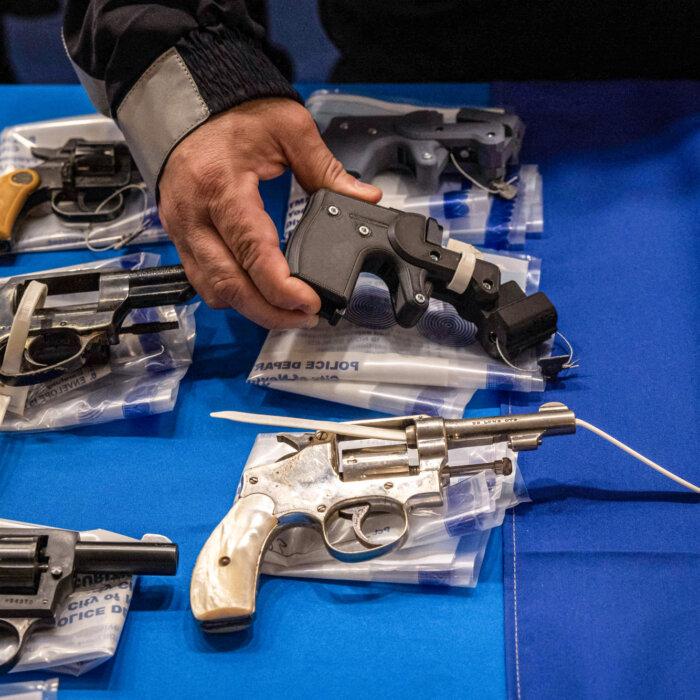
So-called ghost guns do not require a serial number under Minnesota law, the state’s Supreme Court concluded in an Aug. 6 decision.
The law prohibits people from receiving or possessing “a firearm that is not identified by a serial number.”
Under federal law, serial numbers are not required for privately made firearms if the maker does not make guns for a job or profit.
A Minnesota district court dismissed the charges against Vagle, finding that the law was unconstitutionally vague as applied to him. A state appeals court reversed the decision, determining that the law “plainly applies to any firearm.”
Vagle asked the Minnesota Supreme Court to overturn that ruling, and a majority sided with the appellant.
Thissen said in the Aug. 6 ruling that construing the law as applying to any firearm and adopting a simple dictionary definition of serial number would mean that “a person could seemingly satisfy the requirements of section 609.667(3) and avoid criminal liability by using a marker to write numbers on a firearm.”
“The resulting number, however—even if it is unique and thus distinguishes the firearm—is disconnected from a serial number’s tracing function, intended to enable law enforcement to connect an owner to a firearm; it offers no basis for ‘identifying’ a firearm in any meaningful way,” he said.
State prosecutors had argued that all guns under the law must have serial numbers, even if not required to by federal law.
That includes firearms manufactured before 1968, which are generally exempt from federal requirements for serial numbers, they said, although they also said prosecutors would likely not prosecute people who own any of those firearms without serial numbers.
“The State’s interpretation of section 609.667(3) would have the unfortunate and unnecessary effect of turning a large group of currently law-abiding Minnesotans, like those who own rifles and other firearms manufactured before 1968 (often family heirlooms), which are not National Firearms Act firearms and lack serial numbers, into unsuspecting criminals,” Thissen said.
“We should exercise caution before criminalizing the conduct of a large group of Minnesotans who have never understood their behavior to be criminal.”
He later wrote that privately made firearms pose dangers to public safety and that they should be properly regulated.
“Many states have regulated ghost guns through the legislative process, yet Minnesota has not acted,” he said. “Indeed, in 2023, the Legislature had before it, but did not enact, a proposed prohibition on ghost guns. In the end, the final decision on whether and how to regulate ghost guns rests with the Legislature.”
The Minnesota Attorney General’s Office and a lawyer representing Vagle did not respond to requests for comment.
In a dissent, Chief Justice Natalie E. Hudson said she reads the state law as requiring serial numbers on all guns.
“The plain language of section 609.667(3) indicates that a person must somehow engrave or otherwise place a serial number composed of a unique combination of numbers and digits on the frame of the firearm,” Hudson said.