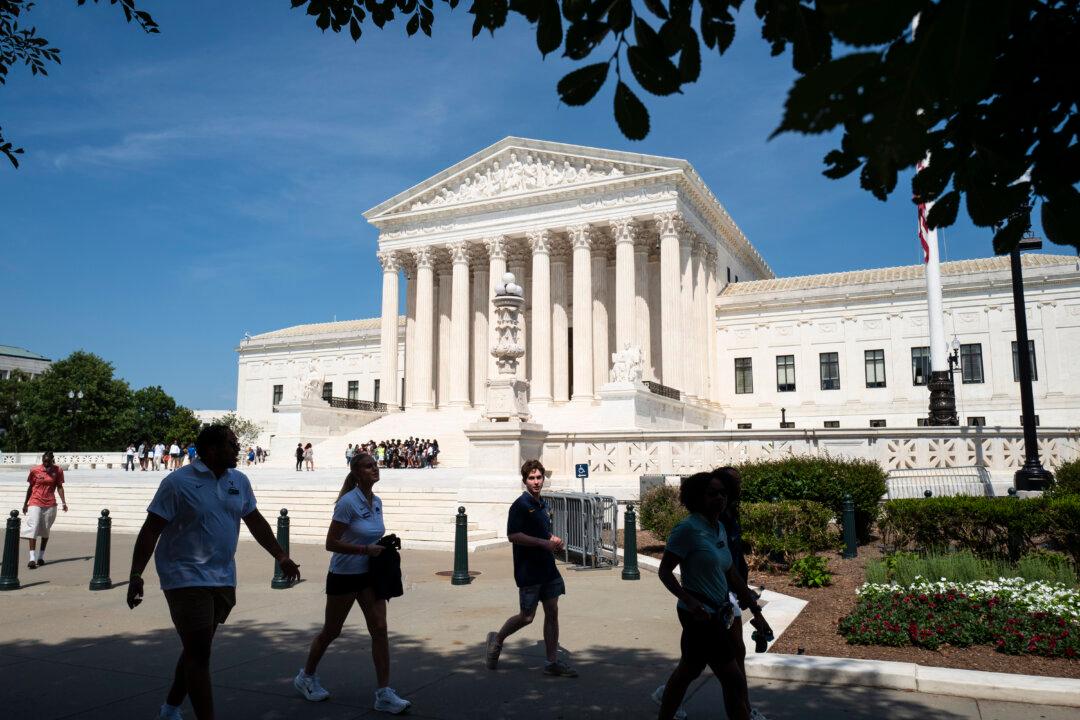
The federal government on Aug. 29 withdrew an emergency request at the Supreme Court to give it control over billions of dollars in foreign aid after an appeals court cleared the way for the government to withhold the funding.
But as the panel did not issue what lawyers call a mandate, its ruling did not take effect immediately.
Instead, a Feb. 25 preliminary injunction issued by U.S. District Judge Amir Ali that required the foreign aid funds appropriated by Congress to be spent remained in effect after Ali denied the government’s request to formally stay his injunction.
This allows the government to withhold the appropriated foreign aid funding.
The injunction “will effectively force the government to rapidly obligate some $12 billion in foreign-aid funds that would expire September 30 and to continue obligating tens of billions of dollars more—overriding the Executive Branch’s foreign-policy judgments regarding whether to pursue rescissions and thwarting interbranch dialogue,” the filing stated.
The district court overreached here, appointing itself “as overseer of spending decisions,” the filing said.
Because the actions of the D.C. Circuit Court on Aug. 28 vacated the injunction, the government withdrew its emergency application to stay the injunction, Sauer said in the Aug. 29 filing.
The funds were allocated to the Department of State and the U.S. Agency for International Development, which is in the process of being dissolved by the Trump administration and merged into the Department of State during the fiscal 2025 appropriations process.
Under the Impoundment Control Act, the government must make a rescission request to Congress, which then has 45 days to approve the cancellation of appropriated funds. A “pocket rescission,” however, refers to such requests made within 45 days of the end of the federal fiscal year, which is Sept. 30. In such cases, the funds are withheld during the 45-day congressional review period, and if Congress fails to act before the fiscal year ends, the funds expire.
Pocket rescissions are uncommon, and the last one attempted was in 1983, when President Ronald Reagan sought to cut $2 million appropriated to the National Oceanic and Atmospheric Administration. Trump, during his second term, has successfully requested some rescissions from Congress. A rescissions measure canceling $9.4 billion in funding for foreign aid and public broadcasters was approved by Congress in July.
Rescission requests, when presented to Congress, may be enacted through legislation with simple majorities voting in favor in both houses, meaning that the minority has no leverage to stop or alter the process. Democrats in Congress, who are in the minority in both houses, have protested against Trump’s rescissions, often to no avail.