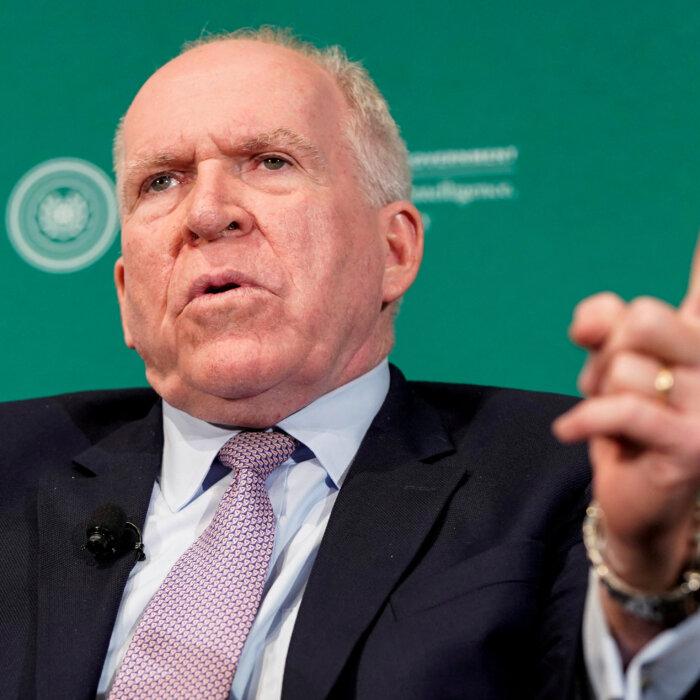
Former CIA Director John Brennan is seeking a court order requiring the Trump administration to retain records related to allegedly vindictive investigations into him and his involvement in probing alleged Russian interference in the 2016 presidential election.
While the Justice Department had not formally brought an indictment against Brennan, his lawsuit noted that it had undertaken grand jury investigations in recent months. He accused prosecutors of abusing their authority and said there was reason to believe that the administration was not preserving records as required under law.
Brennan said the judge’s order was necessary to preserve his constitutional rights and evidence that he could use to prove vindictiveness in a would-be prosecution.
“This Administration has adopted a policy of using criminal process and prosecution to punish the President’s perceived adversaries,” Brennan’s legal team wrote in the court filing.
“It is against this backdrop that former Director of the Central Intelligence Agency, John O. Brennan ... is being vindictively singled out for investigation and prosecution.”
The lawsuit filed by Brennan’s legal team on July 1 names President Donald Trump, acting Attorney General Todd Blanche, FBI Director Kash Patel, CIA Director John Ratcliffe, White House chief of staff Susie Wiles, and other government officials as defendants.

A Justice Department spokesperson told The Epoch Times, “While we cannot comment on the existence, or lack thereof, of an investigation, it is certainly rich that John Brennan is accusing anyone of a ‘retribution campaign.’”
Brennan’s lawsuit focused on two investigations. One centered on an alleged conspiracy to deprive Trump of his rights by probing alleged Russian interference. Another was related to statements he made to Congress regarding an Intelligence Community assessment of Russian influence during the election.
Brennan’s legal team stated that Justice Department officials have “taken steps that clearly violate well-established norms and limitations on prosecutorial conduct” as part of the Trump administration’s investigations.
“Those overreaching actions have violated Director Brennan’s constitutional rights and will serve as the basis for challenges to any resulting charges, including motions to dismiss any indictment on the grounds that it is the result of selective and vindictive prosecution,” they wrote.
The lawsuit noted that the examination of prosecutors’ emails, texts, and other communications would allow the courts to determine if decisions were based on legitimate law enforcement concerns or an effort to “selectively” and “vindictively” prosecute the former CIA director.
“There is a very real risk, however, that some of these materials and communications will no longer exist by the time any such challenges are filed and the court hears them,” the lawsuit reads.
Brennan’s legal team cited technology changes that it stated do not ensure the routine preservation of communications and “ample evidence in the public record” of Trump administration officials failing to meet legal obligations to preserve records as the two reasons for its concern.
The lawsuit states that the Trump administration is obligated to preserve records and evidence that would be relevant in a potential challenge if Brennan were indicted. Brennan’s legal team pointed to both the Presidential Records Act and the Federal Records Act as regulations covering many of the communications and materials involved in the two investigations.
In the House Judiciary Committee’s criminal referral, Jordan wrote, “Brennan falsely denied that the CIA relied on the discredited Steele dossier in drafting the post-election Intelligence Community Assessment.”