This copy is for your personal, non-commercial use only. Distribution and use of this material are governed by our Subscriber Agreement and by copyright law. For non-personal use or to order multiple copies, please contact The Epoch Times Reprints.
Defense Secretary Mark Esper holds a news conference at the Pentagon in Arlington, Va., on Oct. 28, 2019, the day after it was announced that Abu Bakr al-Baghdadi was killed in a U.S. raid in Syria. Chip Somodevilla/Getty Images
Defense Secretary Mark Esper has approved a one-year extension of Pentagon assistance to the Department of Homeland Security, authorizing the deployment of 4,000 U.S. military personnel at the U.S.–Mexico border.
The authorization comes after the DHS requested support in its mission to protect the border. The deployment will start in October and continue until the end of September 2021, with most of the force coming from the National Guard.
The National Guard personnel will operate under a Title 10 status, which authorizes them to carry out federal active-duty military service.
“The duties to be performed by military personnel include the same categories of support as those currently being carried out along the border, including detection and monitoring, logistics, and transportation support to U.S. Customs and Border Protection,” Pentagon spokesman Lt. Col. Chris Mitchell said in a statement.
“Military personnel will not directly participate in civilian law enforcement activities,” he added. “DoD and DHS constantly review the situation along the border, adjusting requirements as necessary to maintain the safety and security of the American people.”
The current authorized troop level at the southern border is at about 5,000, with 2,600 active duty and 2,400 National Guard, reports Washington Examiner, which means that the new deployment is a decrease in personnel supporting the DHS.
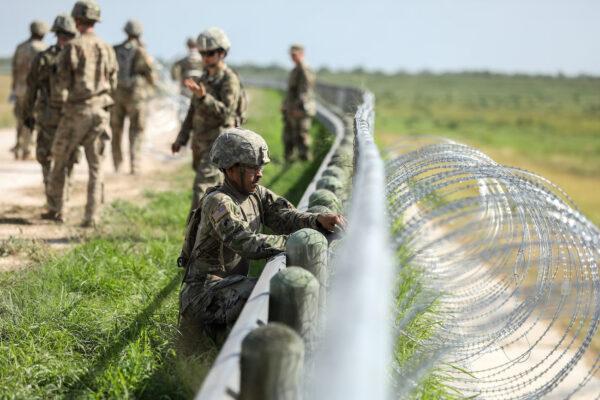
More than 5,000 troops began deploying to the U.S. Mexico border around October 2018 in Texas, Arizona, and California in efforts to “harden the U.S. border with Mexico,” the Pentagon announced at the time. The announcement came ahead of an anticipated arrival of a caravan of migrants moving northward from Central America. At the time, troops laid down barbed-wire fencing along the border in an effort to stem the swell of people trying to enter the United States.
The U.S. military installs concertina wire on the levee behind Granjeno in Texas, just north of the U.S.-Mexico border on Nov. 7, 2018. Samira Bouaou/The Epoch Times
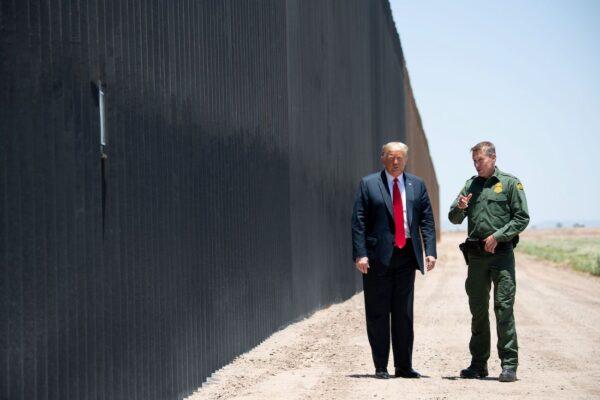
“We’re on pace to complete 450 miles by the end of the year and 500 miles almost immediately thereafter,” Trump said on June 23.
President Donald Trump speaks with Border Patrol Chief Rodney Scott (R) as they participates in a ceremony commemorating the 200th mile of border wall at the international border with Mexico in San Luis, Arizona, on June 23, 2020. Saul Loeb/AFP via Getty Images
Trump in February extended the national emergency declaration on the U.S.-Mexico border for another year, according to a notice submitted to the Federal Register (pdf). The initial emergency declaration was made in February 2019.
Since taking office, Trump has demanded that Congress fund construction of a wall on the southern border, his landmark campaign promise.