The months following the National Guard’s deployment to Washington have seen a precipitous drop in crime, but experts say it is unclear how much of the decline can be attributed to the federal troops’ recent presence.
On Jan. 3, 2025, the U.S. attorney’s office announced that violent crime in Washington was at a 30-year low.
The 2026 year-to-date crime comparison data through March 25, released by the Metropolitan Police Department, reports that homicide (minus 63 percent), sex abuse (minus 67 percent), and robbery (minus 29 percent) were all down, and violent crime was down by 13 percent overall. Motor vehicle theft (minus 55 percent) and burglary (minus 25 percent) are also down. Assault with a dangerous weapon had increased by 34 percent. All crimes on average were down by 26 percent.
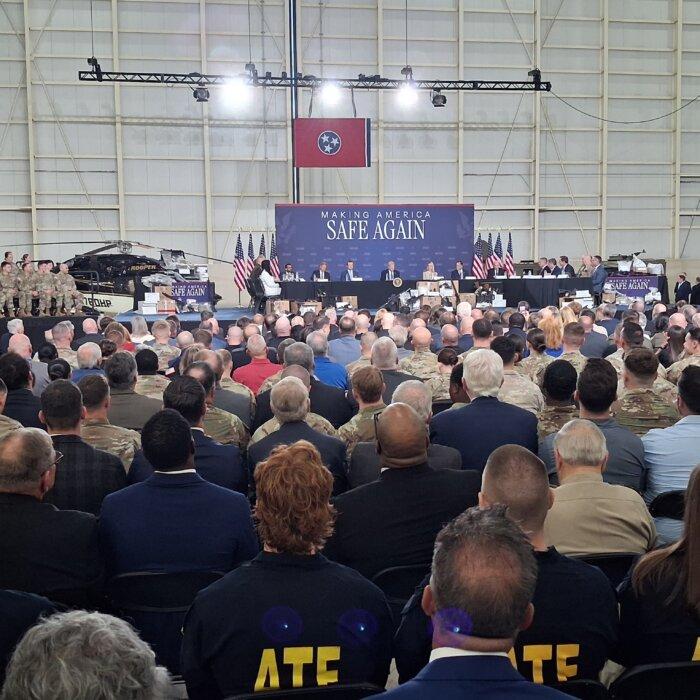
The White House is taking credit for the drop in crime. President Donald Trump said at a Cabinet meeting on March 26 that he “never” wanted to withdraw the National Guard from the nation’s capital.
“President Trump’s bold actions in DC have made the city safer and more beautiful for all residents and visitors, with crime rates rapidly declining across the board in all categories,“ White House spokeswoman Abigail Jackson said in an email to The Epoch Times. ”As of last month, the crime task force had made over 100,000 arrests and removed 1,036 illegal firearms from the streets.
“The Administration continues to coordinate closely with local officials to enhance operations and keep all members of the community safe.”
But some crime experts say the National Guard’s impact is difficult to gauge. Darrel Stephens, a policing expert with 50 years of experience, told The Epoch Times that sorting out the National Guard’s impact from other factors is difficult.
“Crime statistics are not a good measure—they have been going down since well before the deployment, and there is nothing to indicate the Guard did anything during their presence that was directed toward crime,” said Stephens, who codirects the Policing, Security Technology, and Private Security Research and Policy Institute at Florida State University.
“They were deployed as an addition to the resources already in place—DC police, Capitol police, Park police, [General Services Administration] security, and private security personnel.”
As of March 25, there were 2,700 National Guard service members mobilized in the nation’s capital, according to the military reserve organization. The effort has included National Guard members from 17 states, according to the Joint Task Force–District of Columbia, the military task force overseeing the National Guard’s deployment.
National Guard members have administered naloxone to more than 100 individuals experiencing drug-related emergencies since August 2025.
The National Guard pointed to individual interactions as examples of its role on the ground. In one instance reported on March 20 by the National Guard, soldiers assisted a man experiencing a mental health crisis by calling 911 and remaining with him until emergency responders arrived.
Thaddeus Johnson, an assistant professor in the Department of Criminal Justice and Criminology at Georgia State University, said he was skeptical of the guard’s impact on violent crimes.
He told The Epoch Times that offenses such as homicide and aggravated assault were often impulsive and less likely to be affected by an increased law enforcement presence.
However, property crimes—including motor vehicle theft and robbery—are more susceptible to deterrence.
“If you have more eyes on the street, you will see less robberies,” Johnson said.
A Democrat-led Senate committee released a report in February stating that Trump’s deployment of the National Guard in Washington has cost more than $330 million in the first seven months, or nearly $1.65 million per day.
“Protecting public safety is essential, but this deployment has spent hundreds of millions of taxpayer dollars without making our nation’s capital any safer,” Sen. Gary Peters (D-Mich.) said in a Feb. 5 statement.
“The Trump Administration’s decision to keep the National Guard in our nation’s capital without clear goals, measurable outcomes, or an end date diverts critical resources away from important national security and public safety missions that keep our communities safe.”
Trump, meanwhile, has described the situation in Washington as an emergency that needs federal intervention. In an Aug. 11, 2025, memo mobilizing the National Guard, he described an “epidemic of crime in [the] Nation’s capital.”
Officially, a Joint Task Force–D.C. spokesperson said in an email to The Epoch Times that its mission is “to provide a visible deterrent and support our partners, reinforcing public safety for everyone in the District.”
“This allows D.C. Metropolitan Police officers to focus on their primary law enforcement duties and adjust their resources accordingly,” the spokesperson said.
Johnson said the presence of the National Guard could reduce residents’ fear of crime, but that even that effect is uncertain.
“People may think, ‘Should I go someplace that needs the National Guard?’“ he said. ”It really is hard to say if there is a measurable impact.”