Cuban espionage against the United States goes back decades, State Department spokesman Tommy Pigott told The Epoch Times’ sister media NTD in an exclusive interview on July 31, and the communist nation’s effort to infiltrate the government “continues to this day.”
“What this report does, for really the first time, is tell the untold story of the decades-long influence and espionage campaign in the United States that has been waged by the Cuban regime to undermine the national security of the American people,” Pigott said.
Among the issues addressed in the report is the Cuban regime’s “rapid response plan,” calling for certain left-wing organizations within the United States to mobilize in the event of U.S. military action against Cuba, which President Donald Trump and other administration officials have hinted could happen if the Cuban regime doesn’t collapse on its own.
“A rapid response plan—calling for agitation and resistance, while also publishing the locations of U.S. military bases and [Immigration and Customs Enforcement] installations—that is the type of network that we are talking about here,” Pigott said.
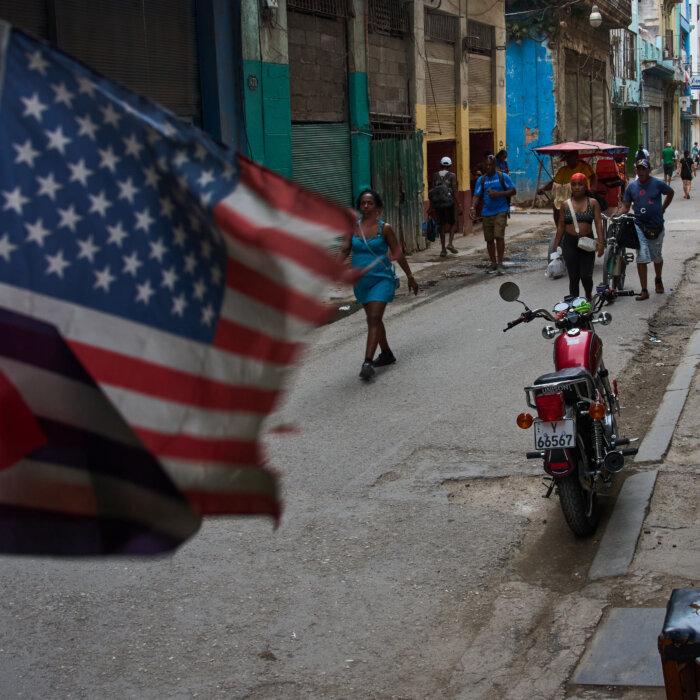
Cuba has brought “tens of thousands of far-left activists” to its country to indoctrinate then spread communist ideas.
“The spread of this insidious ideology meant to undermine the security of the United States is having a real impact on our national security,” Pigott said. “This revolutionary tourism has had such an impact on destabilizing our entire hemisphere.”
In the interview, the State Department spokesman also rebutted claims that these problems posed by the Cuban regime no longer exist.
“One of the things that I find most astonishing that has been detailed in this report is that many of these [left-wing] groups are outrageously proud of their links to the Cuban regime. They talk about it openly,” Pigott said. “This is a real and pressing problem that continues to this day.”
Left-wing organizations named in the State Department report included Antifa, Code Pink, Communist Party USA, Democratic Socialists of America, the National Network on Cuba, and the National Lawyers Guild.
Pigott advised U.S. citizens to take the time to fully understand the depth to which Cuba has worked to disrupt the American way of life, offering as an example how some left-wing groups have been linked to supporting violence, and a different Cuba-linked group bails the violent agitators out of prison.
He said other communist countries—Russia and China—are also using the island nation to further their goals.
“We are seeing other countries using Cuba to enter our hemisphere, to destabilize our hemisphere, and to undermine U.S. interests,” Pigott said. “That’s something that we take incredibly seriously.”
Cuba, for years, essentially had a sponsor in the Soviet Union, Pigott said, and up until recently, Venezuela as well.
U.S. forces captured then-Venezuelan leader Nicolás Maduro in Caracas in January to answer to allegations of narcoterrorism and drug trafficking. The operation targeting Cuba’s main ally and oil provider in the Western Hemisphere further weakened the Caribbean country.
Havana transmits information and intelligence gathered by its agents in the United States to China, Russia, Iran, and North Korea, the department said.
Aside from the Venezuela operation, the Trump administration has deployed a multi-pronged approach aimed at further destabilizing the Cuban regime, Pigott said.
This includes heavy sanctions, countering cartel activity, and building strong economic relationships with other countries in the region to face the myriad of threats in the Western Hemisphere.
Most important, Pigott noted, is helping the Cuban people.
“What we see in Cuba is a humanitarian crisis of the island’s own making,” Pigott said. “We’re working with partners across our hemisphere, while also transparently calling out the threat that we face, so the American people can see it with their own eyes.”