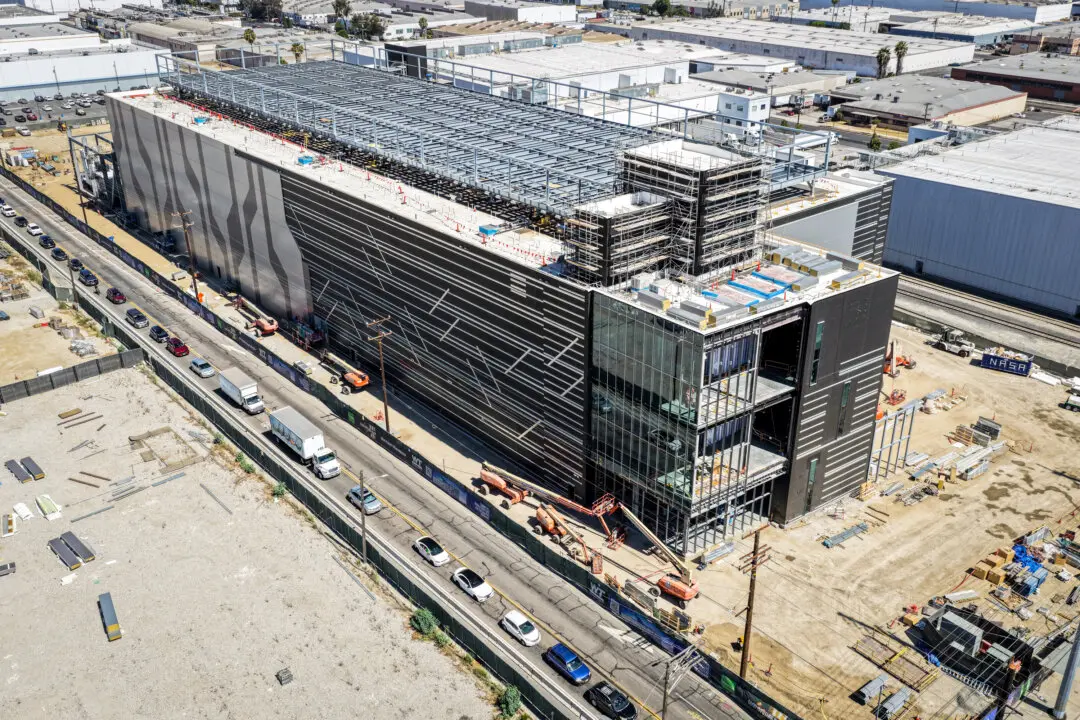
America’s artificial intelligence boom is colliding with an older, slower-moving entity: the nation’s aging electrical grid.
From Virginia’s data center corridor to multistate electricity markets, analysts, government agencies, and AI insiders say the scramble to handle technology’s expanding power demands will be an uphill battle.
At the same time, big tech companies and data centers are working to reduce the impact of AI’s expansion on the U.S. grid infrastructure. Some experts have said that changes and significant investment are needed to reduce grid stress and possible energy shortages.
Although AI’s current computing needs represent just a fraction of total energy consumption, the rate of growth has raised the question whether U.S. energy infrastructure can keep up.


“This has major consequences on our communities: power outages, susceptibility to cyberattacks, or community emergencies caused by faulty grid infrastructure,” the agency stated.
And that is without any added energy demands.
The Bank of America analysis states that the United States is going through a period of power “load growth” primarily driven by building electrification, data centers, industrial demand, and the rise of electric vehicles.
Perfect Storm
Even after two years of modernization efforts, the U.S. power grid network remains in a race to continue upgrading while consumption demand surges. Because of data center growth, researchers at S&P Global predicted that power grid requirements would increase by 22 percent by the end of 2025 and nearly three times by 2030.“People keep saying the lack of chips is the problem, and it’s not,“ Tyler Saltsman, CEO of Seattle-based EdgeRunner AI, told The Epoch Times. ”It’s a lack of power.”
Part of the conversation surrounding unsustainable AI growth in recent months has focused on structural shifts in support sectors.

However, Saltsman said he believes that a shortage of microchips is moot if the power grid cannot support AI’s rapid buildout.
Working at the intersection of AI and energy, Saltsman’s company has three active research and development contracts with the U.S. military. From his perspective, alarm over AI and U.S. energy infrastructure is not overstated.
“If anything, it’s downplayed,“ Saltsman said. ”Our grid is pretty fried. ... Nationwide, you see a lot of lazy [maintenance] practices.”
Although he has not encountered any power-related issues while working on the front lines of AI, Saltsman said he expects to if data center growth continues at the current rate.
“We can make chips much faster than we can make power,” he said.
When asked what could be done to safeguard U.S. power grids, Saltsman said, “We need to commit to building nuclear reactors, and we need to do it now, but that isn’t a quick fix.”
Meanwhile, some energy experts have said that concerns over AI and power demands are legitimate, but aren’t being framed correctly.
“The risk isn’t that AI will ‘break’ the U.S. grid. Rather, the risk is that outdated planning, cost-allocation rules, and inflexible load assumptions will force inefficient solutions like emergency peakers or deferred retirements despite smarter and cleaner alternatives that exist,” Gaurav Shah, managing partner at Trident Renewables, told The Epoch Times.
Despite the relatively small portion of America’s total electricity consumption for which AI is responsible, energy demand growth has been enough to require the use of peaker plants.
Shah has spent nearly 20 years working with U.S. energy infrastructure, including renewable energy, grid-connected assets, fuel transition projects, and, most recently, AI-linked energy strategy.
“This is a governance and market-design challenge more than a physics problem,” he said.
“The grid struggles with concentrated AI clusters in places like Northern Virginia, Texas, and parts of the Southeast, not because power doesn’t exist but because deliverability, redundancy, and timing don’t align,” Shah said.
“Reforms like faster permitting for transmission upgrades and incentives for siting data centers near retiring industrial sites with existing grid headroom are much needed,” he said. “Without reforms, we are likely to see higher costs, delayed retirements of older plants, and localized reliability stress.”
Saltsman said, “With the increase in [electric vehicles], it’s a perfect storm of factors.”

He said he believes that AI has the potential to be dangerous for U.S. electrical infrastructure. With the power grids already stressed and in need of upgrades, sudden surges in power loads—or even a rogue AI agent—could tip the scales for the worse.
Regional Challenges
Shah said AI’s energy footprint is “hyperlocal,” and power grids will likely fail locally, not nationally.He said a 100-megawatt data center in a congested area can cause more stress than 1 gigawatt of overall national growth in power demand.
Energy grids in the United States are broken down into different sections instead of a seamless power supply. Most of these subgrids are part of the Eastern Interconnection, the Electric Reliability Council of Texas, or the Western Interconnection.
Officials for the PJM Interconnection warned that an energy capacity shortage could affect its systems as early as June 2026.
“The demand for electricity is growing at the fastest pace in years, primarily from the proliferation of data centers, electrification of buildings and vehicles, and manufacturing,” the agency stated.
Shah said: “Regions like [the Electric Reliability Council of Texas] and PJM face different challenges. Texas has generation but not transmission constraints. The Northeast has aging infrastructure and limited siting options. AI load growth is geographically concentrated, capital-intensive, and fast.”
“National averages hide the fact that a single county can suddenly need the equivalent of a mid-sized city’s power demand,“ he said. ”Planning frameworks were not built for this.”
Major players in tech are investing in multiple strategies to blunt the impact of data center-related power demand spikes, including energy-efficient hardware, advanced cooling systems, and power management systems, according to NZero and Flexential.
Saltsman said that with the current rate of AI expansion, it is “not going to be a pretty sight ... unless you also plan to build a power plant in that same area.”
“We need a unified plan on modernizing the grid,” he said.