All of the recent cases were decided by 5–4 majorities, and one of those was really 3–2–4. As I stated in the previous installment, one reason the justices divide as they do is that the law in this area is chaotic. It is also quite divorced from the Constitution’s actual rules on the subject.
The Articles of Confederation
The Articles of Confederation were a defensive treaty arrangement among the American states, somewhat comparable to today’s NATO. The Continental Congress proposed the Articles to the states in 1777, and the last of the 13 states (Maryland) ratified them in 1781.Under the Articles, each state sent delegates to an assembly known as the Confederation Congress, where each state had one vote.
The Constitution Becomes Effective
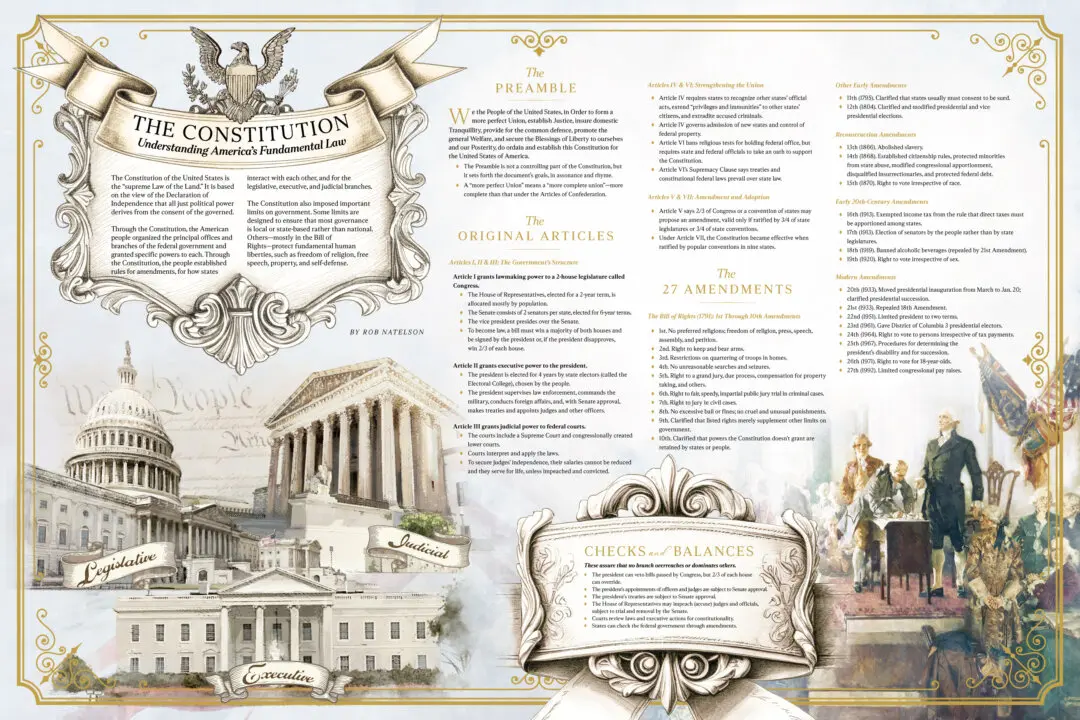
The Constitution was written in 1787, but the new government did not displace the Articles until 1789. Initially, that new government represented only 11 states. However, North Carolina joined later in 1789, Rhode Island in 1790, and Vermont in 1791.The Constitution granted more authority to the federal government than the Articles had granted the Confederation Congress. But under the Articles all the authority had been unified in Congress; under the Constitution it was split among different governmental branches. This is called “separation of powers.” Functions not allocated among the branches of the federal government were reserved to the states.
This also was true of Indian affairs: The new federal government received more authority over relations with the Natives than the old Confederation Congress had enjoyed—but that authority was split up. Here’s how:
First: The president was assigned responsibility for diplomacy and for fighting wars.
Second: The president, with the approval of two-thirds of the Senate, was assigned the duty of making treaties with the tribes (Article II, Section 2, Clause 2). Treaties defined U.S.—tribal relationships. They could address almost any subject. Within the United States, a treaty had the same legal force as a congressional statute.
In those days, the state legislatures elected senators, so the requirement that two-thirds of the senators consent to any treaty protected the states against proposed pacts that might invade the sphere of government reserved to the states.
Third: For a treaty to be binding on a tribe, the tribe had to accept it. This preserved some freedom for the tribes; how much freedom they enjoyed would depend on their military power and on other circumstances.
- declare war (Article I, Section 8, Clause 11);
- govern federal territories outside state boundaries (Article IV, Section 3, Clause 2);
- regulate the “law of nations,” particularly the movement of people across the boundaries of Indian country (Article I, Section 8, Clause 10);
- regulate “commerce with the Indian Tribes” (Article I, Section 8, Clause 3); and
- pass laws to aid the president in negotiating and executing treaties (Article I, Section 8, Clause 18).
Fifth: To the extent federal officials (following the rules set forth above) did not regulate an aspect of Indian affairs, the states could (Amendments IX and X). For example, a state legislature could pass laws governing Natives living within its borders. Of course, enforcing state laws might not be practical if an Indian nation was strong enough.
How This System Worked in Practice
Let’s see how these rules worked in practice.After the Constitution came into effect, the president negotiated frequently with Indian nations and sometimes carried out military operations. The president also hammered out treaties with individual tribes and submitted them to the Senate for approval. Often the parties to a treaty agreed that the tribe would interact solely with the federal government and not with any state, and that no state had jurisdiction over the tribe.
A Legal Myth: The Constitution Gives Congress ‘Plenary Power’ Over Indian Affairs
Unfortunately, many writers on Indian law are not familiar with the wider context of constitutional law and history. They are usually unfamiliar with 18th-century legal concepts and how we analyze constitutional meaning. And many of them also have political agendas. As a result, the modern law of U.S.–Indian relations has been infected by misunderstandings and myths.The most important of these misunderstandings or myths is that the Constitution gives Congress “plenary” (absolute) authority over Indian affairs. The primary source of this authority is, supposedly, Congress’s constitutional power to “to regulate Commerce ... with the Indian Tribes.” Some writers even make the unlikely claim that the phrase “regulate Commerce” changes meaning when applied to Indian affairs.
Naturally, Congress has seized upon the “plenary power” myth to justify its own overreaching. And—as I’ll document in a forthcoming article—liberal academics have tortured the evidence to support congressional pretensions.
But as we have seen, the Constitution separated Indian affairs powers. The Constitution did not make any government, or any branch of government, absolute. Congress’s power to regulate commerce is limited to administering a traditional body of jurisprudence called the “law merchant,” which includes governing such activities as trade across political boundaries, navigation, and marine insurance.
It certainly does not encompass “plenary authority” over Indians.