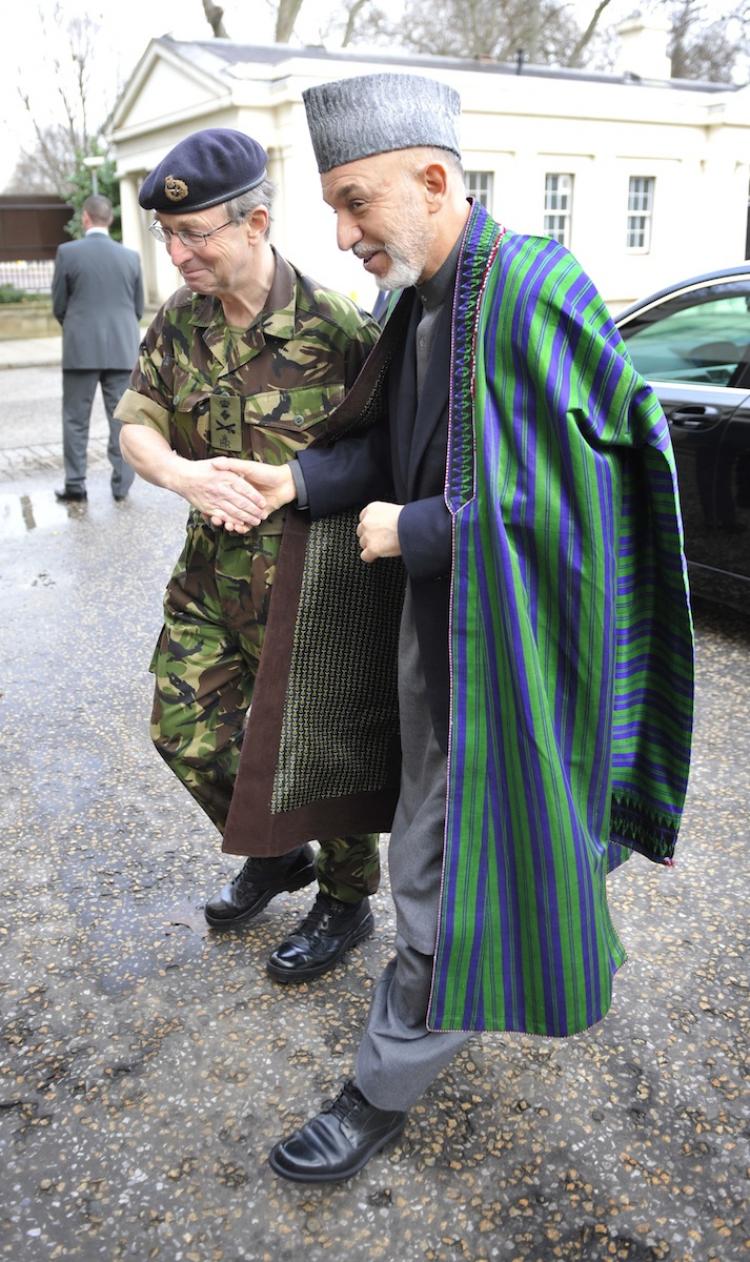
LONDON—Talks with moderate Taliban in Afghanistan should begin “pretty soon” the head of the British army has said.
Discussion between allied politicians, army chiefs, and the less extreme of the insurgents should begin “sooner than later” as part of the exit strategy for international forces in Afghanistan, General Sir David Richards told BBC radio on Sunday.
“If you look at any counterinsurgency campaign throughout history there’s always a point at which you start to negotiate with each other, probably through proxies in the first instance, and I don’t know when that will happen.
“From my own, and this is a purely private, view, I think there’s no reason why we shouldn’t be looking at that sort of thing pretty soon,” he told Radio 4’s “The World This Weekend.”
This echoes the views of Prime Minister David Cameron, who has said he wants British troops to be out of the war-ravaged country within five years.
Also on Sunday, head of the CIA Leon Panetta told the ABC’s “This Week” that progress in Afghanistan was harder than expected.
“There are some serious problems here,” he said. “We’re dealing with a tribal society. We’re dealing with a country that has problems with governance, problems with corruption, problems with narcotics trafficking, [and] problems with a Taliban insurgency.
“We are making progress. It’s harder, it’s slower than I think anyone anticipated,” he said.
“Negotiation with moderate elements of the Taliban is likely to form an important part of future coalition strategy.”
At the London Conference on Afghanistan in January, plans were announced for international money to ease the Taliban back into civilian life.
General Stanley McChrystal, terminated last week as commander of multinational forces in Afghanistan, said more contact should be made with those rebels whose main motivation was financial, rather than ideological.
General Richards said, “At the same time you have got to continue the work we are doing on both the military, governance, and development perspectives to make sure that they [the Taliban] don’t think that we are giving up.”
Discussion between allied politicians, army chiefs, and the less extreme of the insurgents should begin “sooner than later” as part of the exit strategy for international forces in Afghanistan, General Sir David Richards told BBC radio on Sunday.
“If you look at any counterinsurgency campaign throughout history there’s always a point at which you start to negotiate with each other, probably through proxies in the first instance, and I don’t know when that will happen.
“From my own, and this is a purely private, view, I think there’s no reason why we shouldn’t be looking at that sort of thing pretty soon,” he told Radio 4’s “The World This Weekend.”
This echoes the views of Prime Minister David Cameron, who has said he wants British troops to be out of the war-ravaged country within five years.
Also on Sunday, head of the CIA Leon Panetta told the ABC’s “This Week” that progress in Afghanistan was harder than expected.
“There are some serious problems here,” he said. “We’re dealing with a tribal society. We’re dealing with a country that has problems with governance, problems with corruption, problems with narcotics trafficking, [and] problems with a Taliban insurgency.
“We are making progress. It’s harder, it’s slower than I think anyone anticipated,” he said.
“Negotiation with moderate elements of the Taliban is likely to form an important part of future coalition strategy.”
At the London Conference on Afghanistan in January, plans were announced for international money to ease the Taliban back into civilian life.
General Stanley McChrystal, terminated last week as commander of multinational forces in Afghanistan, said more contact should be made with those rebels whose main motivation was financial, rather than ideological.
General Richards said, “At the same time you have got to continue the work we are doing on both the military, governance, and development perspectives to make sure that they [the Taliban] don’t think that we are giving up.”