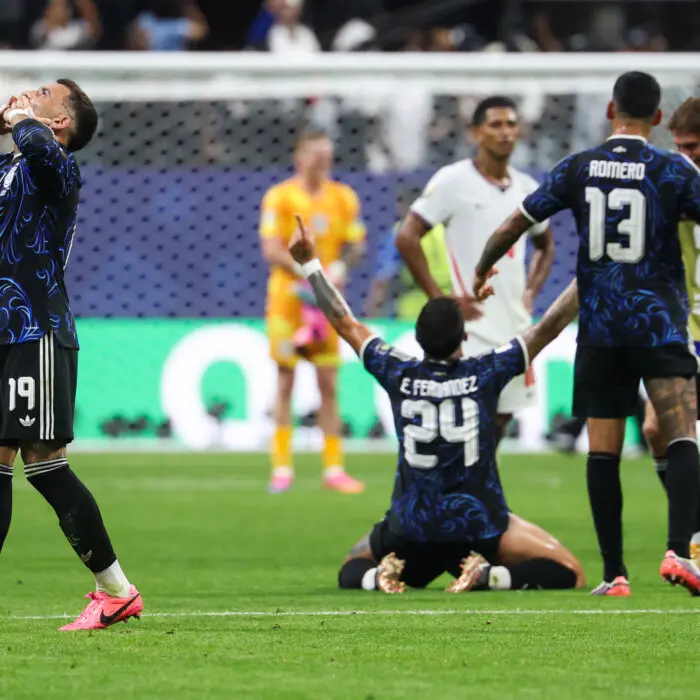
Lionel Messi and other members of the Argentine national team are under investigation by FIFA’s Independent Disciplinary Committee after they turned their semifinal victory celebration over England on July 15 into an opportunity to make a statement on the Falkland Islands.
Midfielder Giovani Lo Celso appeared to take a sign previously held in the stands that read, “Las Malvinas son Argentinas” (“The Malvinas Are Argentinian”). He held it up with Messi, with several other dancing teammates behind him, before placing it down on the field.
British officials have spoken out against this demonstration and called upon FIFA to uphold its regulations and punish Argentine players seen partaking in the celebration, specifically by banning them from playing in the upcoming final.
Previous mid- and post-game political statements, including this one, have warranted fines amounting to tens of thousands of dollars and even game suspensions.
The Malvinas is the Argentine name for the Falkland Islands, a British territory in the Southern Ocean just 300 miles off the coast of mainland Argentina.
Argentina invaded the islands in 1982, but they were ultimately reclaimed by the UK after a conflict that lasted from April 2 to June 14 of that year and resulted in the deaths of 255 British soldiers, 649 Argentine soldiers, and three civilians.
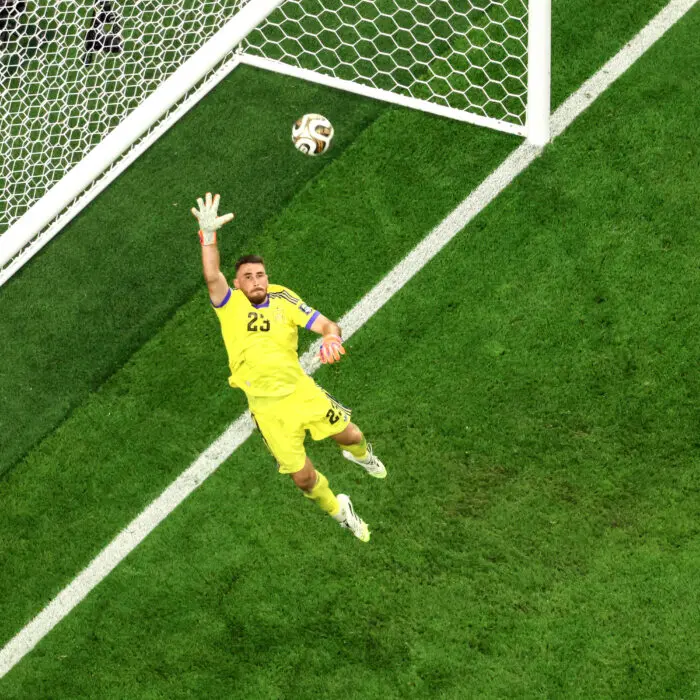
The Falklands War, as the conflict came to be known, established bad blood between the two nations that persists today. The South American nation continues to claim the British Overseas Territory.
Argentine Vice President Victoria Villarruel posted a video on X of what appears to be Argentine soldiers from the Falklands War, one of whom doubles back to give a vulgar gesture to the camera, thanking the team and saying, “It wasn’t just another match.”
She also posted a picture of Messi and his teammates holding the sign, declaring “The Malvinas are Argentine! They banned bringing them to the stadium and forgot that we carry them in our blood and our hearts.”
Meanwhile, Argentine President Javier Milei reposted several statements on X that appear to affirm his nation’s claim to sovereignty over the islands. Those statements included one, formally sent by the Argentine Ministry of Foreign Affairs to the British Embassy in Buenos Aires, protesting the presence of the Royal Navy offshore patrol vessel HMS Medway in the vicinity of the islands.
Another recognized July 16 as the Day of Argentine Interests at Sea, and a third quoted Milei saying that “the Malvinas” will be recovered through diplomacy and intelligence.
Across the Atlantic, British Prime Minister Keir Starmer said, “The World Cup might not be ours, but the Falklands definitely are.”
However, some members of Parliament responded more aggressively to the matter. Liberal Democrats leader Ed Davey sent a letter to FIFA president Gianni Infantino, urging the Disciplinary Committee to take immediate action and ban the Argentine players from participating in the final.
FIFA has strict rules concerning political, religious, or even personal statements.
According to the International Football Association Board’s rulebook, “Equipment must not have any political, religious or personal slogans, statements or images. Players must not reveal undergarments that show political, religious, personal slogans, statements, or images, or advertising other than the manufacturer’s logo.”
“For any offense, the player and/or the team will be sanctioned by the competition organizer, national football association, or by FIFA.”
FIFA has held fast to this neutrality in the past, even going so far as to deny France’s request to wear black armbands to honor the passing of head coach Didier Deschamps’s mother at this most recent World Cup.
It also fined England, Scotland, Wales, and Northern Ireland for wearing poppy armbands during matches in 2016 that occurred around Armistice Day, which commemorates the end of World War I.
In his letter to FIFA, Davey recalled a moment in 2024 when UEFA gave Rodrigo Hernández Cascante (Rodri) and Alvaro Morata of Spain’s national team a one-game suspension for chanting “Gibraltar is Spanish” during post-match celebrations.
“UEFA rightly ruled that bringing territorial, political disputes into the sporting arena violates the basic principles of decent conduct, brings the sport of football into disrepute, and constitutes a non-sporting manifestation,” Davey wrote.
“FIFA must hold its competitors to the same ethical standards.”
Argentina has previously faced disciplinary action for claiming the Falklands, earning a $26,000 fine for displaying a similar sign with the same statement after a 2–0 friendly victory over Slovenia in 2014.
FIFA announced on July 16 that its Independent Disciplinary Committee had begun assessing reports from the match. However, no anticipated deadline for any decisions or disciplinary actions was included in the announcement.