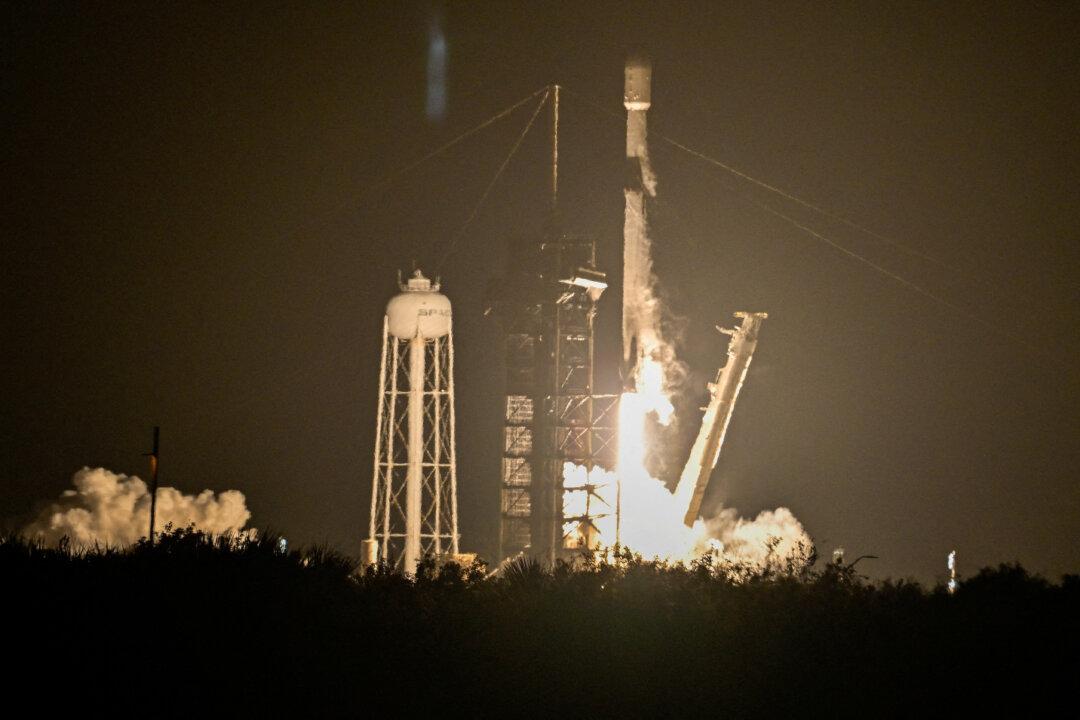
KENNEDY SPACE CENTER, Fla.—SpaceX’s Falcon 9 rocket threaded through the clouds of a stormy Florida sky just before midday on Aug. 1, as the 11th act of the National Aeronautics and Space Administration’s (NASA) commercial crew program set off for the International Space Station.
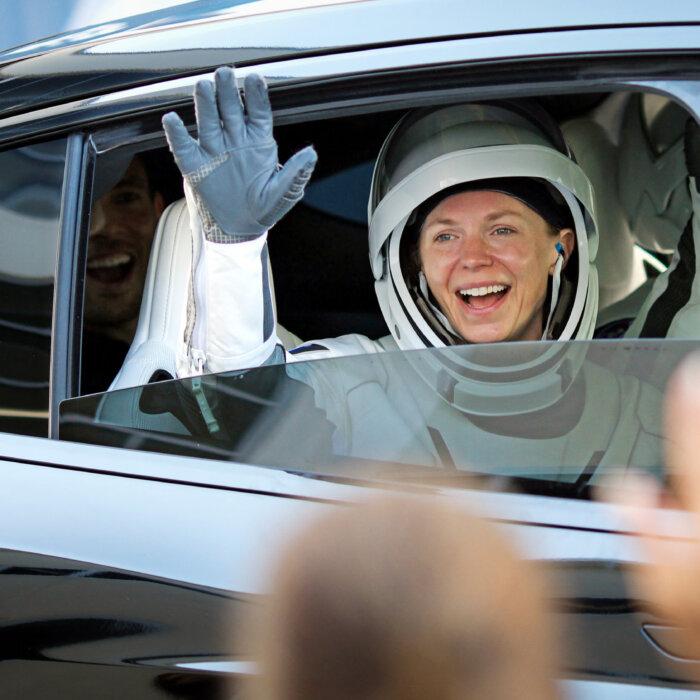
Strapped on top, inside the Dragon Endeavor capsule, were NASA Astronauts Zena Cardman (mission commander) and Mike Fincke (mission pilot, as well as Russian Cosmonaut Oleg Platonov of Roscosmos and Kimiya Yui of the Japan Aerospace Exploration Agency (JAXA), both of whom were named mission specialists.
This was the second launch attempt, following one on July 31 that was scrubbed due to weather, with only 67 seconds left on the countdown. Like the first attempt, this launch required an instantaneous launch right on time, but the storm remained clear of the site long enough for the four-person crew to lift off.
Steve Stich, program manager for NASA’s Commercial Crew Program, said cameras onboard the rocket showed what appeared to be a “horseshoe” shape of clouds surrounding the clear launch pad.
Ken Bowersox, associate administrator of NASA’s Space Operations Mission Directorate, said at NASA’s post-launch press conference, “I think it was a great reminder that we don’t control everything in the space business, and that sometimes good fortune helps a lot, and timing just works out so that you can launch your mission. But that wouldn’t happen without excellence on the part of the teams that make it possible.”
After taking off from Launch Pad 39A, the crew began to make a series of orbital adjustments called “phasing” to catch up to the space station. Stich said in the post-launch press conference that the journey from launch to dock would be about 15 hours. That’s far shorter than the nearly 40-hour spaceflight the crew would have had if their rocket had launched on July 31.
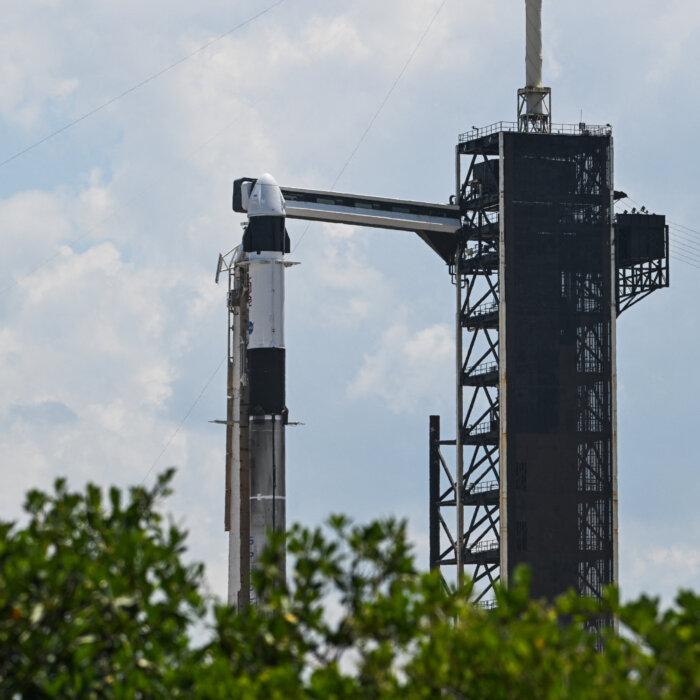
Despite the launch delay, NASA confirmed that Crew-11 would arrive at the space station at the time originally planned.
Following the crew’s arrival, they will participate in a three-day handover period with the Crew-10 mission.
During that time, Yui will reunite with fellow JAXA astronaut Takuya Onishi, a member of Crew-10. According to Kazuyoshi Kawasaki, associate director general at JAXA’s Space Exploration Center/Space Exploration Innovation Hub Center, this would be the third time two Japanese astronauts have been on the space station together.
This was the third launch of the Dragon 9 booster, which made the final landing on Landing Zone 1 at Kennedy Space Center, the sixth flight for the Endeavor capsule, and SpaceX’s fourth crewed flight and fifth overall to the space station so far this year.
Crew-11 will then spend 6 months onboard, doing a variety of scientific experiments and conducting lunar landing simulations.
Dana Weigel, manager of NASA’s International Space Station Program, told reporters after the launch that the landing simulations were going to be mimicking the region of the moon’s south pole targeted by the Artemis moon program.
“The goal of this study is to really understand how the disorienting effects of microgravity impact piloting and landing, and then we‘ll take that feedback and we’ll put that into our planning for our tools and needs for the crew.”
They will also look at microgravity’s effects on the human body, continuing an ongoing study of the human body in preparation for long-duration missions to the moon and Mars. Those studies will include a look at the movement of fluids throughout the body, and eye damage that some astronauts have previously experienced, affecting their vision.
“We’re going to be using vitamin B supplementation to see if that helps with swelling in the back of the eye, and if it minimizes the eye conditions that can impair vision,” Weigel said. “And we'll also be looking at thigh cups to see if that helps with the overall shift of fluids in the body.”
The astronauts themselves will be the test subjects.
The crew will also be tasked with receiving several visiting resupply vehicles throughout their mission.
SpaceX’s upcoming cargo mission will deliver a booster kit designed to help save fuel already onboard to keep the space station at an optimal altitude.
The most seasoned among the crew was Fincke, having already logged 381 days, 15 hours, and 11 minutes in space, including nine spacewalks, over his three previous trips to the space station for Expedition 9 in 2004, Expedition 18 in 2008, and the final flight of the Space Shuttle Endeavour, STS-134, in 2011. Crew-11 was his first trip to space in more than a decade.
Next in experience was Yui, who recorded 142 days in space serving as a flight engineer for Expeditions 44 and 45. He was the first Japanese astronaut to use the station’s robotic arm to capture JAXA’s H-II cargo vehicle, and he is expected to play a significant role in the capture of JAXA’s HTV-X unmanned vehicle.
Cardman and Platonov made their first-ever trip to space on Aug. 1.
Cardman and Yui found themselves on Crew-11 due to the grounding of Boeing’s Starliner capsule. Cardman was originally assigned to Crew-9 but had to give up her seat in order to bring Starliner’s test pilots Butch Wilmore and Suni Williams home. Meanwhile, Yui was training to fly a subsequent mission aboard the Boeing Starliner before NASA grounded it until 2026.
25 Years of Continuous Human Presence in Space
Crew-11 will be part of the 73rd and 74th Expedition crews, and will be on the space station on Nov. 2 to mark 25 years of continuous human presence in space, thanks to the International Space Station.Starting with long-duration crews of three, the station grew to accommodate long-term crews of seven, hosting as many as 13 astronauts at a time during short-term space shuttle visits in 2009 and 2012. When Dragon Endeavor arrives, the station’s crew will grow to 11 during the handover with Crew-10.
According to NASA officials, the space station has received more than 280 individuals from 26 countries during its near-quarter-century of service, conducting more than 4,000 groundbreaking experiments.
Primarily reliant on the United States for its life support systems and on Russia for its propulsion systems, but also dependent upon the participation of JAXA, the European Space Agency, and other partners, the station is set to remain operational until at least 2028. However, NASA officials have expressed their desire to keep it going until 2030. It will be retired by a controlled deorbiting into the ocean that is said to take roughly two years.
By that point, it is expected that private spacefaring companies such as Axiom and Vast Space will launch their own orbiting modules, which NASA will utilize to maintain its continued presence.
Bowersox told The Epoch Times that NASA’s private partners continue to make “great progress.”
“Our commercial partners for the future commercial space stations are making great progress on their different milestones for their Space Act agreements, and we’re excited,” he said, adding that hopefully NASA would be putting out a request for proposals for the next phase of that work.
But it is still unclear at this time whether NASA will have an alternative platform to utilize in Low Earth Orbit before the space station is retired.
“Whether we'll have them available right at the end of ISS [International Space Station], remains to be seen,” he said. “And the amount of time we have available to where we’re planning to deorbit ISS is pretty tight for actually getting the hardware done and launching it, but there’s still a lot that can change between now and then.”