The National Aeronautics and Space Administration (NASA) is the closest it has ever been to discovering signs of ancient life on Mars, according to Nicky Fox, associate administrator of the space agency’s Science Mission Directorate.
NASA announced on Sept. 10 that after a year of peer-reviewed research, a rock sample found on Mars could contain evidence that microbial life once existed on the planet.
The sample, called Sapphire Canyon, was taken by NASA’s Perseverance Mars rover in July 2024 as it explored an ancient riverbed in a location called Jezero Crater.
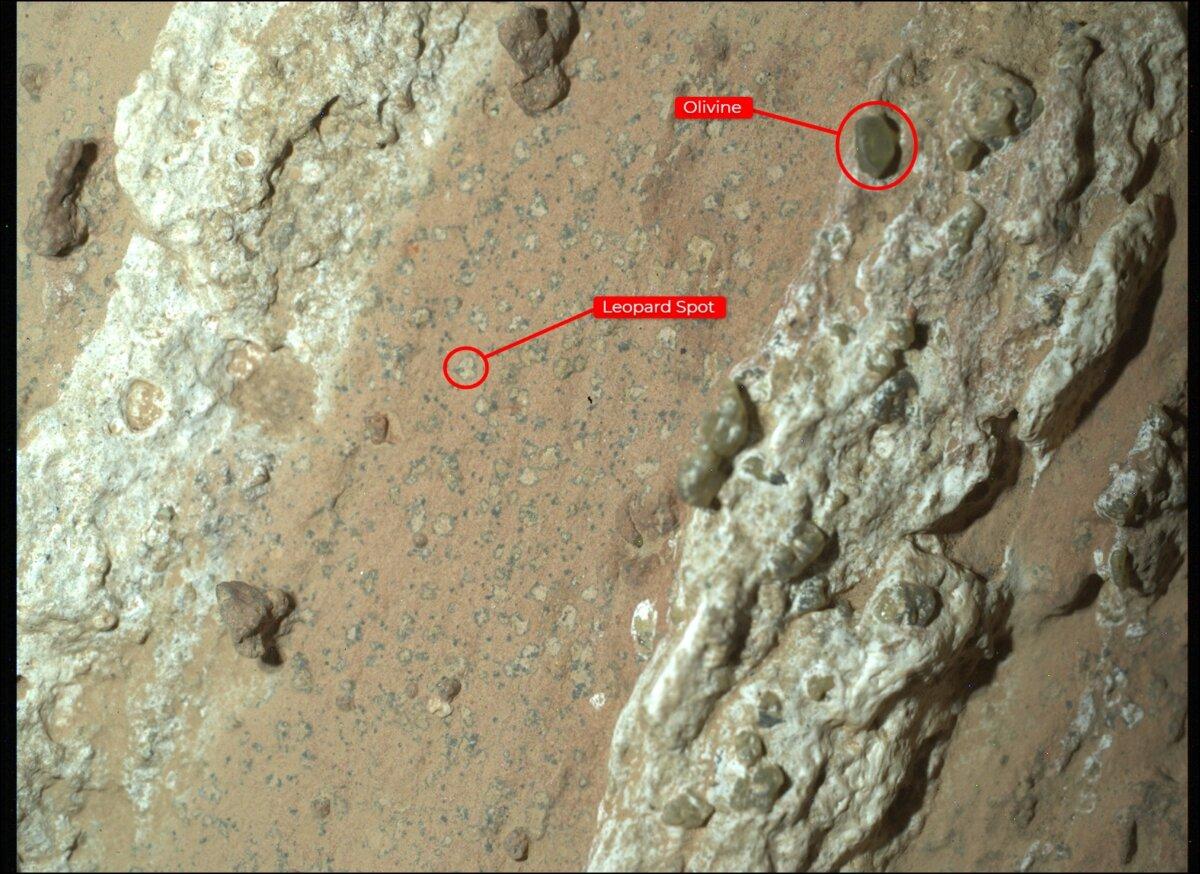
It was taken from a multibillion-year-old rock named Cheyava Falls, which was described as having “leopard spots” and could stand as evidence of ancient microbial life.
Those leopard spots were found to be made up of organic carbon, and two iron-rich minerals: greigite (iron sulfide) and vivianite (hydrated iron phosphate), the latter of which NASA said is frequently found in peat bogs on Earth, surrounding decaying organic matter.
Perseverance scientist Joel Hurowitz, of Stony Brook University and lead author of the paper, explained that those minerals are often the byproduct of microbial life that is consuming organic matter.

Fox said that “it’s kind of the equivalent of seeing like leftover fossils, you know, leftovers from a meal, and maybe that meal has been excreted by a microbe.”
Hurowitz said there were also nonbiological ways that those features could form.
He noted that they could not be ruled out just yet based on the data collected with the rover.
“What we need to do from here is to continue to do additional research in laboratory settings here on Earth, and ultimately bring the sample that we collected from this rock back home to Earth so that we can make the final determination for what process actually gave rise to these fantastic textures,” Hurowitz said.
The consensus was that the samples needed to be studied by instruments on Earth to know for sure.
“Ultimately, we conclude that analysis of the core sample collected from this unit using high-sensitivity instrumentation on Earth will enable the measurements required to determine the origin of the minerals, organics, and textures it contains,” the paper reads.
Built and managed by NASA’s Jet Propulsion Laboratory and Caltech, NASA’s Perseverance rover mission set out in 2020 to answer the question of whether life ever existed on Mars, as well as collect samples of Martian soil to be returned to Earth.
Duffy affirmed the importance of bringing these samples back to Earth—especially before communist China’s sample-return mission planned for 2028. But he said it would be different than originally planned.
“We have to look at all of our missions, and we have to look at the cost and the time on each of the missions that are going to be deployed and have been deployed,” he said.
“And because we care about resources, we care about the time frame, we believe there’s a better way to do this, a faster way to get these samples back.
“We’re not going to take it back on [Perseverance]. We’re going to actually figure out a different way to bring it back again, and we think we can do it faster and more cost-effectively.”