CAPE CANAVERAL, Fla.—Humanity’s next ride to the moon made its way out to the launchpad on Jan. 17, and NASA leadership marked the special occasion as the culmination of the global effort that made it a reality.
“We see this beautiful hardware behind us, the SLS, the Orion,” NASA astronaut and Artemis II mission commander Reid Wiseman said at a press conference.
“But for this crew, we’ve been on this journey for about two and a half years, and we just, we truly look at that and see teamwork. We see global cooperation. We see a strong nation leading the way.”
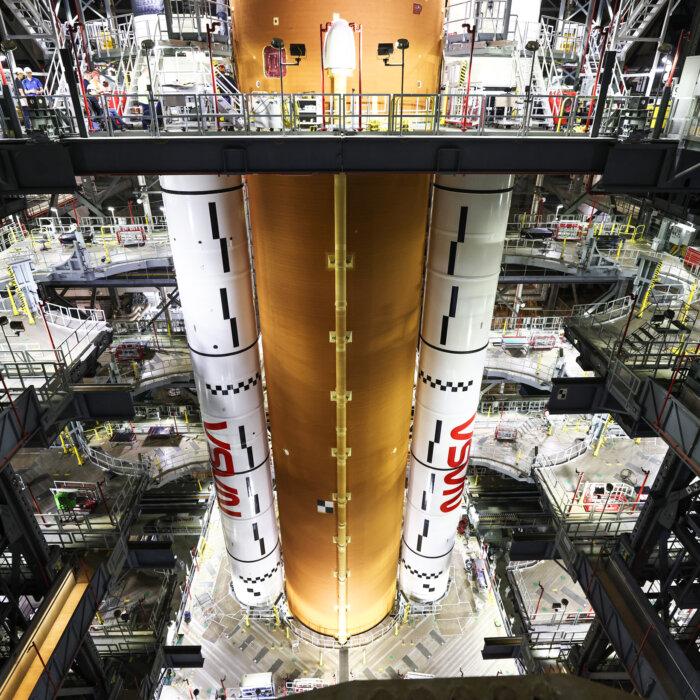
Called the Space Launch System, the towering orange and white rocket capped with the Orion crew capsule began crawling out of the Vehicle Assembly Building at 7 a.m. EST as crowds of NASA employees and their families waited outside.
Flanking the building was a fence bearing poster after poster, each representing a team that had a hand in building the rocket. Each poster was signed by individual team members.
“We don’t do it alone,” NASA administrator Jared Isaacman said, praising the “army” of personnel behind the mission and the entire Artemis campaign to return humans to the lunar surface.
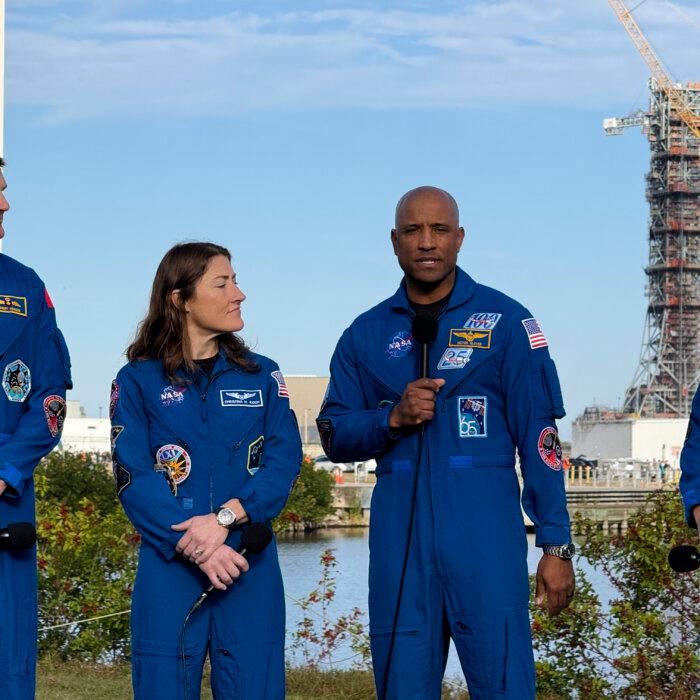
“We have commercial partners. We have international partners that are involved in this, but we have thousands of people that have brought us to this moment, the thousands of people that have been working near 24/7 preparing us for this rollout, the thousands of people across the country that trained and prepared this crew to undertake this mission, the controllers that will look out for them on space, the recovery crews that will bring them safely home to their family at the conclusion of their 10 day journey.”
Wiseman recounted visiting the men and women who had a hand in building the components of the rocket he and his crewmates—Victor Glover, Christina Koch, and Jeremy Hansen—will fly not just around the moon, but also deeper into space than any other humans have traveled before.
Wiseman’s grand tour included stops in Utah, Colorado, Louisiana, and Germany to meet the men and women of Boeing, United Launch Alliance, Airbus, and Lockheed.
Wiseman also praised the exploration ground systems team led by Artemis launch director Charlie Blackwell-Thompson for hitting every milestone over the past year to make the day’s rollout possible, as well as the flight control teams in Houston led by flight director Jeff Ratigan.
Hansen elaborated on international cooperation as the first Canadian chosen to fly beyond Earth’s orbit.
“I’ve really applauded the American space leadership because they carved out space for Canada to hone some of our skills, to develop workforce in specific areas, and to bring that knowledge,” he said.
“And the future for Canada kind of looks like where the international collaboration wants to go. We aren’t leading that collaboration. NASA is leading that collaboration and inviting our participation.”
“We have skill sets, and I know Canada will rise to the challenge, just like they did in the Artemis,” he said. “When we were asked to join Artemis, we started to lean into developing new robotic systems for Deep Space, even we’re working on lunar surface stuff now. So we'll just bring that workforce to bear to meet joint, collective objectives.”
Reid, Hansen, and their fellow crew members also touched on their families and the work needed to prepare them for the mission. That work included having difficult conversations, going through estate planning, and watching the Artemis I launch video to help loved ones know what to expect along the way.
Glover, Artemis II’s pilot, specifically highlighted the support system among fellow astronauts when it comes to taking care of family members left behind.
“We’ve all got someone, an astronaut that is going to be with our family members when they’re watching launch, which can be this terrific and terrifying moment, all at the same time,” Glover said. ”And so I’m just really grateful to that team that helps us to get ready.”
He recalled being the support person for Isaacman’s family during the Polaris Dawn mission in September 2024.
“I was here to support a colleague and their family while they watched their loved one launch,” Glover said. ”That’s my favorite role in this office. That is my most cherished, honored experience that we get to do with and for each other.”
The crew is due to enter a quarantine period on Jan. 23, before and during which they will most likely receive additional training. Meanwhile, their rocket will undergo testing, integration, and system power-up, as well as a wet dress rehearsal of launch day.
If all goes well, Wiseman, Glover, Hansen, and Christina Koch will join the Space Launch System out on the pad and begin their 10-day trip around the moon, and that could happen as early as Feb. 6.
“We really are ready to go,” Wiseman said.