Middle East Peace Talks Resumed

September 6, 2010 Updated: September 9, 2010

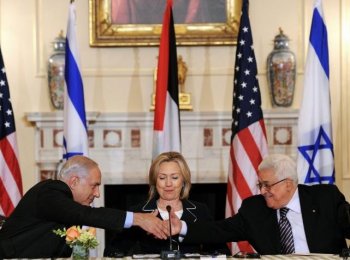
Secretary of State Hillary Clinton (C), looks on as Israeli Prime Minister Benjamin Netanyahu (L) and President of the Palestinian Authority Mahmoud Abbas (R) shake hands at the U.S. State Department on Sept. 2. (Jewel Samad/Getty Images)
WASHINGTON—The direct peace talks between Israel Prime Minister Benjamin Netanyahu and Palestinian President Mahmoud Abbas began with high hopes on September 1, with President Barack Obama hosting a dinner for the negotiating parties at the White House. Talks began between Netanyahu and Abbas the following day in the presence of Secretary of State Hillary Clinton. Both sides agreed to Obama’s requirement that the talks be completed within one year’s time.

Given previous failures to reach an agreement, prospects of success for this new round of talks are the source of caution if not skepticism on the part of some Middle East scholars.

“It's hard to be optimistic about these direct talks. … Beyond the kind of symbolism of hope such talks produce, the reality is that at the domestic political level, neither the Israelis nor the Palestinians are capable of making the types of concessions that are necessary to achieve significant progress,” said Steven A. Cook, Hasib J. Sabbagh Senior Fellow for Middle Eastern Studies on the Council of Foreign Relations.

Supporting the talks are Arab states interested in an overall Middle East peace process. Present at the White House dinner, in addition to Netanyahu and Abbas, were President Hosni Mubarak of Egypt and King Abdullah of Jordan. Both are conservative Arab leaders, who will cover for Abbas should he strike a deal with the Israelis and find himself under attack by Arab rejectionists who want no agreement with Israel.

End of moratorium threatens talks
The talks are beginning under the shadow of an event that has threatened to derail them almost before they begin. Under immense U.S. pressure, Israel agreed to a moratorium on further building in the West Bank, a partial freeze to end on September 26. One of the major stumbling blocks to reaching an accord has been Israel’s expansion of its settlements on the West Bank—territory that the Palestinians claim under a Palestinian state.

Abbas wanted a total freeze on settlement construction imposed as a condition to renew talks, but reluctantly agreed to the talks. Netanyahu would not agree to a total freeze because he cannot afford to upset his fragile right wing coalition, some of whom are vocal about not continuing the moratorium.

From his perspective on the Council of Foreign Relations, Cook notes that "even though there's been a moratorium, there's been a bit of a construction boom in the West Bank." Cook says the 10-month new construction moratorium was directly related only to new housing projects in the West Bank. “Whatever construction was in the pipeline when Netanyahu agreed to this moratorium has continued," he said.

A reluctant and partial Israeli freeze makes the Palestinian position difficult. Abbas is “vulnerable to political attacks from Hamas, because the negotiations rarely lead anywhere,” said Cook. Abbas is also weakened in this round of peace talks because there has been a fractious Palestinian Authority dating back to January 2006. When Hamas won a majority in the Palestinian Parliament in June 2007, Hamas then took over Gaza by force.

According to various media reports, Abbas gave a note to the president of the United States on September 1, in which Abbas said that if settlement activities resume after September 26, it will be extremely difficult for him, probably impossible, to continue with the negotiations.

Continued on the next page…