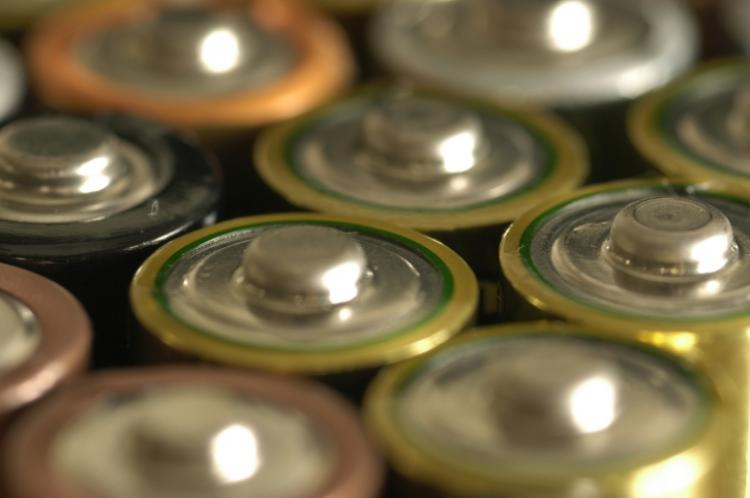
Rechargeable batteries. Many of our gadgets depend on them, and battery developers know that recharging batteries repeatedly will eventually wear them down. But understanding why they break down has never been exactly clear—until now.
High-resolution images produced by researchers at the U.S. Dept. of Energy’s (DOE) Pacific Northwest National Laboratory (PNNL) reveal that the nanomaterials found inside these rechargeable batteries become contorted and damaged from repeated stress from charging. These findings offer new insight into finding more resilient materials to make longer lasting batteries. Results were published in a recent issue of the journal Science.
Lithium ions are naturally attracted to electrons—this is the principle responsible for the rechargeable lithium battery. Positively charged lithium ions normally hang out in the battery’s positive electrode, where a metal oxide shares its electrons with lithium.
But recharging shakes things up. When a battery is charging, free electrons are pumped into the negative electrode, which sits across a sea of electrolytes that lithium ions can cross but electrons cannot. Lithium wants the electrons on the negative side more than the electrons it shares with the metal oxide on the positive side, so lithium ions flow from the positive to pair up with the free electrons on the negative electrode.
When a device using a battery is turned on, however, it allows electrons to slip out of the negative electrode, leaving the lithium ions without a mate. Without free electrons, the lithium ions return again to the positive electrode.
The PNNL research reveals that all this back and forth action of the lithium ions is hard on the tiny structures inside the battery. When these nanowires become charged with electricity they actually change shape—swelling, elongating, and spiraling.
The nanowires of the battery’s negative electrode were found to swell by a third and double in length when subjected to lithium ions. Scientists say that the stress on these nanowires can eventually damage them, as tiny defects accumulate over time.
The lithium ions were also shown to change the metal (in this case, tin) oxide nanowires from a neatly arranged crystal to what researchers described as an “amorphous glassy material,” in which atoms were arranged more randomly.
“Nanowires of tin oxide were able to withstand the deformations associated with electrical flow better than bulk tin oxide, which is a brittle ceramic. It reminds me of making a rope from steel—you wind together thinner wires rather than making one thick rope,” said Chongmin Wang, a materials scientist at PNNL in a statement for the project.
Wang, chemist Wu Xu, and others previously succeeded in taking a snapshot of a partially charged, larger nanowire one-hundredth the width of a human hair, but this project did not reveal the charging in action.
To view the dynamics of a charging electrode, Wang and Xu enlisted the help of other laboratories and used a specially outfitted transmission electron microscope to set up a miniature battery, allowing researchers to image even smaller wires while charging it.
The team used a battery that included a positive electrode of lithium cobalt oxide and a negative electrode made from thin nanowires of tin oxide. Between the two electrodes, an electrolyte provided a conduit for lithium ions and a barrier for electrons. The electrolyte was designed to withstand the conditions in the microscope.
When the team charged the miniature battery at a constant voltage, lithium ions ran through the tin oxide wire, drawn by the electrons at the negative electrode. They observed that the wire swelled and lengthened by about 250 percent in total volume, and twisted like a snake.
Wang hopes that this work will stimulate new ideas for energy storage and inspire a design for a better battery.
High-resolution images produced by researchers at the U.S. Dept. of Energy’s (DOE) Pacific Northwest National Laboratory (PNNL) reveal that the nanomaterials found inside these rechargeable batteries become contorted and damaged from repeated stress from charging. These findings offer new insight into finding more resilient materials to make longer lasting batteries. Results were published in a recent issue of the journal Science.
Lithium ions are naturally attracted to electrons—this is the principle responsible for the rechargeable lithium battery. Positively charged lithium ions normally hang out in the battery’s positive electrode, where a metal oxide shares its electrons with lithium.
But recharging shakes things up. When a battery is charging, free electrons are pumped into the negative electrode, which sits across a sea of electrolytes that lithium ions can cross but electrons cannot. Lithium wants the electrons on the negative side more than the electrons it shares with the metal oxide on the positive side, so lithium ions flow from the positive to pair up with the free electrons on the negative electrode.
When a device using a battery is turned on, however, it allows electrons to slip out of the negative electrode, leaving the lithium ions without a mate. Without free electrons, the lithium ions return again to the positive electrode.
The PNNL research reveals that all this back and forth action of the lithium ions is hard on the tiny structures inside the battery. When these nanowires become charged with electricity they actually change shape—swelling, elongating, and spiraling.
The nanowires of the battery’s negative electrode were found to swell by a third and double in length when subjected to lithium ions. Scientists say that the stress on these nanowires can eventually damage them, as tiny defects accumulate over time.
The lithium ions were also shown to change the metal (in this case, tin) oxide nanowires from a neatly arranged crystal to what researchers described as an “amorphous glassy material,” in which atoms were arranged more randomly.
“Nanowires of tin oxide were able to withstand the deformations associated with electrical flow better than bulk tin oxide, which is a brittle ceramic. It reminds me of making a rope from steel—you wind together thinner wires rather than making one thick rope,” said Chongmin Wang, a materials scientist at PNNL in a statement for the project.
Wang, chemist Wu Xu, and others previously succeeded in taking a snapshot of a partially charged, larger nanowire one-hundredth the width of a human hair, but this project did not reveal the charging in action.
To view the dynamics of a charging electrode, Wang and Xu enlisted the help of other laboratories and used a specially outfitted transmission electron microscope to set up a miniature battery, allowing researchers to image even smaller wires while charging it.
The team used a battery that included a positive electrode of lithium cobalt oxide and a negative electrode made from thin nanowires of tin oxide. Between the two electrodes, an electrolyte provided a conduit for lithium ions and a barrier for electrons. The electrolyte was designed to withstand the conditions in the microscope.
When the team charged the miniature battery at a constant voltage, lithium ions ran through the tin oxide wire, drawn by the electrons at the negative electrode. They observed that the wire swelled and lengthened by about 250 percent in total volume, and twisted like a snake.
Wang hopes that this work will stimulate new ideas for energy storage and inspire a design for a better battery.