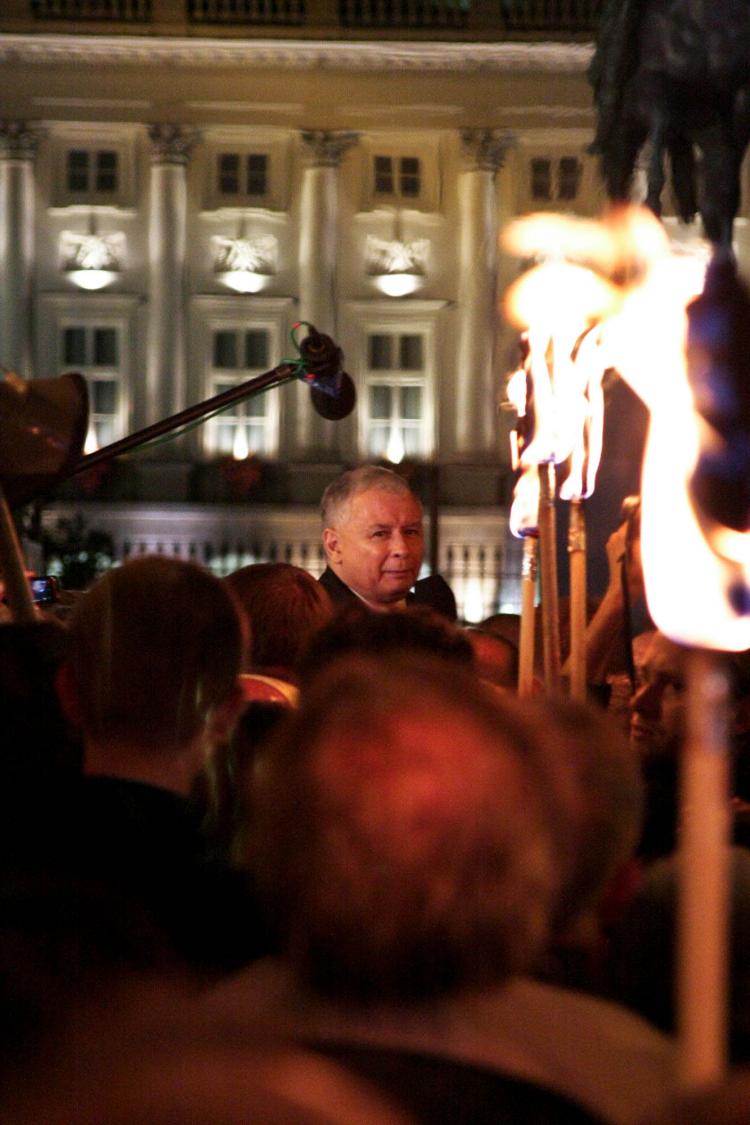
For months now, on the 10th of each month, supporters of the late president have demonstrated at the presidential palace to demand the memory of Kaczynski be appropriately honored. Friday night, Sept. 10, the demonstrations were led for the first time by former Prime Minister Jaroslaw Kaczynski—twin brother of the late president. Joining him at a torchlight rally were protesters from across the country as multiple pilgrimages converged on the presidential palace, Warsaw’s equivalent to the White House.
Thousands of protesters carrying flags, crosses, and torches descended on what's become a battleground in recent months between right-wing Catholic conservatives and left-wing secular liberals.
Seeds of Discontent
In the days that followed the fateful plane crash in Smolensk, Russia, a Boy Scout troupe erected the simple wooden cross outside the presidential palace. The Scouts maintained the site, managing the wreaths and the sea of candle lanterns that grew rapidly as the nation grieved.
After the initial mourning period, the government announced it would move the cross to the nearby church of St. Anne, which thus sparked the current controversy.
Supporters of the late president are determined not to let the cross be moved unless it is replaced with an appropriate permanent monument. They have physically fended off attempts by police to remove it. The cross has now become the focus of conflict between a very polarized Polish society.
The Political Divide
The “defenders of the cross,” as they have been dubbed by the Polish media, are supporters of the late president and his party, the opposition Law and Justice Party. They represent right wing, Catholic conservatives, characterized by being highly patriotic, traditionalist, and generally distrustful of both Russia and Germany. Often with rural roots, they are broadly representative of the older generation who personally experienced the ills visited upon Poland by both the Nazis during the second world war, then the communist regime imposed by Soviet Russia.
Many have family members who were murdered by the Soviets in the 1940 mass execution of Polish elite in the Katyn forest, near Smolensk, Russia, where the plane went down. The president and his entourage had been en route to Russia to a ceremony commemorating 70 years since the massacre.
They fear the government is sweeping under the carpet unexplained aspects of the Smolensk tragedy, and that removing the cross is designed to dilute the legacy of the late president. Some journalists and investigators in this camp have suggested that the crash was an orchestrated assassination.
On the other side of the chasm are the Poles who see themselves as progressive, cosmopolitan, and unencumbered by the conventions of tradition. They are mostly young, liberal, business savvy, and inclined to forgive and forget the horrors of the past in return for a prosperous present, marked by free trade with Poland's biggest trading partners, Russia and Germany. They are enthusiastic about being part of the European community.
They describe their opponents as stodgy, Eurosceptical, nationalistic, provincial, and paranoid, and say it’s time to draw the line under the tragedy. They would like to revert to business as usual, and see the vehement defense of the cross and call for a monument as embarrassing. They, in turn, are seen by the cross supporters as anything-goes liberals, leftist, consumerist, anti-clerical, and naive.
So the 9-foot cross has become a symbol of what Poles want for their country. And the sidewalk in front of the presidential palace is where the two collide.
In the hours leading up to the march, as the crowd swelled into the hundreds, scuffles and shouting matches broke out, with several people being taken away by the police.
At about 9:00 p.m. the former prime minister arrived with the bulk of the pilgrims, accompanied by an entourage of Law and Justice politicians and event organizers, all bearing burning torches.
Kaczynski delivered a speech, in which he called for a monument to be erected in place of the cross that would “honorably commemorate all the victims of the Smolensk tragedy.” He thanked the participants for joining in a “beautiful demonstration” that reminded him of the freedom marches in 1968 and 1980 protesting communist rule. He also called for the demonstrators to disperse peacefully afterward.
His speech was interrupted by shouts from the opposing camp that although heavily outnumbered that night, could still be heard, and made their presence felt. One young man ran up to a demonstrator who was holding a cross, wrested it out of their hands, and ostentatiously broke it in two, which elicited shouts of protest from the crowd.
Police intervention was minimal and at around 10:00 p.m. the crowd dispersed leaving the battleground empty, save for a wooden cross, and some police barricades.