


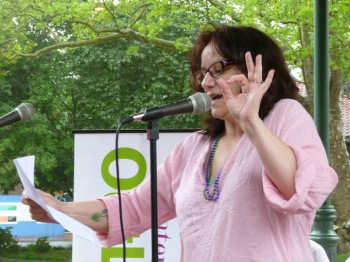
NEW YORK—Staten Island poet Marguerite Rivas told the story, through her poems, of how she and many of her neighbors experienced the tragedy of September 11, 2001 and its aftermath.
Some of her poems are now in the National September 11 Memorial and Museum. Rivas is also a literary scholar. She holds a Doctor of Arts and Letters from Drew University and a Masters Degree in English Literature from the City University of New York.
Ten years after the tragedy, she reflected on her poems, the effect they have had on herself and others, and on the use of art to confront catastrophe.
The Epoch Times: Could you share a little about how expressing your feelings about 9/11 through art affected you?
Marguerite Rivas: Well, I think that my poetry, especially poems like Witness and Don’t Tell Me Brother, Years of Fallout Are Still Ahead are poems of witness, cementing pivotal moments in time that were imprinted on my psyche as, well as the psyches of many of us who experienced the shock and grief of that day.
I don’t remember writing much of anything right after 9/11 except for email to my best friend, Kathleen, a native Staten Islander who had just moved to Denver. She kept my email for me, and sent it back to me when I recovered a bit, because that was basically all I wrote then. I think Witness came out of that batch of emails.
I write poetry, not just to express my feelings through art, but to “tell the tale” of my “tribe,” to quote Ezra Pound. No two people have the same experience, of course, but when Staten Islanders hear me read my 9/11 poems, or they are read at events, they evoke powerful responses from listeners, heads nod in assent and recognition of a shared experience, people sometimes weep.
My Aquehonga Night Chant (“Aquehonga” is one of the original names for Staten Island.) was a poem that was staged by Staten Island OutLoud, a community dialog and performance project, for the anniversary of the founding of Richmondtown, our one-time county seat.
It was staged for three voices with a chamber orchestra playing as it was read. I started to sob when I heard it, as did people around me. One of the readers, a professional, got choked up during the reading of the piece.
It was clear that my poetry not only expressed my feelings, my hope, and my grief, but the feelings of those among whom I live, and have lived all my life.
Actually, Aquehonga Night Chant is probably the first poem I remember writing with intention after 9/11. I was on my way home from a funeral for a firefighter and had just read the Navajo night chant. I was on the ferry and looked around me and saw my fellow Islanders, all of us sad, anxious, and grief-stricken, thought of my Island home and how many people here suffered, and it just came out.
Epoch Times: When you wrote your poems about the tragedy, how did you feel?
Marguerite Rivas: Numb and immersed at the same time.
When I wrote Witness I felt like I was there again, exactly there again, standing with people, watching that tower burn and fall, like it was a dream. Like it wasn’t happening.
So when I wrote Witness I was in a zone, right back there standing at the shore, scrambling, frantic in a sort of flashback. A flashback so vivid that my heart races a little as I write this now.
It’s seared into my brain, as is the color of the deep blue sky and the golden September sunshine of that morning. I lived near a church at the time, and I worked at night, so I would hear the bagpipers tune their bagpipes to Amazing Grace while I wrote in my home office, so there was this knee-jerk flashback that would happen, and tears would come unbidden. It was horrible.
I went to many funerals/memorial services, and when they were firefighter’s funerals, Amazing Grace was always played. So sometimes, even if I was doing something else, I'd try to write to make the fear go away for a minute or so.
Sometimes I just wrote journal entries, and sometimes I‘d write long letters to my friend in Denver knowing that she’d keep my writing safe for a time that I could look at it without fear. I was so very fortunate that no one in my family died at the WTC despite having four firefighter brothers-in-law, but I lost a good friend and people who were the fabric of my community—kids basketball coach, neighbors, students’ husbands, school friends, like that.
But whether you went to one funeral or none, it was terrifying and so sad here on the North Shore of Staten Island as it was in other places on Staten Island. Staten Island suffered so many losses, over 270, for New York City’s smallest borough.
Epoch Times: In what ways did it help you to write about 9/11?
Marguerite Rivas: In the beginning, writing didn’t help me at all. It just was. I am a writer, so it was just something that I do. Writing is one of my jobs.
However, I started to do a workshop here and there, for the New York Public Library or Poets House later on, and I realized that writing can be an outlet for many people. Also, it was when I was hired as a teaching artist and trained by FEMA under its “Project Liberty” program (where I was partnered with painter, Sarah Yuster, our first collaboration) that I truly understood the power of art and writing in the recovery process.
With this understanding came acknowledgement that it was an outlet for me, to speak to the paper and to put it away for another day.
Also, my then-husband (now my ex-husband) was hospitalized for a psychiatric admission, and things started to fall apart for us both internally. I was heartbroken; I was angry. It was the last straw, I guess, and I felt sad and sick all the time myself. Those “secret messages” came out of some of that sadness.
I was aware that I was writing things and not re-visiting them and saving them when I could write again. It was weird. It is still strange.


