Just think of it: This magisterial achievement, which belongs uniquely to America, has been adopted by most parts of the world and is the dream and goal of every good society. Everything is measured against it, even all these years later.
The document itself is a masterpiece of rhetoric, both precise and sweeping in its claims, arguments, and conclusions. It’s embarrassing to me that it is approximately the length of one of my articles for The Epoch Times, including this one.
I’ve never written anything as meaningful and impactful or even as well composed from a literary point of view. Indeed, I’m not sure that anything but the Gospels compares in persuasive power and substance, such that it still packs a punch two and a half centuries later.
I revisited the document to find its themes and tease out of it one single principle that rises above the rest. The answer is obvious from the title. It is exactly what the title says, a declaration of independence from Britain, the colonial masters that ruled for 169 years and had intensified control over the previous decade.
The idea of independence from foreign powers is the beating heart of the entire American idea. Should we ever give that up, we’ve certainly lost the plot.
The signers were profoundly aware of the importance of what they were doing. Under what authority would they decide on their own to throw off their colonial masters? What is the philosophical basis, and what are the facts of the case that create a conflict with that philosophy? By which measure? And who or what would make independence happen? Is it enough just to sign a piece of paper? And what happens then?
They knew that the burden of proof was on them. They were willing to bear it.
Anticipating all these issues, the Founders laid out their philosophical priors with a wildly interesting statement drawn from centuries of political reflection. Most directly, this outlook was drawn from English political writer John Locke, but it found its roots in the Middle Ages in the writings of Thomas Aquinas and in the words and example of Jesus of Nazareth before that.
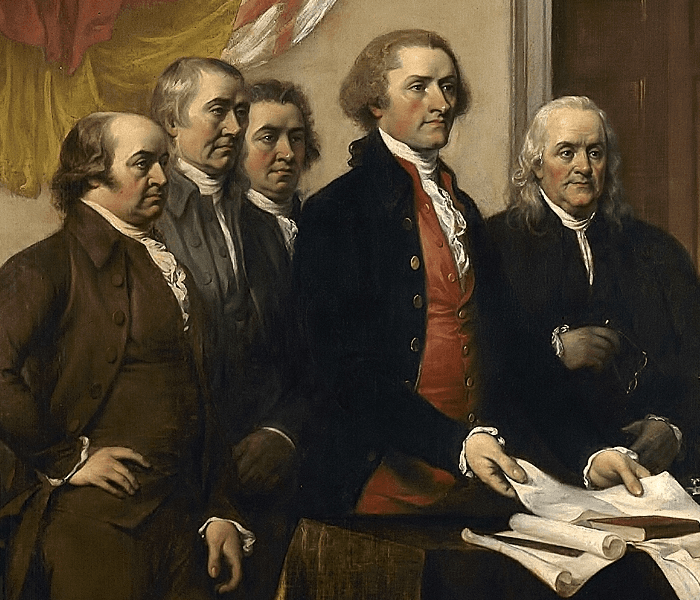
How can all this be boiled down into a single statement? Thomas Jefferson tried his hand, and this was the result:
“We hold these truths to be self-evident, that all men are created equal, that they are endowed by their Creator with certain unalienable Rights, that among these are Life, Liberty and the pursuit of Happiness. — That to secure these rights, Governments are instituted among Men, deriving their just powers from the consent of the governed, — That whenever any Form of Government becomes destructive of these ends, it is the Right of the People to alter or to abolish it, and to institute new Government, laying its foundation on such principles and organizing its powers in such form, as to them shall seem most likely to effect their Safety and Happiness.”
The argument as framed in its opening is decisive, even morally dogmatic. But keep in mind: The Founders were not looking to forge a perfect world. They were not enticed by delusions of some utopia wherein every sin against rights has an easy path to eradication.
They were not Rousseauians, who later became the Jacobins who led the French Revolution to ruin. As Russell Kirk used to observe, the Declaration and the drive for independence was, in many ways, a conservative effort. They wanted a restoration of the liberties that they once had.
The Founders were trying to find the best and most prudent but morally necessary means of protecting the lives they had built and lived, without the constant annoyance and deep hindrance of foreign imperial rule.
Thus the second sentence, which is just as important as the preceding:
“Prudence, indeed, will dictate that Governments long established should not be changed for light and transient causes; and accordingly all experience hath shewn, that mankind are more disposed to suffer, while evils are sufferable, than to right themselves by abolishing the forms to which they are accustomed.”
There is profound wisdom in that statement as well. It puts a damper on the revolutionary spirit that has caused so much wreckage in the modern age. This was not really about some far-flung attempt to reset history. The goal of the effort was very precise: gain political independence.
So how do we know when the time has arrived to throw off the status quo in favor of an achievable separation from the foreign hegemon? The document gives the standard too:
“But when a long train of abuses and usurpations, pursuing invariably the same Object evinces a design to reduce them under absolute Despotism, it is their right, it is their duty, to throw off such Government, and to provide new Guards for their future security.”
You see the model here? We have the ideal clearly stated. We have the prudential reasons to be cautious about far-flung and ill-thought-out attempts to achieve it by any means. We have the standard of measurement and the conditions under which men should act. And then, in perfectly logical order, we are given the evidence.
- He has erected a multitude of New Offices, and sent hither swarms of Officers to harass our people, and eat out their substance.
- He has kept among us, in times of peace, Standing Armies without the Consent of our legislatures.
- He has affected to render the Military independent of and superior to the Civil power.
- He has combined with others to subject us to a jurisdiction foreign to our constitution, and unacknowledged by our laws; giving his Assent to their Acts of pretended Legislation.
- For Quartering large bodies of armed troops among us.
- For cutting off our Trade with all parts of the world.
- For imposing Taxes on us without our Consent.
Britain and its industrial kings regarded the American colonies as a host for predation: its resources, its labors, its landowners, and its innovations. The purpose of America, so far as the British Crown was concerned, was for exploitation. It required exclusive trade deals. It forbade the Americans from developing their own trade relationships, even for agricultural products. It added injury to insult by adding taxes on the products and services the colonies consumed.
Thomas Paine wrote in “Common Sense”: “America is only a secondary object in the system of British politics. England consults the good of this country, no farther than it answers her own purpose.”
The ambition of independence was not only about politics, justice, and law; it was also about finance, economics, and enterprise. The Boston Tea Party underscored the point. This was a protest against an industrial monopoly enforced by a foreign hegemonic power. All these monopolies were revenue sources, backed by law: the Navigation Acts (1651), the Sugar Act (1764), the Stamp Act (1765), and the Townshend Acts (1767).
When it came time to imagine what kind of government would exist in America, the Founders chose independence as a first principle.
“Peace, commerce, and honest friendship with all nations—entangling alliances with none.” — Thomas Jefferson.
“The great rule of conduct for us in regard to foreign nations is in extending our commercial relations, to have with them as little political connection as possible.” — George Washington
“The means of defence against foreign danger have been always the instruments of tyranny at home.” — James Madison
Most famously, John Quincy Adams summed up the lesson and ethos of the American idea: “Wherever the standard of freedom and independence has been or shall be unfurled, there will her heart, her benedictions, and her prayers be. But she goes not abroad in search of monsters to destroy. She is the well-wisher to the freedom and independence of all. She is the champion and vindicator only of her own.”
The semiquincentennial is a time for renewal in our core values as a nation. Pray that we never forget them.