It’s a trope of Western culture that we want meaning from the turn of one century to another. We have the salient sense that the past is left behind and a new era is opening. Intense curiosity prevails about what is next. This desire can take the form of apocalyptic prediction (remember the panic about Y2K?), technological speculation, and artistic ambition.
You know this if you were around in 1999, the excited sense of anticipation. We know that such moments are artifacts of systems of time we make up—man’s construct, not God’s—but we cannot shake the sense that there is magic behind the turning of the century.
A version of this also prevailed in 1899 too. Invention was omnipresent: telephony, photography, sound recording, steel and resulting bridges and tall buildings, internal combustion, the promise of flight, electrical everything, prosperity blooming. In Europe, the habit prevailed of looking to the composers to provide interpretation.
In the Austro-Hungarian culture of music of the preceding decades, a battle raged between the ethos of Richard Wagner (1813–1883)—whose music celebrated heroic nationalism, myth and legend of battle-hardened people, and the apotheosis of Hegelian achievement—versus the sweetness of Johannes Brahms (1833–1897) with his celebration of private life, love and imagination, and bourgeois life.
In this battle, we had brash and bold Bismarkianism versus the quiet liberalism of the old German city states of the Middle Ages. Who would win?

Gustav Mahler (1860–1911) emerged on the scene to settle the dispute with a new way of thinking entirely. He already developed a mighty reputation as a conductor, so confident in his ways that he even had the temerity to write new arrangements of some of the most famous compositions of J.S. Bach and Ludwig van Beethoven.
He was also a new voice for composition, blasting onto the scene with his mighty 1st Symphony, named “The Titan” for a reason. And yet it seemed almost superficial in light of the 2nd, dubbed “The Resurrection,” which carried awesome power with all-embracing messaging.
The year was now 1901 and rumors of a 3rd symphony were everywhere, and some movements had already been performed. Mahler’s conducting schedule made the completion of this 6-movement masterpiece slow and delayed and no one had yet heard the whole.
Anticipation was high for what it would reveal about nature, time, and eternity. Something grand and cosmic: that’s what people had come to expect from Mahler, the new genius of the age.
But just before the 3rd could be performed in full, Mahler sketched a 4th symphony in only 10 days and finished the complete work while working over two summers. The premiere was 1901 in Munich, Germany, with Mahler as the conductor. What followed is almost incredible to consider in retrospect. There were boos and hisses in the audience, only scattered applause, and reviews in the papers that said unflattering things.
It’s amazing because today, the 4th is probably the most frequently performed of all 10 of his symphonic works. That’s not only because it uses a smaller scale orchestra than the others and only lasts one hour. It’s also because people adore it so very much. It connects deeply with the listener and has themes that stick in your head. It has an ethos about it that is uplifting, unfailingly charming, and celebrates the simple life with no pretense toward all-embracing meaning.
This is not what people were expecting. They wanted a philosopher-king with cosmic messaging; Mahler’s 4th revealed a poet of love, a minstrel of bourgeois life, a songster putting music to innocent visions of family, community, and small-scale commerce. The 4th disappointed the critics who expected something else, particularly given the moment of the turned century.
The question at the time was: Maestro Mahler, what is the meaning of this moment? What he gave them was sleigh bells, happy families, a funny fiddler, a quiet prayer, and a delightful song with a child’s view of heaven, complete with amusing commentary on the menial jobs that saints perform in an afterlife so much so that it seems much like this life.
Hence the strange anger at the first performance: This is not what the people demand. Mahler’s implied message of this symphony: The meaning you seek is all around you. Seek and you shall find.
The piece is strikingly dissimilar from all the others in his catalog. If you know Mahler’s works, you know there is tremendous focus on the opening thematics. I can tick through the list: the forest waking, the rumblings of danger, the dangerous depths of winter, the distant sound of a heavenly announcement, the beginnings of battle, the fears of death, the mighty cry of the spiritual realm, and so on.
With Maher’s 4th we begin with sleigh bells, the sound of a carriage on the move in the snowy winter months. It’s followed by sweet sounds of a melodic dance performed in safety and love, like a domestic scene. Already minutes in, you know there is something different happening there, not an epic story of life and death, time and transcendence, but a simple celebration of sounds and things we know from everyday life.
Just when it becomes complex, the score reverts to small melodies intoned by clarinets and flutes with gentle obligatos by violins, filled with trills and dance-like ascending scales, always with grace and charm. This is followed by long lines of melodies from cellos that call to mind the sensibility made famous in Beethoven’s 6th symphony—pastoral.
If you want to get a sense of what’s going on, imagine inhabiting the mind of a child discovering the world around her for the first time, filled with sights and sounds, treats and challenges, love and affection, and unfamiliar discoveries that leave unrelenting hopes for more. The sleigh bells return again and again to ground you on where you are. You are here, right now, surrounded by the people and things you love and love you.
That seems like the major idea here is domesticity—not battles, not empire, not even philosophy but rather just finding magic in the mundane. Was this because Mahler was anticipating his upcoming marriage with the hope of children? Perhaps.
Let’s talk about the second movement, which has the strangest feature about which you should know before you listen. It features what is called the Scordatura violin. It’s tuned a whole step above a regular violin (Normal tuning: G-D-A-E; Scordatura tuning: A-E-B-F♯). In performance, the concertmaster keeps the special instrument nearby and switches back and forth as the score requires.
It sounds eerie and macabre but also slightly fun, like a country fiddler. It is bright, strained, and slightly out of tune. In actual fact, the sound is meant to impersonate a figure from German folklore, the Freund Hein, a personification of death depicted as a grinning skeleton who plays a happy fiddle and leads people (or dances with them) into the afterlife. Death, this movement says, isn’t a tragic hero; he’s a slightly off-key country musician leading you to the next experience, and hence there is nothing to fear.
Again, we have distinct religious and rural messaging here, one that seeks to straddle the distance between earthly and heavily visions of utopia, strongly suggesting that one can become the other. The dance says goodbye to the old century and invites us into a new and better one, just as death leads to new life.
This leads to the third movement, which will send you into a swirling trance with its astonishing prayerful beauty. We have here the foreshadowing of a genre Mahler later perfected in his famed adagietto of the 5th and the powerful longings of the 9th. Here is the very slow tempo, the impossibly high strains of violins combined with rich alto melodies from violas. It is quiet and tender, dreamlike, completely intoxicating.
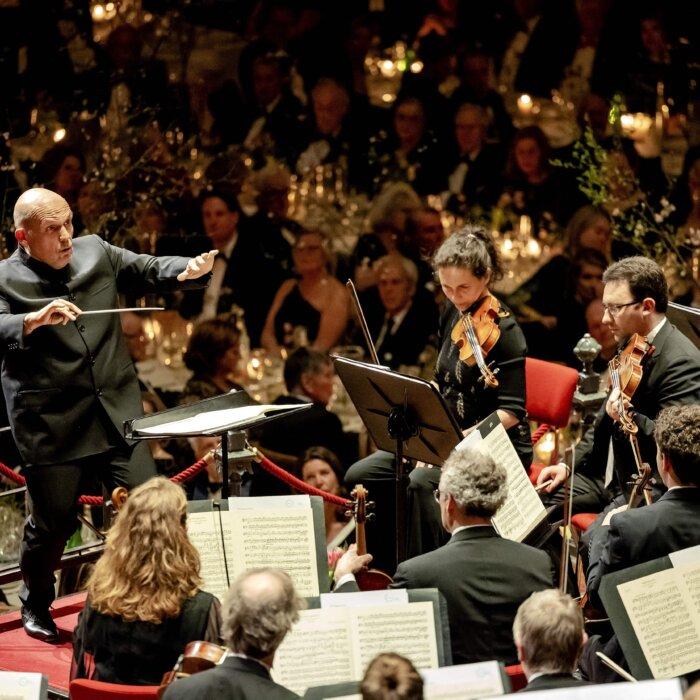
Listening live, as I did in Carnegie Hall last week, I felt tremendous anxiety for the horn player who has to manage very high registers on passages so fragile you fear that they could break at any moment. I cannot fathom that amount of breath control.
The prayer gradually comes to an end with eyes wide open to observe sunlight, meadows of flowers, dolls, and playtime of all sorts. This movement also contains the most dramatic music of the whole symphony as Mahler unleashes the bombast and pounding tympani for which he was already famous at the time.
With blasting horns and trumpets and soaring strings, one suspects that this could be the finale. It is not.
It’s the final movement I find most thrilling and surprising. The entire thing is a naive song from folklore about heaven sung by a single mezzo-soprano. The lyrics are divided into stanzas featuring the oddest description of heaven one can imagine. It has the passage of time and dancing but also cooking, a calendar, and all the mundane tasks one might expect on earth, as if, again, to say, heaven is all around you.
“We revel in heavenly pleasures,” she sings, “leaving all that is earthly behind us. No worldly turmoil Is heard in heaven; We all live in sweetest peace. We lead an angelic existence, And so we are perfectly happy. We dance and leap, And skip and sing; Saint Peter in Heaven looks on.”
She continues: “Saint Luke is slaying the oxen, Without the least hesitation; Wine costs not a farthing In the Heavenly tavern; The angels bake the bread. Fine sprouts of every description
are growing in Heaven’s garden. Fine asparagus, fine herbs, and all we desire, huge platefuls for us are prepared. Fine apples, fine pears and fine grapes, the gardeners let us pick freely.”
Each stanza is divided by a speedy and stirring riff accompanied once again by the sleigh bells we heard at the opening, only to settle back again to introduce a new stanza.
“You want venison, hare?” she continues. “In the open streets they go running around. And when there’s a holiday [fast] near, All the fishes come joyfully swimming; And off runs Saint Peter with net and with bait, towards the celestial pond. Saint Martha will have to be cook!”
This is all very charming and amusing if oddly puzzling: Who thinks this way? The answer is a child, and that is the answer to the entire mystery of this symphony. A young mind looking forward to a newborn century, with hope, glee, and utopian visions of the possible.
No, it was not what the audience wanted but it is what Mahler wanted to say. It was not long before the symphony overcame its initial reception and became a favorite of the entire symphonic repertoire.
As I say, I heard it live at Carnegie Hall, a place mercifully preserved so we can remember when symphony halls were elegant and human scale. Opened in 1891, the architecture of the building still dazzles with its pillbox-style seating, gentle lines, and a design that has one toe on the other side of the Gilded Age and initiating the step into the Art Nouveau: calmer, without ostentation, with a purer spirit.
There was so much promise in the air the night of the performance I attended, with that combination of symphony and hall imagined at the same time with the optimism for the future that turned to dust with the Great War a decade and a half later. The experience reminds us that there we should face the future without fear and always and ever with hope in the new, in those times and ours.
Consider this remarkable fact: Mahler himself conducted the New York Philharmonic at this very hall for a time after the debut of this symphony, conducting 70 concerts from 1907 to 1911. I sat in this space where he was and felt his spirit and the spirit of the past all around me. Strangely, once you know this history, the past doesn’t seem so long ago, almost yesterday.
Thanks to this performance, his outlook still lives among us; indeed it is the theme of our time: that which is rejected upon hearing is eventually embraced as prophetic. Always be the visionary, and, like Mahler, tell the truth as you see it.