When I was 12, I went to work for an organ repair company—not biological organs, but the kind in old churches. Pipe organs. I was paid in cash. And I absolutely loved the job.
I would crawl around in the loft, crunching dead pigeon bones under my feet as I made my way to the pipe that needed a repair. The repairs usually consisted of knocking out the dust and grime. I would find the pipe in question by listening as my boss played a key on the manual below. When I would find it, I would pull it, repair it, and put it back.
Mostly, I worked on the highest notes, which had pipes made of steel. Flutes, in effect.
My boss warned me to relax my throat throughout the day. This is because we unconsciously try to mimic the pitch, and the throat grows sore as the day goes on. The first day, I went home with a sore throat. The next day, I complied with his advice, and the problem disappeared.
I had no previous experience in this job, so why was I picked? Only years later did I think it through. It’s because I was small and skinny. I could make my way through the tiny chambers of the loft in ways that adults never could. Yes, my size and youth were exploited.

Warnings against “child labor” aside, I had the time of my life. We had to break to watch services, and I saw my first Catholic Mass, which I found magical and mystifying. I would never have seen that otherwise. Then we got back to work. When we finished with one church, we would move to another. I did this all summer. Those are some of the greatest memories of my childhood.
Yes, I was chosen for the job because of my youth and size, the same reason that kids were the chimney sweeps in Victorian England. The old pictures of kids in top hats and tails are real. They loved dressing up as aristocrats and getting filthy dirty by climbing in and out of chimneys and getting paid to do it!
Were there problems and tragedies? Yes, of course, but the solution was draconian: forced idleness and compulsory full-time school.
In 1936, President Franklin Roosevelt signed legislation that banned so-called child labor, which should really be called youth work. World War II came soon after, and young people were drafted and sent off to foreign lands while young kids did what they could for the war effort. Compliance with the new law was sketchy at best.
The new law did not really start affecting young people until the 1950s, and then we saw what happened when that generation grew up: the dawn of social anomie stemming from the “generation gap.” Sure, there was a gap: the first generation ever that knew not work.
Even when I was young, you could find a job as a youngster. This is pretty much impossible today unless your family owns a business, you work on a farm, or you are a child actor. These are all carve-outs in the law that survive to this day.
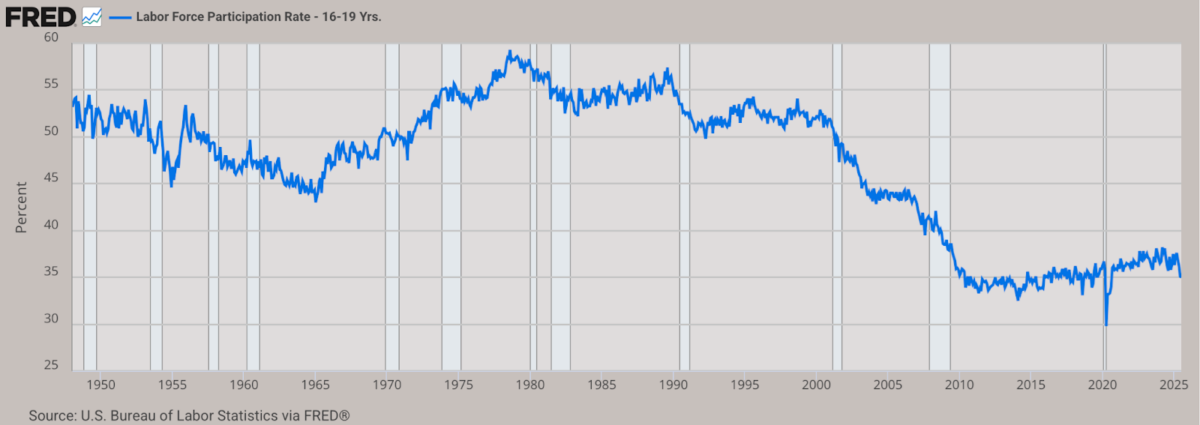
Technically, you can work from the age of 14, but the restrictions and mandates on employers are highly controlled. There are required waivers from schools and parents, plus a range of restrictions on what children can do. The kids cannot work much anyway, given compulsory schooling, so few employers even look at the applications. In reality, kids cannot work until they are 16, but even then, there are restrictions. After that point, kids have filled their extra hours with other things. This is why youth work has steadily declined.
Most kids now go to college and graduate without ever having held any kind of job at all. They are thrown into the workplace while waving around a degree that prepares them for nothing. They get angry at tasks, resentful of bosses, and find every possible way to goof off. This is because they were shaped entirely by the welfare state of college and otherwise coddled in classrooms for 18 years of nothing much. They simply are not prepared for work.
As for the kids in middle and high school, one in three is on some psych med to sedate them to sit quietly in a chair all day for 12 years. We have an epidemic of mental illness with new names that didn’t exist a century ago.
I blame Roosevelt for this. We have paid a huge cultural price. And now we see the birth rate collapsing, in part because children represent a gigantic cost to the household and zero benefit at all. No one likes kids to be “commoditized,” but you know what is worse? An economic arrangement that makes them only costly to the tune of a million dollars each. It’s no wonder the birth rate has collapsed.
This is simple economics. But for reasons I do not understand, anytime I bring up this topic, people try to shut me up. They are horrified that I’ve allowed my mind even to go there. After all, the abolition of “child labor” is one of the grandest achievements of modernity. That’s what they say.
Frankly, I’ve never understood the thinking here or the taboo surrounding rational discussion of this. Someone finally recently mentioned what is considered to be the best and most decisive argument for banning child labor. It is from Karl Marx, in his first volume of the book “Capital.” I decided to read it. He praised the UK Parliament for banning child labor in the Factory Act of 1844 and regaled the reader with the horrors of child labor.
I’m in no position to dispute the facts of the case. I’m sure it was all quite gritty and often horrible for the kids. That said, they were trying to make money and seizing on opportunities. Especially orphans. Was there exploitation? Surely. Does it make sense that government regulators got involved? Probably.
That said, Marx’s section on this topic includes a fascinating piece of theory on childhood. I had to read it several times to make sure I had it correct.
He wrote: “The intellectual desolation artificially produced by converting immature human beings into mere machines for the fabrication of surplus-value, a state of mind clearly distinguishable from that natural ignorance which keeps the mind fallow without destroying its capacity for development, its natural fertility, this desolation finally compelled even the English Parliament to make elementary education a compulsory condition to the ‘productive’ employment of children under 14 years, in every industry subject to the Factory Acts.”
Did you catch that? Marx is here offering a sweeping theory of childhood. He says a teen’s “natural ignorance” keeps “the mind fallow without destroying its capacity for development, its natural fertility.” Fallow is an unusual word here, but it refers to farmland left alone for a time to recover from previous planting so that it can be more fertile in future years. So the mind of a child, to Marx, is akin to farmland that should be allowed to rest.
Let me ask you: Do you think that is true? Is the young person really best off without any tasks, burdens, expectations, jobs, or any serious engagement at all? It’s not as if a 10-year-old is instead going to frolic through fields of flowers or otherwise push around a hoop with a stick. After all, in Marx’s view, even household chores or demands to clean the room or sit quietly in church would all spoil the “fallow” mind with its “natural ignorance” and “natural fertility.”
So this is not just about holding a job. Marx here seems to be decrying any expectations or tasks for kids at all! This is “Lord of the Flies” stuff, the creation of a criminal class.
I will say this much: This is a gigantic error. The worst possible thing for young minds is to experience forced idleness, such as we saw during the COVID-19 pandemic lockdowns, when kids could not go to school and instead had to sit in their bedrooms scrolling social media. This is the path of catastrophe. Talk about destroying natural mental fertility! This is a prescription for a life wholly wasted.
My main point is that Marx’s critique of remunerative child labor is actually much more than that. It is a wild theory of childhood itself, something like what you might find in Jean-Jacques Rousseau and other utopians who see society itself as inherently corrupted.
Imagine if we liberalized these laws. The kids could go to work at younger ages, giving them access to an adult world of responsibility and expectation. They could experience what it is like to be paid. They would learn to mingle among adults. They could encounter bosses and customers and swirl around in a world that is not just parents, teachers, and peers. They could gain insight into the way the real world works.
I can imagine a range of hybrid solutions. Kids could go to school in the morning, work in the afternoon, and study in the evening. Maybe they would be schooled for three days and then work for three days. Maybe school would be seasonal and work would be in the offseasons without following a strict pattern. Why must all this be so scripted by federal authorities?
It does not have to be salt mines, chimneys, or even organ lofts. It can be serving fast food, working in hotels and restaurants, gardening, or working as caddies on the golf course. Whatever. Anything that needs to be done. Parents can oversee matters and find the best path.
I fail to see any great catastrophe here. Where I see catastrophe is in forced lethargy and sloth. That simply has not worked.
Sorry for breaking a taboo, but I loved my job at 12, and I’m thrilled in retrospect that I faced real responsibilities and that at least one businessman saw my value. I’m sorry that kids today cannot experience the same. Marx was simply wrong about the youth and their needs.