



For centuries, battleships reigned supreme on the world’s oceans. From the age of sail through the ironclad era and into the 20th century, these floating fortresses decided empires.
Over time, the range of their guns increased steadily: a few hundred yards with ships of the line in the 1700s to the mid-1800s; more than a mile with armored dreadnoughts from 1906; 23.6 miles with the Iowa-class leviathans of World War II.
Only when lightly armored aircraft carriers increased a ship’s effective target range to hundreds of miles were the mighty battleships’ guns silenced. Fly-boys took over the U.S. Navy—big guns and thick armor gave way to big decks.
Today, the U.S. carrier fleet remains the world’s most flexible and powerful force. “Where is the nearest carrier?” is often the president’s first question in times of crisis. Four sovereign acres of floating U.S. territory with more firepower than most European nations tends to make an impression on our enemies. The U.S. fleet of 11 major carriers and nine smaller amphibious assault ships is unmatched.
But naval warfare is changing in three major ways.

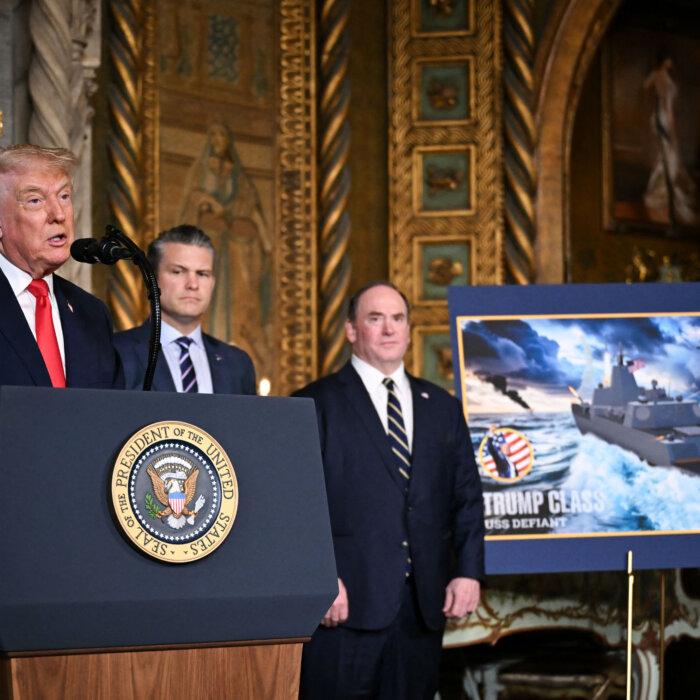
First, few Americans realize that for the past two years, the U.S. Navy has been engaged in the biggest sustained naval battle since the Battle of the Atlantic (1939–1945). Although temporarily paused, the U.S. Navy’s Red Sea fight has involved sustained defensive and offensive operations against Houthi drones, missiles, and boats, with 380–400 engagements, including more than 220 missiles fired. We’ve expended billions in costly interceptors such as the Tomahawk (about $2 million apiece) and the SM-6 ($4 million to $9 million per shot).
Destroyers fired only 160 rounds from five-inch guns (at bargain prices compared with missiles) to down Houthi drones, proving naval artillery’s cost-effective edge in sustained, high-volume engagements. President Donald Trump’s battleships, with heavier guns and lasers, would amplify this advantage dramatically.
Second, the United States now faces a peer adversary in China. Beijing boasts the world’s largest arsenal of “ship killer” missiles, including thousands of hypersonic-capable variants, designed to overwhelm and sink a carrier battle group. China’s navy now numbers more than 400 warships and a flagged merchant fleet of approximately 10,000, dwarfing the United States’ 295 warships and 185 merchant vessels. The United States still maintains naval supremacy in gross tonnage, so Trump’s plan to add 10 enormous battleships to the USN would enhance this advantage.
Lastly, but certainly not least, in small-power conflict, Ukraine has demonstrated that low-cost naval drones can dominate. Using unmanned, remote-controlled boats, Ukraine sank multiple Russian warships in the Black Sea and bottled up the rest of Russia’s southern fleet in Novorossiysk. Ukraine has also struck Russia’s shadow fleet oil tankers (Kairos, Virat, Dashan), disrupting Putin’s war funding. Now, more than ever, ships with heavy armor and multiple defensive systems will dominate.
Like an aging Tom Cruise, the top guns of the USN haven’t wanted to lose their main-character energy. Trump is wise to override the fly-boy admiralty. Trump’s golden fleet will be more survivable, with thick armor that can shrug off hits that would otherwise sink a carrier or destroyer. Battleship guns have cheaper shell costs than precision-guided munitions and will be able to fire thousands of rounds without breaking the Treasury’s bank. And Trump-class battleships will make shore bombardment great again, with heavy-caliber guns delivering rapid, sustained fire on coastal targets (fun fact: 90 percent of the world’s population lives within 100 miles of the coast).
