Voters gave Republicans a mandate last year—and most Americans expect the GOP to be busy cutting taxes, passing budgets in regular order, reducing the deficit, and taking a chainsaw to Washington’s bureaucracy.
Yet reform is dying in fluorescent silence. Just this fall, the entire U.S. government flickered out for 43 days. President Donald Trump correctly identified the culprit: the modern, speech-free filibuster—and he wants to eliminate the rule. And why not? The president rightly sees Democrats at DEFCON 1, ready to press the red button the next time they take control of the upper chamber. Exhibit A: 48 Democrats voted to suspend the filibuster in 2022 for their so-called voting rights bill.
Yet despite this clear and present threat, only six Republican senators appear to support ending the filibuster as of 2025: Sens. Tommy Tuberville (R-Ala.), Jim Banks (R-Ind.), Josh Hawley (R-Mo.), Marsha Blackburn (R-Tenn.), John Cornyn (R-Texas), and Ron Johnson (R-Wis.). The other 47 have remained silent, and with the Old Guard still influencing the Senate Rules Committee, the nuclear option is firmly off the table.
A Brief History
Today, under Senate rules, a single senator can quietly object and, without setting foot in the chamber, freeze a bill indefinitely. No speeches, no all-night vigils, no sweat—just a polite threat delivered through staff, and the entire gilded wedding cake of the U.S. Senate grinds to a halt. It’s obstruction by out-of-office memo.This wasn’t the Founders’ intent. Originally, a filibuster was a physical act, not a procedural trick. To stall a vote, you had to hold the floor in person—talking until your voice gave out. If you wanted to stop the majority, you had to be seen doing it.
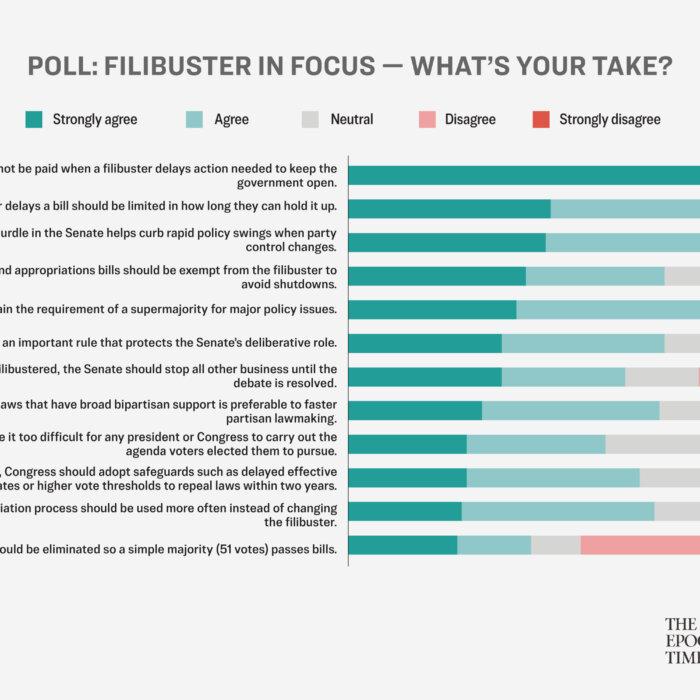
Along with bell-bottoms and shag carpet, the 1970s brought another regrettable trend to the Senate: the silent filibuster. Before 1975, a filibuster could be ended by two-thirds of senators “present and voting.” Afterward, the requirement shifted to two-thirds of senators “duly chosen and sworn.” Changing those two words made a big difference.
“Present and voting” meant at least one senator had to be on the floor, actively debating. It also meant that 51 senators could establish a quorum and end a filibuster at any time. During this fall’s shutdown, that would have totally changed the game. Imagine Republican senators secretly agreeing to meet on the Senate floor at 4 a.m.—if only one or two Democrats were filibustering, it would have ended the shutdown right then and there.
The Case for Reform
Reinstating the “present and voting” rule would have another benefit: transparency. Americans would see exactly who is obstructing a bill. Better yet, they would see that many senators are woefully unprepared to speak on complex issues. Most vulnerable? The Democrats. With a compliant media for the past 30 years, many Democrats have grown lax in debate.When I worked in the Senate, I frequently saw poorly prepared Democratic senators stumble over notes, misquote facts, and fall back on tired talking points. Republicans would be skewered in the press for such mistakes and, as a result, are generally better prepared.